Best Laser Levels for Home Renovation UK: 4 Practical Picks

Share
X
Copy Link
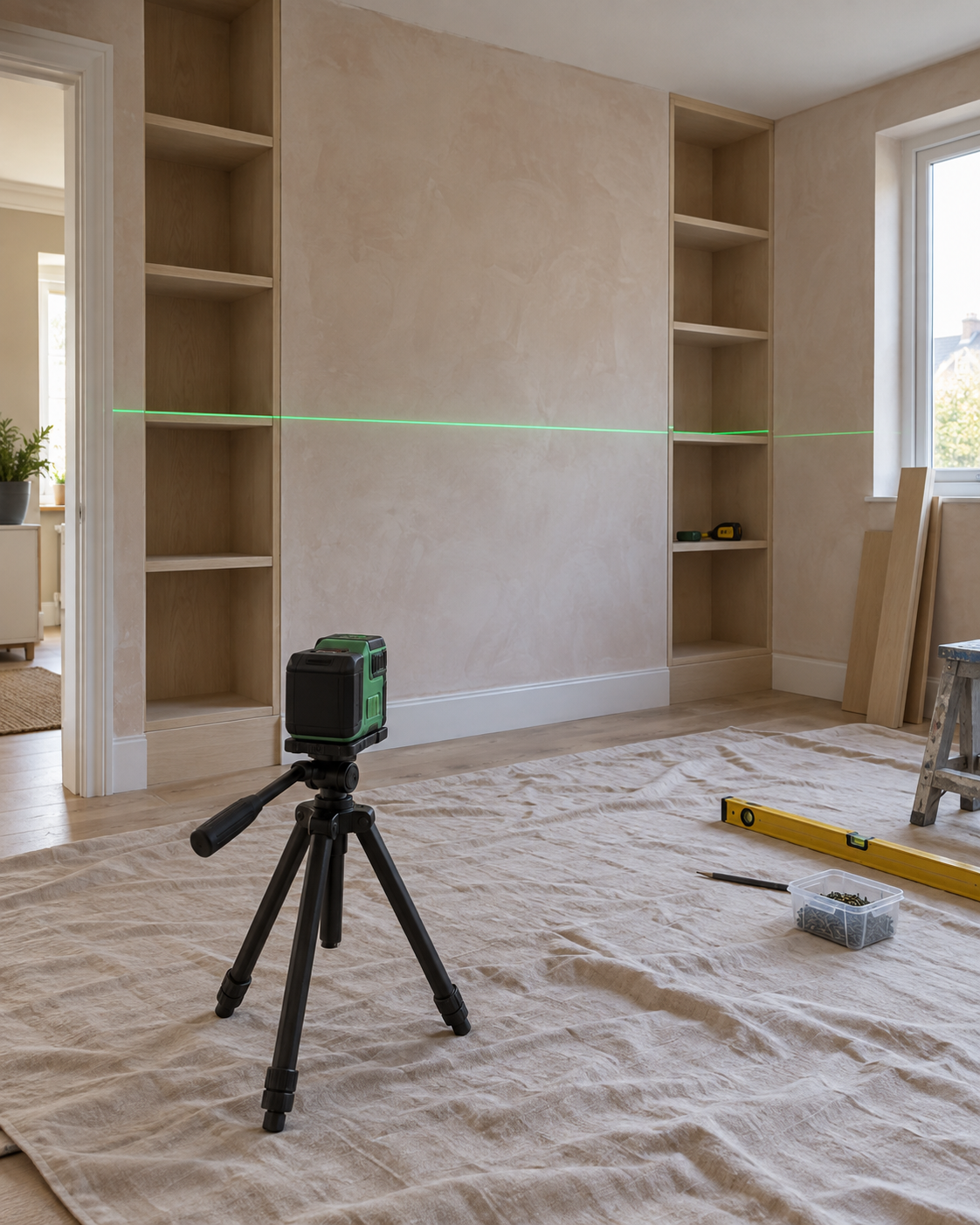
A laser level projects a straight reference line across a wall or around a room. During a renovation, that makes it much easier to align kitchen units, shelves, sockets, tiles, panelling and pictures without repeatedly moving a spirit level.
The right choice depends on the work. A cross-line laser covers occasional jobs on one wall, a 360-degree model carries one level around a room, and a three-plane laser helps with more involved floor-to-ceiling layouts.
Our top pick
Bosch UniversalLevel 360
For most home renovations, its continuous horizontal line offers the best balance of useful coverage and straightforward operation. Choose the Amazon Basics model for occasional DIY, the DeWalt for a tougher cross-line tool, or the LasGoo when you genuinely need three full planes.
Best laser levels for home renovation at a glance
| Model | Projection | Stated range | Stated accuracy | Best for |
|---|---|---|---|---|
| Amazon Basics CLL-002 | Cross line | Up to 18m | Check listing specification | Occasional indoor DIY |
| DeWalt DW088CG | Cross line | 15m; up to 50m with detector | ±0.3mm/m | Frequent renovation work |
| Bosch UniversalLevel 360 | 360° horizontal plus vertical | Up to 24m diameter, depending on variant | ±0.4mm/m | Whole-room alignment |
| LasGoo LG-3DM | 3 x 360° planes | Up to 30m indoors | Check listing specification | Tiling and multi-plane layouts |
On a phone, swipe the table sideways to compare every column.
How we selected these laser levels
This is an editorial comparison based on current manufacturer specifications, manuals, UK availability and the renovation tasks each design suits. We have not claimed hands-on testing. Specifications can vary between bundles, so check the exact model number and included accessories before ordering.
- Projection: a simple cross, one 360-degree line or three full planes.
- Accuracy: appropriate precision for the installation work we recommend.
- Visibility: green beams that are generally easier to see indoors, although strong daylight can still overwhelm them.
- Mounting: useful brackets, clamps or standard tripod threads.
- Protection: features such as a pendulum lock and suitable dust or splash resistance.
Best affordable choice
1. Amazon Basics CLL-002
The Amazon Basics CLL-002 is a straightforward option for shelves, pictures, wall cabinets and short tile runs. It can project a horizontal line, vertical line or both together, giving an occasional DIYer the useful essentials without the cost of 360-degree coverage.
Its manual specifies an indoor visible range of up to 18 metres and self-levelling within ±4 degrees. Manual mode lets you lock an angled line for jobs such as stair rails. It runs on two AA batteries and includes a magnetic pivoting base, although the batteries are not supplied.
Choose it ifYou want an affordable green cross-line laser for occasional indoor tasks.
Skip it ifYou need a continuous line around a room or tighter accuracy over distance.
Best all-round cross-line laser
2. DeWalt DW088CG
The DeWalt DW088CG suits frequent renovators who want a straightforward horizontal and vertical cross with stronger job-site protection. DeWalt specifies accuracy of ±0.3mm per metre, a 15-metre working range and up to 50 metres with a compatible detector.
The green beam is designed for indoor visibility, while the IP54 rating provides resistance to dust and splashing water. Its limitation is coverage: you must rotate or reposition it to transfer a level between walls, making it less convenient than a 360-degree model for units or sockets around a whole room.
Choose it ifYou value accuracy, robust construction and a simple professional-style cross line.
Skip it ifYour priority is establishing one height continuously around several walls.
Best for whole-room alignment
3. Bosch UniversalLevel 360
The Bosch UniversalLevel 360 is the most useful step up for kitchens, utility rooms, panelling and tiled walls. Its horizontal beam runs through 360 degrees, establishing one consistent height around the room without moving the unit. A separate vertical line helps with upright alignment.
Bosch specifies accuracy of ±0.4mm per metre and a self-levelling range of ±4 degrees. Current specifications describe up to a 24-metre diameter, while some retailer listings describe the distance from the tool as 12 metres. Check the model number and included accessories before ordering.
Choose it ifYou need to align units, shelves, tiles or sockets at one height on several walls.
Skip it ifYou need simultaneous floor, wall and ceiling layout planes.
Best value three-plane model
4. LasGoo LG-3DM
The LasGoo LG-3DM projects one horizontal and two vertical 360-degree green planes. These references can help with tile layouts, cabinetry, partitions and transferring points from floor to ceiling.
LasGoo specifies visibility up to 30 metres indoors, self-levelling within ±4 degrees and a built-in 5200mAh battery charged by USB-C. The Amazon bundle includes a magnetic rotating stand, target plate, wall-mounting plate and carry bag. As with any multi-plane laser, place it on a stable support and check its calibration before critical work.
Choose it ifYou want rechargeable three-plane coverage for repeated renovation projects.
Skip it ifYou prefer the support network and replaceable batteries of a mainstream trade brand.
Which type of laser level do you need?
Cross-line laser
A cross-line model projects one horizontal and one vertical line. It is usually enough for shelves, pictures, curtain rails, individual cabinets and short tile runs. It offers the best value when most jobs happen on one wall at a time.
360-degree laser
A 360-degree horizontal line gives you a consistent reference height around the room. This is particularly useful when fitting kitchen units, aligning sockets, installing panelling or continuing a tile line around corners.
Three-plane laser
Three-plane models add two vertical 360-degree lines to the horizontal plane. They suit more complex work, including right-angle tile patterns, partitions, fitted furniture and transferring references between floor and ceiling.
What to check before buying
- Accuracy: compare like with like. ±0.3mm/m means a possible deviation of 3mm over 10 metres.
- Usable range: manufacturer ranges are measured under defined conditions; bright daylight can make even a green line difficult to see.
- Detector compatibility: pulse mode does not mean every receiver will work, so check the manufacturer-approved detector.
- Mounting: confirm the thread size and whether the bracket, clamp, tripod or pole you need is included.
- Pendulum lock: lock the mechanism before transport and let it self-level after repositioning.
- Power: AA batteries are easy to replace; rechargeable packs can suit longer sessions.
- Laser class: follow the manual, never stare into the beam and never aim it at another person.
How to use a laser level accurately
- Place the laser on a stable tripod, bracket or level surface.
- Unlock the pendulum and wait for the unit to finish self-levelling.
- Check that the line is steady and no warning flash indicates the tool is outside its levelling range.
- Use the laser as a reference rather than assuming the floor, ceiling or existing joinery is level.
- Mark only the points you need with a pencil.
- Recheck the setup if the tripod is knocked or the tool is moved.
For critical cabinetry, tiling or structural work, verify the laser against a known reference and follow the calibration check in the manufacturer's manual. A laser level improves consistency, but it does not replace careful measurement or professional judgement.
Frequently asked questions
What is the best type of laser level for home renovation?
A 360-degree horizontal laser is the most versatile option for a broad renovation because it keeps one consistent level around several walls. A less expensive cross-line laser is enough for occasional shelves and decorating.
Is a green laser level better than a red one?
A green beam is generally easier to see indoors than a comparable red beam. It can still be difficult to see in bright daylight, where a compatible detector may be required.
Do I need a 360-degree laser level?
Choose a 360-degree model when you need the same height on several walls, such as for kitchen units, sockets, panelling or tiles. For work on one wall at a time, a cross-line model is usually enough.
How accurate should a laser level be for DIY?
For typical shelves and decorating, modest stated accuracy may be sufficient. Cabinetry and long tile runs benefit from tighter accuracy. Compare specifications over the same distance and verify critical work before fixing.
Can I use a laser level outdoors?
You can, but the beam may be hard to see in daylight. Check whether the model supports pulse mode and a compatible detector; basic indoor lasers are best reserved for indoor fitting and hanging jobs.
Does a laser level replace a spirit level?
No. A laser creates a convenient reference line, but a spirit level remains useful for checking individual surfaces and installations. Critical work should also follow the manufacturer's calibration-check procedure.
Our verdict
The Bosch UniversalLevel 360 is the most balanced choice for a substantial home renovation. The Amazon Basics CLL-002 is enough for occasional shelves and decorating, while the DeWalt DW088CG suits users who favour accuracy and durability over 360-degree coverage. Choose the LasGoo LG-3DM when three-plane layout will be genuinely useful.
Planning a larger project? Use the Love Renovate checklist to organise the work, and estimate the overall budget with our extension cost calculator.
As an Amazon Associate I earn from qualifying purchases.
Published: September 16, 2026

 Sign up with Facebook
 Sign up with Google
