
Cast Iron Radiators UK 2026: How to Size and Specify Them for a Period Renovation

Share
X
Copy Link
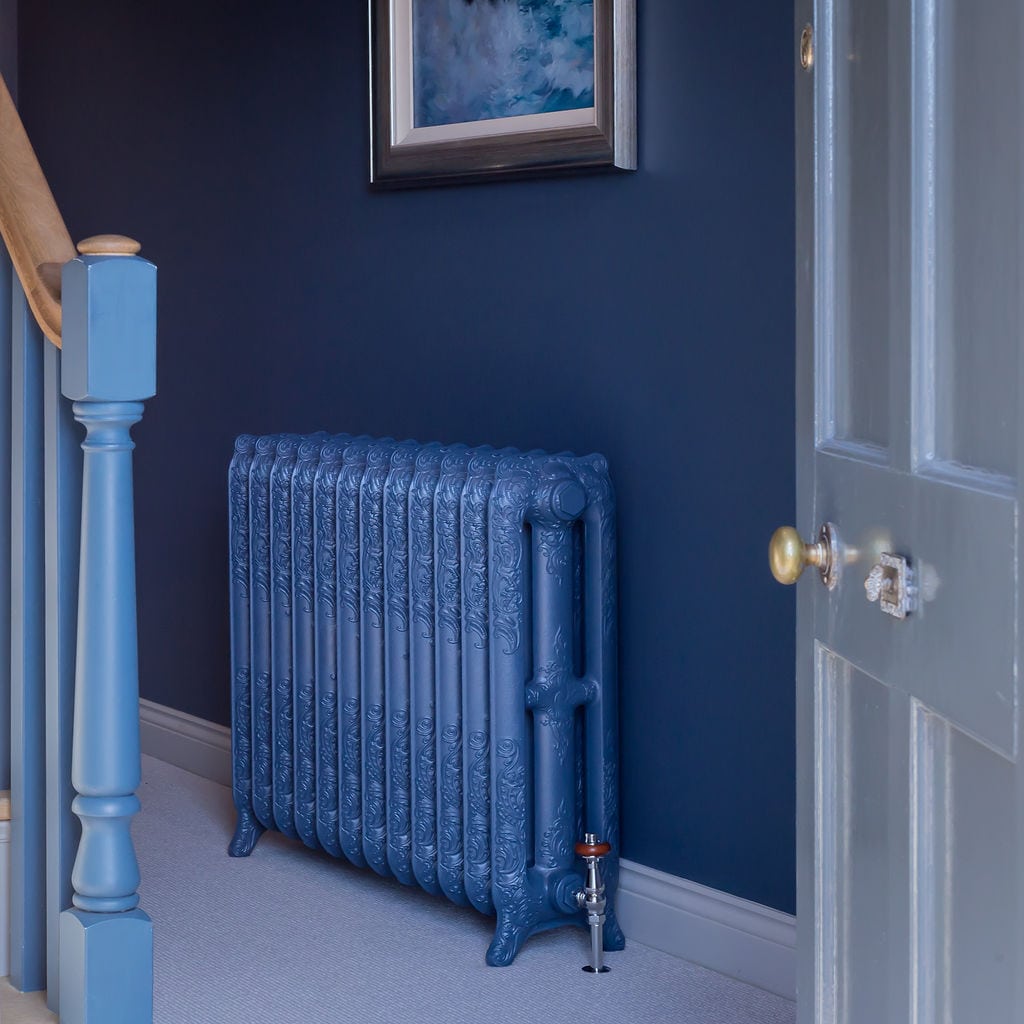
A four-column cast iron radiator under a sash window in a tall Victorian front room.
Size a cast iron radiator for the heat your room loses and the system that feeds it. Choose the pattern and finish after that. Cast iron suits period homes, and many Victorian and Edwardian houses were built with it. It also behaves differently from a steel panel radiator: it is slow to warm up and continues to release heat long after the boiler stops, because each section holds far more metal and water.
How we approached this: This guide covers sizing, column choice, heat pumps, reclaimed and new radiators, finishes, valves and installation for a period renovation. Outputs and weights vary by pattern and maker, so the maker's current specification and your heating engineer's heat-loss calculation take precedence over any general guidance here.
Start with heat loss, not wall width
Every room loses heat at its own rate, and the radiator must replace it. A tall front room with original single-glazed sashes can need far more heat than a bedroom of the same floor area in an insulated extension. Floor area alone is not a reliable guide.
Output is listed in BTU (British Thermal Units). For cast iron it is normally quoted per section, so the total is the per-section figure multiplied by the number of sections. Because cast iron radiators are assembled to order, sections can be added to meet the required output rather than rounding up to the next stock size.
Height is usually set by the windowsill. Some patterns go down to around 350mm for bay windows, but a lower section gives out less heat, so more sections are needed and the radiator becomes longer.
Before ordering: Ask your heating engineer for a room-by-room heat-loss calculation. Measure the available wall between the window reveal and any door architrave, and confirm that the required number of sections fits it at your chosen height.
Column configurations at a glance
More columns make a deeper radiator and more heat from each section, so the column count is a trade between floor space and wall length.
| Configuration | Choose it if | Limitation |
|---|---|---|
| 2 column | The radiator is for a hallway or small room where depth must be kept to a minimum. | The lowest output per section, so a cold room needs a long run of wall. |
| 3 column | The room is a bedroom, dining room or reception room of ordinary size. This balance of output and depth suits most rooms. | It projects further than a steel panel radiator, so check door swings and curtain clearance. |
| 4 column | The room is a living room, kitchen or larger space that needs more output without a very long radiator. | The extra depth is noticeable in a narrow room. |
| 6 column | The space is open plan, a barn conversion or a room with a very high ceiling. | It is deep and heavy, and can dominate a small room. |
| Ornate cast | The radiator is a feature in a room with original cornicing and a ceiling rose. | Decorative faces collect dust, and output varies between patterns, so confirm the per-section figure. |
On a phone, swipe sideways to see every column.
Running cast iron on a heat pump
Cast iron radiators can work well with a heat pump, provided they are sized for it. Makers' published outputs assume very hot water, similar to what an older gas boiler supplies. A heat pump runs at a much lower water temperature to stay efficient, and at those temperatures a radiator typically delivers around half its published output, sometimes less.
The remedy is more surface area: additional sections or a taller pattern. If a heat pump is planned within the next few years, size the radiators for it now. Adding sections to a radiator that has already been finished and plumbed in is a much larger job than ordering the correct length at the outset.
On a gas boiler, the same thermal mass means a slower start on cold mornings. Set the heating to come on around half an hour earlier than you would with steel radiators, and allow it to switch off a little before it is no longer needed, as the iron continues to release stored heat.
Before ordering: Ask the heat pump installer for the room-by-room heat-loss figures and the design flow temperature, and give both to the radiator supplier so outputs are calculated at that temperature.
New casts or reclaimed?
A reclaimed radiator can be the right choice when you are matching an original that remains in the same room. Its condition, however, cannot be judged from the outside. Decades of sludge settle inside the sections, and the joints between them can weep once the radiator is filled and pressurised, sometimes weeks after installation.
Old paint is a separate concern. Paint applied before the 1960s may contain lead, and council guidance on lead paint advises against methods that create dust or fumes, such as dry sanding or burning paint off. If a radiator needs stripping, use a firm that can explain how it handles lead.
Older radiators also tend to have larger threaded openings at each end than modern valves fit, so new end fittings are usually needed.
Before ordering: Ask the reclaim yard or restorer for written pressure test results and a guarantee on the restored radiator. If either is refused, look elsewhere.
Specialist makers such as Paladin build Cast Iron Radiators new from period patterns, which avoids most of these risks. Each radiator is built to the length required, and Paladin pressure tests every radiator before dispatch and covers its radiators with a 10-year guarantee.
A new radiator will not carry a century of paint and wear. That matters most in a strict restoration where everything else in the room is original, and much less in a renovation that mixes old and new.
Finishes, and what pushes the cost up
Most cast iron radiators are painted, and finishing is usually charged per section, so a long radiator costs more to finish than a short one. A colour from the maker's own range or a RAL reference is normally the least costly option.
Matching a heritage paint brand costs more, and some makers apply a minimum charge, which makes a short radiator comparatively expensive to finish. Hand-applied paint effects sit above that, with burnished and polished bare-metal finishes at the top because each section is worked by hand.
Polished finishes are traditionally applied only to visible faces, with the back and inner edges painted black. A radiator visible from the side, such as one at the end of a run or beside a doorway, may need a full finish at additional cost. Some of the tallest and most ornate patterns are not offered with polished finishes at all, so confirm availability before choosing one.
If you intend to paint the radiator yourself, order it primed and use a paint formulated for radiators. Standard emulsion is not suitable for hot metal.
Valves, pipe sleeves and wall stays
Cast iron radiators take a valve at the bottom of each end, and the valve type depends on where the pipes enter. Pipes rising through the floor need angled valves; pipes from the wall need straight or corner valves. Check the pipework before choosing a valve style.
In England, Approved Document L requires each room to have thermostatic room controls when a boiler is replaced in an existing home. A thermostatic radiator valve (TRV) on every radiator outside the room with the main room thermostat is the usual way to meet this.
Because cast iron responds slowly, a room may run slightly above the TRV setting as the iron releases stored heat after the valve closes. Set the TRV a little lower than you would on a steel radiator.
Pipe sleeves fit over the copper pipes rising from the floor and are available in the same metal finishes as the valves, concealing modern pipework in a period room.
Wall stays fit near the top of a floor-standing radiator to stop it tipping forward. They stabilise the radiator but do not carry its weight, which rests on its feet.
Installation is part of the decision
A large cast iron radiator can weigh more than 100kg once filled. Floor-standing models spread that load through their feet.
On a suspended timber floor, lift a board and check the joists beneath the feet. In older houses, joists are often notched for pipes and cables, and a weakened joist under a heavy radiator can cause the floor to sag and the ceiling below to crack.
Wall-hung cast iron needs a solid masonry wall and brackets rated for the filled weight. Stud walls and lath-and-plaster partitions are not suitable.
Radiators are delivered assembled, so check that the route through the house, including stairs and landings, can take the full length.
When the radiator is connected, ask your plumber to flush the existing system and add inhibitor when refilling. Sludge from old pipework settles in the bottom of the sections and reduces output.
Plan the wider renovation
- Heating your home: compare radiators with underfloor heating and stoves across the whole house.
- Planning a low-carbon renovation: settle the heat source before you size radiators for it.
- Extension cost calculator: fit the radiators and plumbing into the wider budget.
- Find an architect or designer: get help planning heating as part of a whole-house project.
Our verdict
Start with the heat-loss calculation and the heat source. If a heat pump is likely within a few years, size for its lower water temperature now. Then choose the column count your floor space allows and the height your windowsills set: three columns suits most period rooms, two suits hallways, four suits larger living rooms and six suits open-plan spaces or very high ceilings.
A reclaimed radiator makes sense only when you are matching an original in the same room and the restorer provides a written pressure test. Otherwise, a new radiator built to the required length is the lower-risk choice.
Published: November 6, 2026
Related articles
Modern Ambience with Electric Fireplaces in Contemporary Homes
