

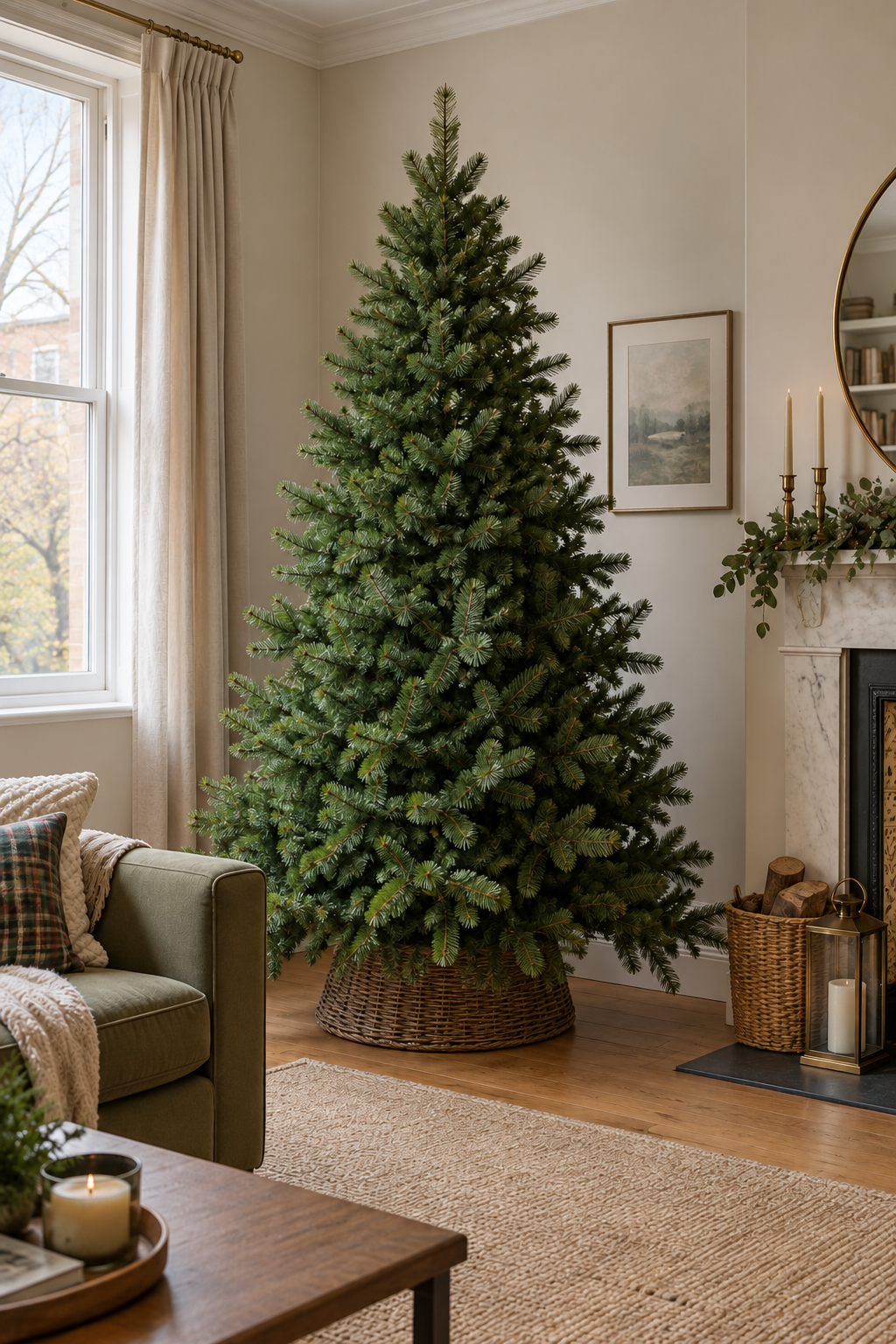
If you’re looking for an artificial Christmas tree this year, think about where it will go and how you want it to look once it’s up. Check the height and width you have room for, then look for photos of the tree without decorations—you’ll get a better sense of its shape and fullness. The type of foliage matters, but even a good tree will need its branches spreading out when you put it up. Here’s what to consider before you choose.
1. What size artificial Christmas tree should you choose?
Measure from the floor to the lowest relevant part of the ceiling, including beams, light fittings and sloping sections. Then decide whether you want a topper. A 6ft tree is roughly 183cm tall; a 7ft tree is roughly 213cm. In a room with a 230cm ceiling, a 7ft tree leaves only about 17cm before the topper and any clearance you want above it. The stated height may include the stand, so check the exact listing rather than adding the stand height automatically.
Width matters just as much. Mark the stated diameter on the floor with a tape measure. Leave space to walk past, reach curtains and open doors. A slim or pencil tree can solve a floor-space problem, but check its actual diameter: “slim” can mean anything from around 45cm to more than a metre. Compare slim artificial Christmas trees for smaller rooms if width is your main constraint.
2. PE vs PVC needles: which look more realistic?
Most artificial-tree foliage uses polyethylene (PE) or polyvinyl chloride (PVC) plastic. PE is moulded into three-dimensional needles; PVC is cut into flatter strips. Moulded outer tips can resemble real foliage close up, while PVC can fill the inner branches. Material alone is not a quality verdict: a well-shaped PVC or mixed tree may look better in a room than a sparse PE one.
| Foliage | What to look for | Buying consideration |
|---|---|---|
| PE | Moulded, three-dimensional needles | Inspect the visible outer branches. |
| PVC | Flatter, cut-strip needles | Check close-ups rather than relying on decorated images. |
| PE/PVC mix | Often moulded outer tips with inner PVC filler | Check where each material is used. |
On a phone, swipe the table sideways to read all three columns.
Look for variation in needle length, shade and direction, not a uniform green cone. The seller’s close-up images should show the tips clearly. A headline “PE tree” claim tells you less than seeing where the PE sits and how the undecorated branches look. Balsam Hill’s material guide illustrates the different needle constructions.
3. Tree shape, branch density and tip count
Step back from the product photograph. Does the outline taper naturally? Are there obvious gaps around the trunk? Do the lower branches reach the width you want without crowding the room? A high tip count can sound impressive but is not a standardised measure of fullness across brands. Short tips in one design are not directly comparable with longer, layered branches in another.
Look for photographs of the tree undecorated and fully opened. Heavy ornaments, garlands and lighting can hide sparse areas. Customer photographs can help, but check that they show the exact height and variation you plan to order.
4. Hinged vs hook-on Christmas tree branches
Hinged branches stay attached to the centre pole and drop into place when sections are stacked. They generally reduce the number of loose parts, although every tip still needs arranging. Hook-on branches fit into labelled slots individually; they can take more time to assemble, and a missing branch is harder to ignore. Push-fit designs sit somewhere between the two. Check the instructions for the exact model and make sure the stand is included.
None of these mechanisms makes a tree look finished straight from its box. Budget time to shape it, especially on the first setup. The starting shape in a seller image may reflect careful styling rather than how the tree arrives.
5. Pre-lit vs unlit artificial Christmas trees
Pre-lit trees save wrapping and can give a consistent spread of lights. Before choosing one, check light colour, modes, cable length, section connections and what happens if a section fails. An unlit tree takes more work each December but lets you replace the lights without replacing the tree. Follow the maker’s indoor-use instructions. Electrical Safety First advises checking lights for damage, keeping plugs and transformers indoors and switching lights off when you go out or go to bed.
6. How to fluff an artificial Christmas tree
- Work from the trunk out: open inner branches first to hide the centre pole, then fan the outer tips.
- Change the angles: point some tips upwards, some sideways and a few forwards for a less uniform shape.
- Check at room distance: step back to the sofa and correct gaps you cannot see up close.
- Place lights in layers: on an unlit tree, some bulbs deeper among the branches add depth without relying on extra ornaments.
- Dress the base carefully: a skirt or basket can hide the stand, but must not block the plug or create a trip hazard.
Store the tree dry and avoid crushing the moulded tips. Next year’s shape depends partly on how well you pack it away.
What to check before ordering
Confirm the exact variation’s height and maximum diameter, foliage material, stand, assembly method and whether lights are included. Check delivery and returns before the festive rush. If there are conflicting dimensions in the title, images and detail section, ask the retailer to confirm the assembled width rather than guessing. The best choice is the one that looks convincing in your room, not the one with the largest number on its product page.
Frequently asked questions
What makes an artificial Christmas tree look realistic?
Look at the shape, colour and spacing of the visible branch tips, then at the outline of the whole tree. Moulded PE outer tips can resemble real needles, but careful shaping and a suitable width matter too.
Is a PE tree always more realistic than a PVC tree?
No. PE tips have a more three-dimensional shape, but a poorly shaped PE tree can still show gaps. A mixed PE/PVC tree can look convincing when moulded tips face outwards and PVC fills the centre.
Does a higher tip count mean a fuller Christmas tree?
Not reliably. Brands may count tips differently, and tip length and placement affect coverage. Compare close-up and full-tree photographs, stated diameter and how the branches look after shaping.
What size artificial tree should I choose for a UK living room?
Measure clear ceiling height and the floor diameter you can spare. Leave room for the stand, topper and walking space. A 6ft tree is about 183cm tall; a 7ft tree is about 213cm before a topper.
Are hinged branches better than hook-on branches?
Hinged branches stay attached to the trunk and usually make setup simpler. Hook-on branches can pack down compactly but take longer to position and are easier to misplace. Either type still needs shaping.
How can I make a new artificial tree look less sparse?
Open every branch from the trunk outwards, angle tips in different directions and inspect the silhouette from across the room. Add lights deeper inside the branches and avoid overloading a narrow tree with large ornaments.
Choosing the right tree for your home
Measure first, then compare the visible branch tips and the whole-tree silhouette. Moulded PE can improve close-up realism, PVC can add useful fullness, and careful shaping matters either way. For specific products with different footprints and lighting setups, see our artificial Christmas tree shortlist.


 Sign up with Facebook
 Sign up with Google
