
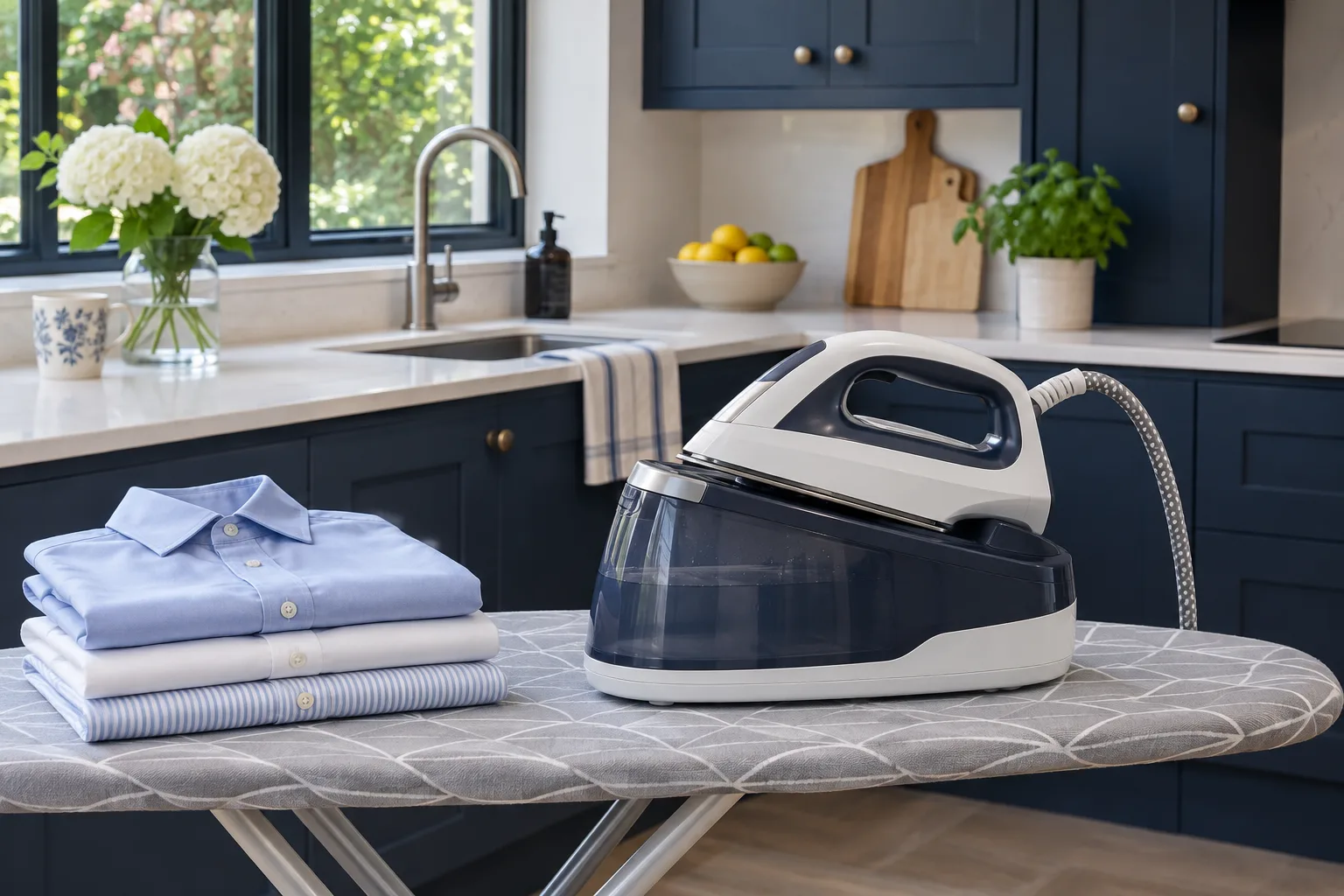
A steam generator iron makes most sense when your ironing tends to build up into one long session. The separate base holds more water than an ordinary steam iron, but it also needs somewhere stable to sit and a place to store afterwards.
This buying guide explains the features worth paying for, from steady steam and tank size to scale care. If you already know what matters to you, compare the six models in our best steam generator irons guide.
Look at steady steam before the headline boost
Continuous steam is the flow you can use as you move through shirts, pillowcases and sheets. A steam boost is a short, stronger burst for a stubborn fold. Both can help, but a large boost number doesn’t tell you how the iron feels through a whole basket. Manufacturers also quote pump pressure in bar; it isn’t a direct measure of the steam that reaches your fabric.
If you mainly iron light cottons and school uniforms, ease of use may matter more than the highest specification. For a regular pile of linen or thick bedding, compare continuous output and whether the iron keeps delivering steam without frequent pauses. Check the fabric care label whichever model you buy.
Choose a tank for your session, not the biggest number
A larger tank means fewer refills, which is useful when you save a week’s ironing for one go. It also makes the base bulkier and heavier to move. A smaller tank can be perfectly workable if you iron little and often, particularly where the model allows you to refill it during use.
Check whether the tank lifts out, whether the filling opening is easy to reach, and whether you can top it up without waiting for the iron to cool. Tank capacity alone doesn’t promise a fixed number of minutes: steam settings and how often you use a boost change water use. That’s why we wouldn’t pay more for a huge tank unless it suits your actual routine.
Measure the board and the cupboard
A steam generator’s base needs a firm, level rest. Check the board manufacturer’s stated load and the size of its iron rest against the exact generator base, not just the handheld iron. Don’t perch a hot base over the edge or put it where the hose can catch. Our ironing-board guide can help with board choice.
For storage, measure the cupboard shelf’s height and depth with room for the hose and cable. A carry lock and cord storage can make a heavy base easier to move; neither changes whether it actually fits. A lighter, compact generator is often the better buy for a small home even if a larger one has stronger paper specifications.
Decide how much control you want
Some models set the temperature automatically for a range of ironable fabrics; others give you separate modes or a manual dial. Automatic settings reduce switching between garments, while manual control may appeal if you prefer to choose the heat yourself. Neither overrides a garment label: test delicate or unfamiliar fabric according to its care instructions.
Look for a soleplate that glides smoothly around buttons and seams, an iron you can hold comfortably, and a hose long enough for your board layout. Vertical steam can freshen suitable hanging garments, but it doesn’t turn the unit into a dedicated clothes steamer. Keep steam away from people and follow the manual for safe use.
Make descaling an easy habit
Hard water can leave mineral deposits inside a steam appliance. Anti-scale systems vary: one model may have a removable collector, another a drain plug or a cleaning cycle. None means you can ignore maintenance. Check how often the exact model asks you to clean it, how long it needs to cool first and whether its water advice matches what you intend to use.
For a closer look at six different maintenance systems, see our steam generator irons for hard-water areas. Follow your own model’s manual rather than adding vinegar or chemical descaler by guesswork; cleaning steps and water advice differ between models.
Which features are worth paying for?
| For your routine | Prioritise | Probably less important |
|---|---|---|
| Short, occasional sessions | Compact base, simple controls, easy storage | The largest tank or strongest boost |
| Large weekly pile | Comfortable iron, steady steam, refill access | A boost figure on its own |
| Hard-water area | Clear cleaning process and accessible collector or drain | Vague “anti-calc” wording without instructions |
| Limited board or cupboard space | Measured base footprint, secure rest and carry lock | Extra capacity that won’t fit comfortably |
On a phone, swipe the table sideways to see all three columns.
Start with the two or three things that will make your ironing easier, then compare the exact models. Our six-model steam generator comparison covers different budgets and storage needs without assuming one specification suits everyone.
How we put this guide together
We compared the everyday decisions behind buying a steam generator iron—steam delivery, refilling, board and cupboard fit, controls and scale care—using manufacturer instructions and product information. This is buying advice, not a claim that we have hands-on tested every model.
Frequently asked questions
What size water tank do I need for a steam generator iron?
A smaller tank can be enough for short sessions, especially if it can be refilled while you work. For a large weekly pile, a larger removable tank reduces trips to the tap. Compare the base dimensions too: a bigger tank often takes more cupboard space.
Is a higher steam boost better than continuous steam?
A boost is a short burst for stubborn creases. Continuous output is the more useful number for a long session, so compare the two separately rather than choosing by the biggest boost figure alone.
Can I use tap water in a steam generator iron?
It depends on the exact model and your water. Follow its manual: manufacturers differ on filtered or demineralised water and on which additives to avoid. Descale or empty the collector when the manual or indicator tells you to.
Will a steam generator iron fit on my ironing board?
Check that the board has a stable rest large enough for the base and can support its weight. Keep the hot iron and hose clear of the edge. Our ironing-board guide explains what else to check.