
Best Dehumidifiers for Drying Laundry UK: 6 Practical Picks

Share
X
Copy Link

A dehumidifier can help laundry dry indoors by collecting moisture released into the room instead of allowing it to settle on windows and cold surfaces. It works best in a reasonably enclosed space with clothes spaced for airflow.
The right technology depends heavily on temperature. Compressor models are generally well suited to heated rooms, while desiccant models can retain more useful performance in colder spaces. Tank size, drainage, noise and energy use matter as much as the headline litre rating.
Our top pick
MeacoDry Arete Two 20L
Its 20-litre class, laundry-focused controls and broad suitability make it the strongest all-rounder for regular indoor drying in a heated home. The 12-litre models suit smaller rooms, while the EcoAir desiccant unit is the more relevant option for a cold utility space.
Best Dehumidifiers for Drying Laundry UK at a glance
| Product | Key reason to choose it | Best for |
|---|---|---|
| MeacoDry Arete Two 20L | A capable all-round laundry choice | Best overall |
| Pro Breeze OmniDry WiFi 20L | Connected control in a larger class | Best smart-value option |
| Pro Breeze 12L Dehumidifier | A compact compressor option | Best for smaller utility rooms |
| MeacoDry Arete One 12L | Smaller format with established controls | Best compact premium option |
| EcoAir DD1 Simple | A desiccant option for lower temperatures | Best for cold utility spaces |
| Russell Hobbs RHDH2002B 20L Dehumidifier | A conventional larger-capacity alternative | Best straightforward 20L option |
On a phone, swipe the table sideways to compare every column.
What matters most
This shortlist separates large and compact compressor machines from a desiccant alternative, rather than pretending every dehumidifier suits the same room. We considered room temperature, laundry use, tank handling, controls and placement. We have not conducted hands-on testing; confirm the exact listing and manual.
Best overall
1. MeacoDry Arete Two 20L
A capable all-round laundry choice. This 20-litre-class model is aimed at households managing regular condensation and indoor washing. It is the most broadly useful choice for a heated utility room where a smaller unit may spend much longer chasing the target humidity.
This model was selected from current UK listings for the use case above; we have not claimed hands-on testing. Confirm the exact dimensions, specification, included parts and instructions on Amazon before ordering.
Choose it ifYou dry laundry frequently in a heated medium-sized room.
Skip it ifYou need a lighter compact unit for occasional use in one small room.
Best smart-value option
2. Pro Breeze OmniDry WiFi 20L
Connected control in a larger class. The OmniDry offers another 20-litre-class option with app-connected controls. Smart features are useful only if the core capacity, noise and tank arrangement work for the room, so treat connectivity as a convenience rather than the buying decision.
This model was selected from current UK listings for the use case above; we have not claimed hands-on testing. Confirm the exact dimensions, specification, included parts and instructions on Amazon before ordering.
Choose it ifYou value remote monitoring and need a larger compressor model.
Skip it ifYou prefer simple physical controls with no app setup.
Best for smaller utility rooms
3. Pro Breeze 12L Dehumidifier
A compact compressor option. A 12-litre-class machine can be easier to place and move in a small heated utility room. It may suit occasional loads, but a compact unit can take longer when the room is large, cold or holding a great deal of wet laundry.
This model was selected from current UK listings for the use case above; we have not claimed hands-on testing. Confirm the exact dimensions, specification, included parts and instructions on Amazon before ordering.
Choose it ifYou have a small heated room and moderate drying needs.
Skip it ifYou regularly dry several loads in a large or very damp space.
Best compact premium option
4. MeacoDry Arete One 12L
Smaller format with established controls. The Arete One 12L is a compact alternative for buyers who want the Meaco format without moving to the 20-litre class. Check the current variant carefully and allow clearance around the air intake and outlet.
This model was selected from current UK listings for the use case above; we have not claimed hands-on testing. Confirm the exact dimensions, specification, included parts and instructions on Amazon before ordering.
Choose it ifYou want a compact established-brand option for a heated room.
Skip it ifYour main priority is maximum extraction for heavy family laundry.
Best for cold utility spaces
5. EcoAir DD1 Simple
A desiccant option for lower temperatures. Desiccant technology makes this the most relevant shortlist choice for an unheated utility room, garage-type space or other cooler area. It can warm the outlet air, but energy use and noise character differ from compressor machines.
This model was selected from current UK listings for the use case above; we have not claimed hands-on testing. Confirm the exact dimensions, specification, included parts and instructions on Amazon before ordering.
Choose it ifYour drying space is regularly cool or unheated.
Skip it ifYou mainly use it in a warm room where a compressor model is more appropriate.
Best straightforward 20L option
6. Russell Hobbs RHDH2002B 20L Dehumidifier
A conventional larger-capacity alternative. This Russell Hobbs model gives a simpler 20-litre-class comparison for a busy laundry space. Check the current controls, tank capacity and drainage provision, because those everyday details often matter more than brand familiarity.
This model was selected from current UK listings for the use case above; we have not claimed hands-on testing. Confirm the exact dimensions, specification, included parts and instructions on Amazon before ordering.
Choose it ifYou want a conventional high-capacity compressor alternative.
Skip it ifYou need a desiccant unit for consistently cold conditions.
Why a dehumidifier helps laundry dry
Wet clothes continually add water vapour to the room. A dehumidifier draws in air, removes part of that moisture and returns drier air, allowing more water to evaporate from the fabric. Closing external windows and doors usually gives it a more manageable volume of air to treat.
A laundry mode normally changes the target or fan behaviour; it is not a separate drying technology. Position the machine so air can circulate around the rack, without directing it contrary to the manufacturer's clearance or safety instructions.
Compressor versus desiccant
Compressor dehumidifiers cool air over a coil to condense water. They are commonly effective in normal heated living conditions and are widely available in 12- and 20-litre classes. Their extraction tends to fall as the room becomes colder.
Desiccant machines pass air through a moisture-absorbing material and can be more useful at lower temperatures. They often produce warmer outlet air and may consume more power. Choose for the real room temperature, not simply the highest stated daily extraction figure.
Understanding litre ratings
A headline such as 12L or 20L is a laboratory-style maximum under specified temperature and humidity conditions, not a promise that the tank fills by that amount every day in a UK home. Real extraction changes with conditions and falls as the room reaches its target.
Use the rating to compare product classes, then check recommended room context, airflow, tank capacity and continuous-drain options. A larger machine may finish a laundry session sooner, but bigger is not automatically better for every small room.
Placement and room setup
Place the laundry rack with gaps between garments and keep the dehumidifier on a level surface. Respect the stated clearances around grilles and do not cover the appliance. Close the room door where practical so it is not trying to dry the whole home.
Avoid placing a portable appliance where it can be splashed, obstruct an exit or create a cable trip. A dehumidifier manages airborne moisture; it does not replace ventilation required for combustion appliances or solve plumbing leaks and penetrating damp.
Tank size and continuous drainage
A larger tank means less frequent emptying, but it also becomes heavier to carry. Check how the tank slides out, whether it has a handle and whether the machine stops automatically when full. Frequent laundry users may value a suitable continuous drain.
Continuous drainage needs a safe route with the fall and hose arrangement specified by the manufacturer. Do not assume the supplied hose suits every installation, and never create a drain route that can siphon, leak or become a trip hazard.
Noise, filters and maintenance
Laundry modes often use a higher fan speed, so compare quoted noise figures on a like-for-like setting where possible. Hard floors and corners can make sound more noticeable. Keep the unit level and avoid placing it against furniture that can resonate.
Clean the filter at the interval in the manual and keep inlet and outlet grilles clear. A blocked filter reduces airflow and can lengthen drying. Before storage, empty and dry the tank and follow any settling-time advice after moving a compressor machine.
Setting a sensible humidity target
Driving relative humidity as low as possible wastes energy and can make a machine run unnecessarily. Many households aim for a moderate indoor range, but the appropriate target depends on temperature, building fabric and the manufacturer's controls. Use the laundry setting for the drying session, then return to a normal target.
Relative humidity changes when temperature changes even if the amount of water in the air does not. Judge the trend alongside condensation and drying performance rather than reacting to one reading. Persistent high humidity without laundry may indicate inadequate ventilation, a leak or another source requiring investigation.
Estimating energy use
Multiply the appliance's input power in kilowatts by hours used, then multiply by your electricity unit rate. This gives a simple upper-style estimate; compressor cycling and mode changes mean actual consumption may vary. Smart-plug measurements are only appropriate if both appliance manufacturers permit the arrangement and the plug is correctly rated.
Compare the whole drying task, not just hourly power. A larger machine may draw more while running but finish sooner; a desiccant machine may add useful warmth in a cold room. There is no universal cheapest type across every room and season.
Planning a practical utility room
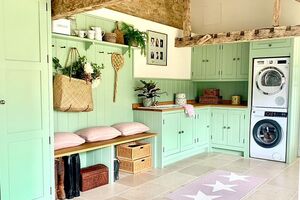
Drying and ironing equipment works best when the room layout supports it. Our utility room ideas guide covers appliance positions, storage, worktops, ventilation and compact layouts. Measure the product in both working and stored positions before ordering.
Frequently asked questions
What size dehumidifier is best for drying laundry?
A 12-litre-class compressor model may suit a small heated room; frequent larger loads may justify a 20-litre class. Room temperature and humidity matter as well as size.
Should I close the door when using a dehumidifier for laundry?
Usually yes, if it is safe and the room has no ventilation requirement that must remain open. This limits the volume of air being treated.
Is compressor or desiccant better for laundry?
Compressor models generally suit heated rooms; desiccant models can perform more usefully in colder spaces. Compare energy use and room temperature.
Where should a dehumidifier go beside a clothes airer?
Use a level dry position with the manufacturer's clearance around the grilles and enough airflow around the laundry. Keep cables out of walkways.
Can a dehumidifier replace an extractor fan?
No. It can collect moisture, but it does not provide required ventilation or remove pollutants and odours outdoors.
Can I run a dehumidifier overnight?
Follow the model's instructions and your household risk assessment. Use intact equipment on a stable surface with unobstructed airflow and working auto shut-off.
Our verdict
MeacoDry Arete Two 20L is our most broadly useful choice in this shortlist. The alternatives solve different capacity, space and budget needs, so use the comparison to narrow the field and verify the exact Amazon variant before ordering.
For layout and storage inspiration, return to our utility room ideas guide.
As an Amazon Associate I earn from qualifying purchases.
Published: September 17, 2026

 Sign up with Facebook
 Sign up with Google
