

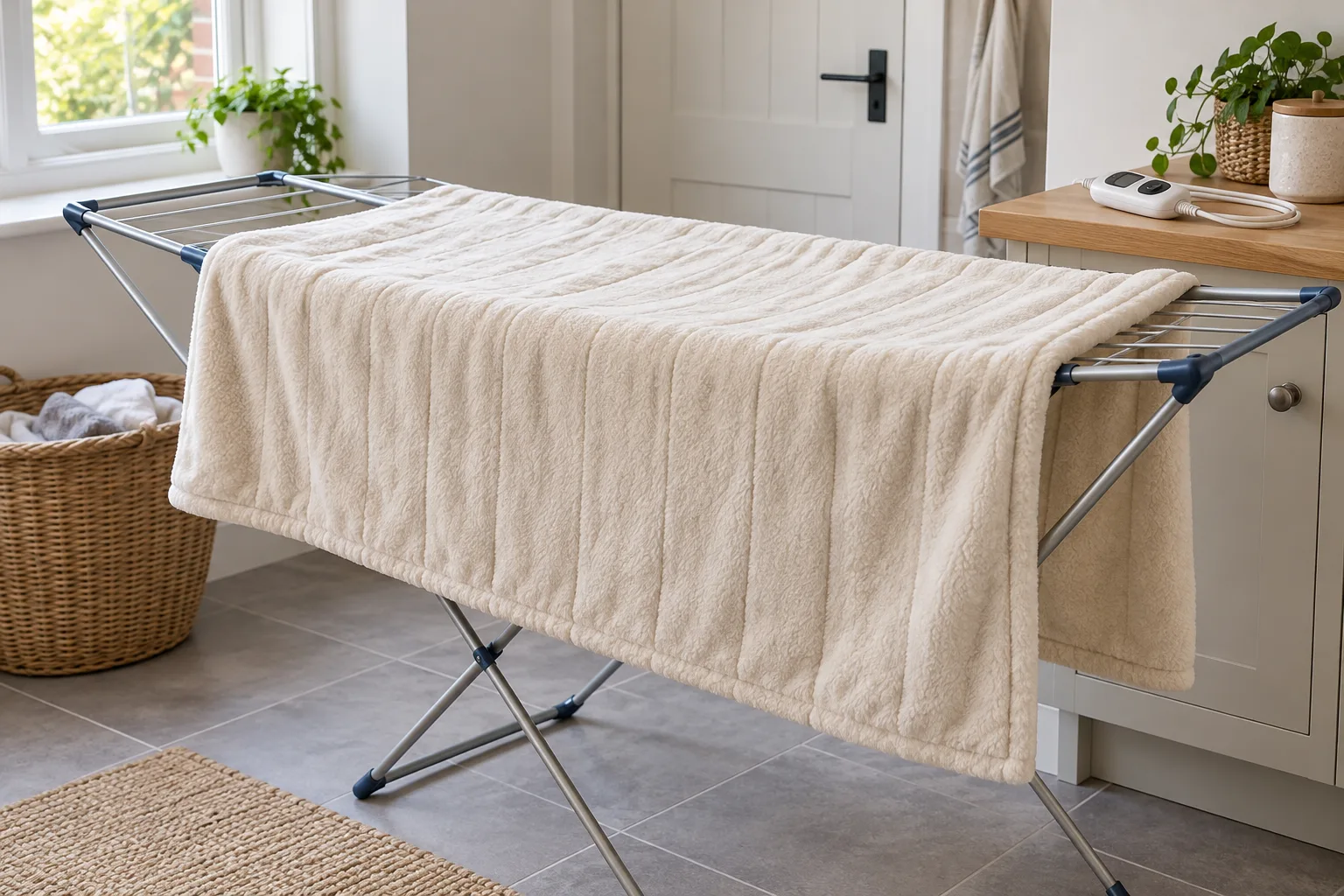
If you’ve been curling up under your heated throw all winter, it might be ready for a wash. Many can be washed at home, but it’s worth checking the care label first, as washing and drying instructions vary between models.
We’ll guide you through what to check before washing, how to follow your throw’s care instructions and how to dry and store it afterwards. If you’re looking for a new one, our washable heated throws guide compares six options and explains how to care for each.
First, check what your throw permits
Look for the wash symbol and the section on cleaning in the manual. Some throws allow a gentle machine cycle, others allow hand washing, and some should not be immersed at all. A removable controller does not by itself tell you which applies. If the label is missing or unclear, ask the manufacturer before washing.
Electrical Safety First says to wash an electric blanket only when the manufacturer confirms it is machine washable. It also advises removing detachable controls and letting the blanket dry before reconnecting it. That’s a useful starting point, but the temperature, cycle and drying instructions still vary by model.
Washing a model that allows it
- Switch off and unplug. Let the throw cool, then detach the controller and lead exactly as the manual describes. Keep electrical controls out of the wash.
- Check the fabric and connector. If you spot a worn cable, frayed fabric, scorch mark or damaged connector, stop using the throw and contact the manufacturer rather than washing it and hoping for the best.
- Use the permitted method. Follow the specified temperature, detergent, cycle and spin limit. A large throw needs room to move in the drum; if it is crammed in, use another permitted method or a suitably sized machine.
- Dry it fully. Follow the manual’s air-drying or tumble-drying directions. Do not assume a machine-washable throw can also go in the dryer.
Once the fabric and connector are completely dry, inspect them again and reconnect the control as instructed. Never power a damp throw to finish drying it. If its care label allows only spot cleaning, use that method instead of soaking the whole throw.
Keeping it tidy between washes
Shaking off crumbs and brushing away loose fluff can reduce how often you need a full wash. Deal with a spill only in the way the manual permits: switch off and unplug first, and let the throw dry completely before use. If you’ve spilt a drink on the connector or controller, check with the manufacturer before using the throw again.
Putting it away at the end of winter
Make sure the throw is clean and entirely dry. Disconnect the control if the instructions say to, then roll or fold the fabric loosely without making tight, repeated creases. Store it in a dry place where heavy boxes will not press on the wiring. Electrical Safety First recommends rolling rather than folding electric blankets to help protect the internal wires.
Before using it next season, spread it out and check the fabric, cable, plug and connector. If anything looks damaged, do not plug it in. For everyday use, our sofa, bed and office-chair guide explains where a throw may be appropriate; our buying guide covers controls and size.
Frequently asked questions
Can every heated throw go in the washing machine?
No. Check the care label and manual for your exact throw. If they do not permit machine washing, do not assume a detachable controller makes the fabric machine washable.
Should I remove the controller before washing?
Yes, if the instructions permit washing and tell you to disconnect it. Unplug the throw first, remove the controller and any detachable lead as directed, and keep those electrical parts dry.
Can I use a heated throw before it is completely dry?
No. Allow the fabric and connector to dry fully before reconnecting and using it. Do not switch the throw on to speed up drying.
Is it better to roll or fold a heated throw for storage?
Follow the manual for your model. A loose roll or gentle fold avoids sharp creases and heavy pressure on the internal wiring; store it somewhere dry without piling heavy items on top.


 Sign up with Facebook
 Sign up with Google
