
If you’re making shelves, building cupboards or tackling other DIY during a renovation, a circular saw can be a useful addition to your tools. Choosing one is easier when you know what you’ll be cutting and whether you’d prefer the convenience of a battery or a corded saw you can plug in.
Our circular saw buying guide explains how to choose a saw that suits your projects, from the cutting depth you need to the blade and guide for the job. We’ll also cover dust control and what’s included when you buy, so you can budget for any extras before getting to work.
Which jobs will your circular saw do?
For straight cuts in plywood, chipboard or timber, a handheld circular saw is a useful general-purpose choice. A jigsaw is better for curves and internal cut-outs; for repeated long cuts where a visible edge needs to be especially tidy, a track saw and compatible rail may be easier to guide. Bosch's guide to saw types makes the same distinction between long straight cuts and other shapes.
Think about the next few real jobs. Cutting a sheet to fit a cupboard is different from repeatedly cross-cutting thick framing timber. The first puts more emphasis on support, an accurate guide and a suitable fine-cut blade; the second may call for more depth and sustained power.
Blade diameter is not the cutting depth
Compare the manufacturer's maximum depth at both 90° and 45°. The base and blade geometry reduce the usable depth below the blade diameter; a 160mm blade does not mean a 160mm cut. As a concrete example, Bosch lists its PKS 55 at up to 55mm at 90° and 38mm at 45°. Those are figures for that model, not a rule for every 160mm saw.
Allow enough capacity for the thickest material you realistically intend to cut, including any angled cuts. More capacity usually brings a bigger, heavier machine, so there is little value in buying it for thin shelving alone. Check the exact manual for permitted blade diameter, bore, tooth type and maximum rated speed before fitting a replacement blade.
Corded or cordless circular saw?
| Format | Useful when | Check before ordering |
|---|---|---|
| Corded | You mainly work near a suitable socket and want uninterrupted cutting. | Cable length and a clear route away from the blade and offcuts. |
| Cordless | You move between rooms or work where a cable would get in the way. | Whether the exact kit includes a compatible battery and charger, plus realistic runtime. |
A bare cordless saw can look cheaper until the battery and charger are included. If you already own that platform, it may be good value; otherwise compare the complete kit cost. The blade and battery also affect how well a cordless saw handles repeated cuts in dense timber.
Straight cuts, rails and blade choice
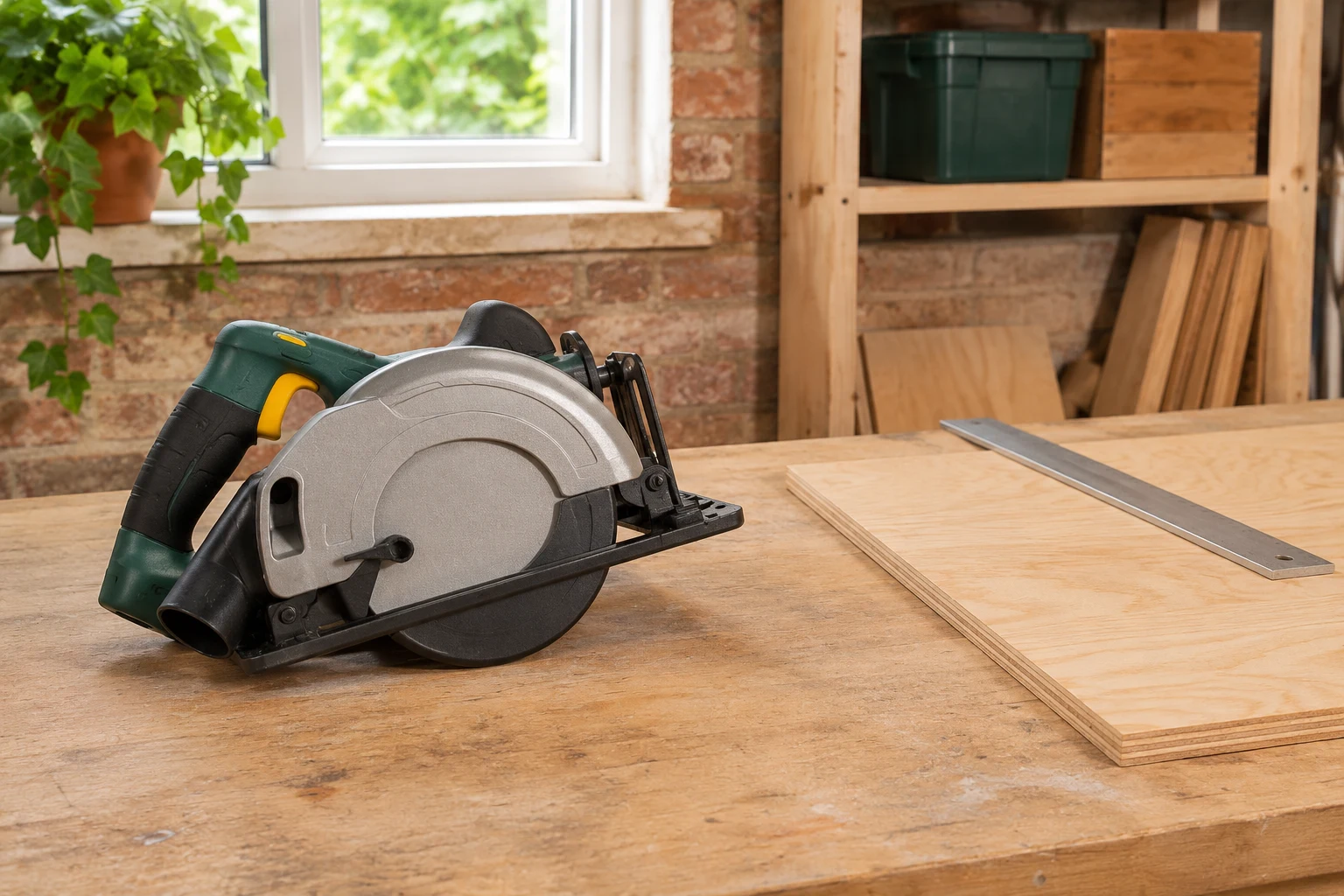
An edge guide follows the board's edge; a clamped straightedge gives the saw a line to follow across a sheet. A proprietary guide rail is different again. Do not assume a saw fits a rail because the product photo shows one nearby: check the exact saw and rail or adapter compatibility with the manufacturer. A secure guide should not interfere with the lower guard.
Choose the blade for the material and the finish you need, using only specifications permitted by the saw maker. The blade supplied in the box may be intended for quick general cuts rather than a neat visible plywood edge. Budget for the right blade and a stable surface to support both sides of the cut; a premium saw cannot compensate for a wobbling sheet.
Plan the cutting setup, not just the purchase
Read the manual before use and keep the guard working freely. Support and clamp the work so it cannot shift or pinch the blade, keep the cable clear, and wait for the blade to stop before setting the saw down. Bosch's circular-saw instructions explain why the depth setting and workpiece support matter; follow the instructions for your own exact model.
Cutting wood with power tools can create high dust levels. The HSE's wood-cutting guidance recommends reducing cutting where possible and using suitable on-tool extraction; it also explains when additional respiratory protection may be needed. A dust port on a saw does not by itself make a household vacuum appropriate for hazardous dust. Check the extraction unit, hose connection and the material you are cutting. Wear eye and hearing protection as directed by the manual and the task.
A short circular saw buying checklist
- Write down the materials and cuts. Include the thickest stock and whether the cut edge will be seen.
- Compare depth at 90° and 45°. Do not use blade diameter as a substitute.
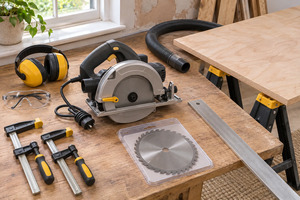
- Check the exact bundle. Confirm blade, guide, case, battery, charger and extraction adapter individually.
- Price the usable setup. Add the right blade, stable support, clamps, extraction and any battery equipment.
- Check guide compatibility. Verify any rail or adapter against the exact model.
Once those decisions are clear, our best circular saw comparison shows six different approaches, from a corded first saw to cordless options for people already using a battery platform.
How we put this guide together
We compared manufacturer information on depth and blade compatibility with current HSE guidance on wood dust and practical buying questions such as bundle contents and guide fit. This is an advice guide, not a hands-on test of any saw; check the supplied manual for the exact model you buy.
Frequently asked questions
What size circular saw do I need?
Match the published cutting depth at 90° and 45° to the timber you actually plan to cut. Blade diameter alone does not tell you the usable depth, and a smaller saw may be easier to control for occasional sheet cuts.
Is a cordless circular saw worth buying?
It can be useful when you work away from a socket or already own compatible batteries. Compare the complete cost of tool, battery and charger with a corded saw, and check the runtime you need.
Can a circular saw cut plywood neatly?
Yes, with a suitable sharp blade, stable support and a straight guide. For long visible cabinet edges, compare a compatible rail or track saw; the blade and support matter as much as the machine.
Do I need dust extraction for a circular saw?
Wood cutting can create hazardous dust. Plan source extraction suited to the task and follow current HSE guidance on additional respiratory protection where needed; a household vacuum is not automatically suitable.