
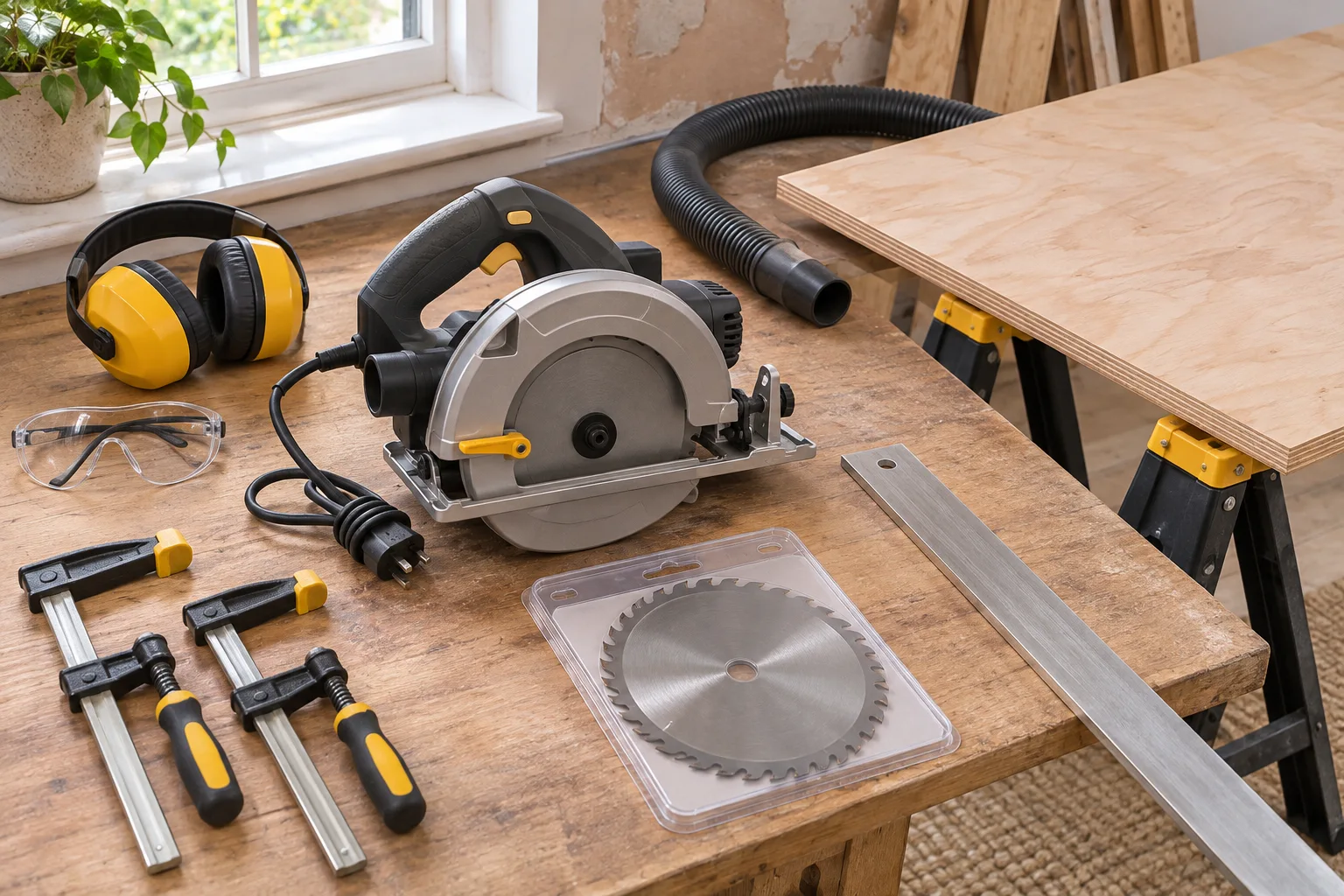
A circular saw on its own won’t do much for the plywood shelves you’ve planned if the blade, guide or work support is missing. The useful accessories depend on the material and the cuts, and a bare cordless saw may also need a battery and charger.
This guide takes you through the circular saw accessories worth checking before you buy: a suitable blade, a way to guide and support the cut, dust control and the small extras that make the setup usable. It also explains what you can leave until a particular project calls for it.
What you actually need beside the saw
| Item | Why it matters | Check before buying |
|---|---|---|
| Blade | Matches the material and the finish you want | Diameter, bore, speed rating and saw approval |
| Guide and clamps | Keeps a straightedge steady through the cut | Clearance for the base and lower guard |
| Work support | Holds the board and offcut safely | Stable, level support on both sides |
| Dust control | Captures wood dust at the tool | Compatible port, hose and suitable extractor |
You may already have some of this kit. The point is to check the complete setup rather than assuming that everything shown in a saw photograph is included. Our circular saw buying guide covers the saw’s cutting depth and power choice.
1. Choose a blade that fits the saw and the material
Check the saw manual for the permitted blade diameter and bore (the centre hole), then check the blade’s maximum speed and intended material. Those measurements are not interchangeable between every saw, even when the outer diameter looks close. Follow the maker’s instructions for any approved reducing ring or adapter; do not improvise one.
A general wood blade may be fine for framing timber, while a blade intended for a finer finish can help on a visible plywood or laminate edge. Neither makes an unsupported sheet cut cleanly by itself. Keep a spare only for a material you actually expect to cut, and replace a damaged or blunt blade rather than trying to force it through.
Disconnect a corded saw or remove the battery before changing blades, following the supplied manual. Check the rotation arrow and refit the guard and fasteners exactly as instructed. Bosch’s circular saw manual illustrates why blade dimensions and accessory fit are model-specific.
2. Give the cut a guide and proper support
For shelves or cupboard panels, a straightedge clamped to the work can be enough. Measure the offset from the saw’s base plate to its blade, then position the guide so the blade—not the edge of the base—follows the marked line. Make a test cut on offcut material before cutting the finished panel.
A parallel guide follows an existing straight edge. A proprietary guide rail can help on longer sheets, but only buy one after checking that your exact saw or approved adapter works with it. For example, Bosch says its compact GKS 12V-26 uses an adapter for its guide-rail system; the same assumption cannot be made for every compact saw.
Support the board and the offcut so neither can move or pinch the blade. Keep clamps out of the saw’s path and leave room for the lower guard to move freely. A straight line on the board is a reference, not a substitute for stable work.
3. Plan dust control and personal protection
Wood cutting can create more fine dust than it appears to. Check whether the saw includes an extraction adapter and whether its hose connection fits a suitable extractor. A dust port is only one part of the setup. HSE guidance on cutting and sanding wood recommends on-tool extraction with an H- or M-class unit for construction work, and explains when respiratory protection may also be needed. It is a useful standard to follow when planning DIY indoors; do not treat an ordinary household vacuum as equivalent.
Protect your eyes and hearing too, and follow the saw and blade manuals for the material you are cutting. If a project involves materials other than wood, check the blade, extraction and safety instructions for that material rather than assuming the wood setup covers it.
4. Add the power and consumables your project needs
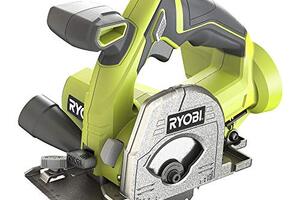
For a cordless saw, read the exact offer carefully. “Bare tool” means the battery and charger are not included. Check the battery platform and the maker’s recommended capacity before adding them to the budget. A second battery is useful for repeated cutting, but may be unnecessary for a few shelves.
For a corded saw, make sure the lead can reach a suitable socket without crossing the cut or creating a trip hazard. Budget for replacement blades when they wear, not a collection of different discs on day one. The circular saw comparison distinguishes the extras included with six specific saws.
A quick check before you order
- Blade fit: confirm diameter, bore, speed and material rating against the saw manual.
- Straight cuts: choose a clamped straightedge or a maker-approved rail arrangement.
- Work support: have stable support for both the board and the offcut, plus clamps clear of the blade path.
- Dust and protection: match the port, hose and extractor, and assess eye, hearing and respiratory protection for the task.
- Power: check whether a cordless offer includes a compatible battery and charger.
That gives you a working kit without buying accessories that may never suit your saw or your first project.
Frequently asked questions
Do I need a different blade for plywood?
A blade suited to sheet wood can help with a neater visible edge, but it must also match your saw’s permitted diameter, bore and speed. Check the saw manual and the blade’s material rating rather than buying by tooth count alone.
Can I use any guide rail with a circular saw?
No. Proprietary rails and adapters are model-specific. A securely clamped straightedge can be a simpler option if it does not interfere with the base plate or lower guard.
Will a dust bag be enough when cutting wood indoors?
Do not assume a bag or an ordinary household vacuum controls fine wood dust. Check the saw’s extraction connection and use equipment suited to the material and task. HSE guidance explains when additional respiratory protection is needed.
Do I need a spare battery?
Only if your cordless jobs last long enough to justify one. First check whether the exact saw offer includes a compatible battery and charger; a bare tool does not. A spare may be more useful than a larger blade collection for repeated work.