
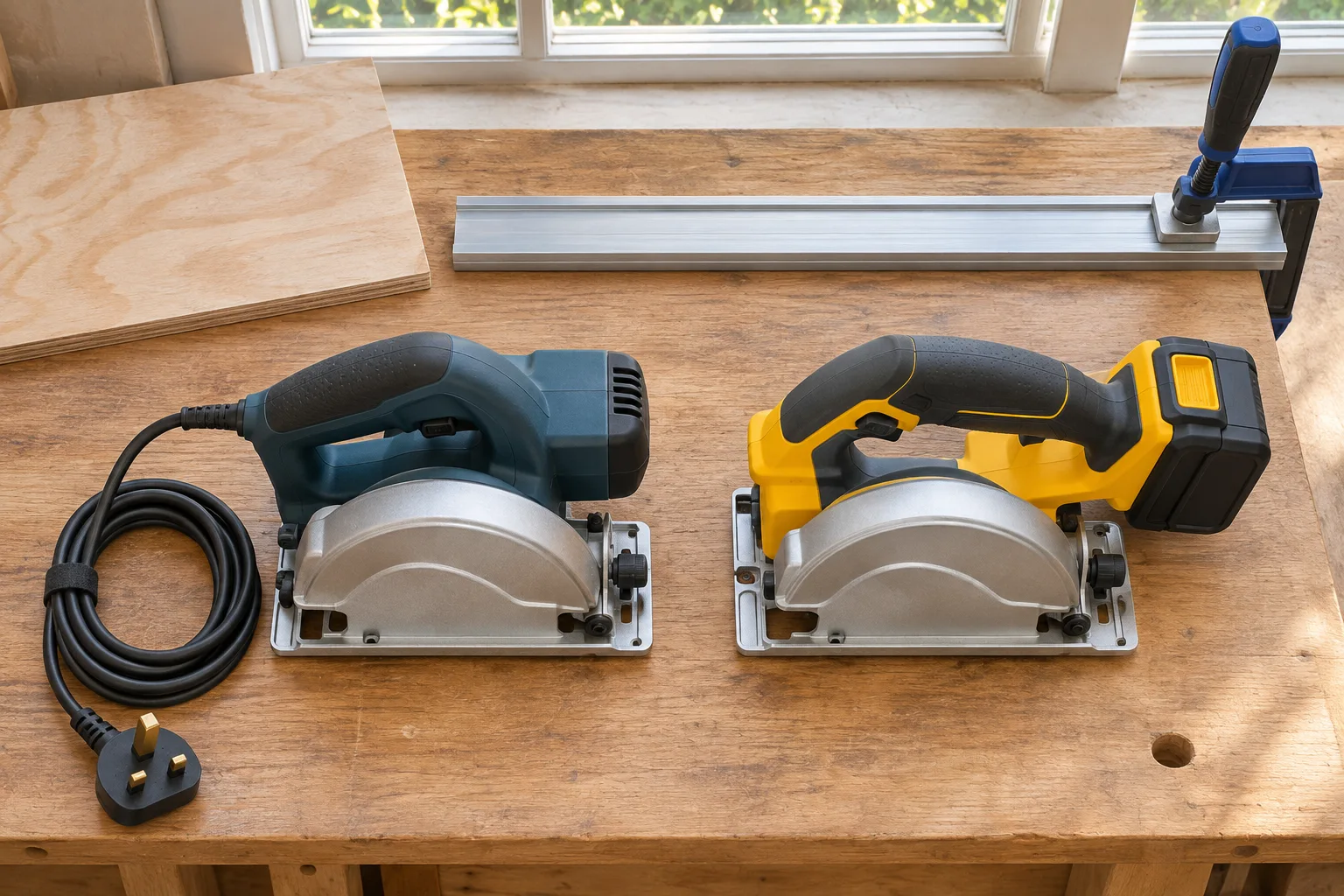
Cutting plywood for a cupboard is a different task from trimming a few lengths of timber. A corded circular saw lets you keep working near a socket, while a cordless one gives you room to move without trailing a cable across the work. Neither format makes a straight cut on its own.
This corded vs cordless circular saw guide compares the practical differences for sheet materials and timber, including battery costs, guides and safe setup. It will help you choose the format that suits the jobs you actually have planned.
Corded and cordless at a glance
| Consideration | Corded saw | Cordless saw |
|---|---|---|
| Best fit | Long sessions near a suitable socket | Moving between rooms or working away from a socket |
| Extra equipment | Suitable power supply and a safely routed lead | Compatible battery and charger, unless included |
| For straight sheets | Choose a suitable blade, stable support and a guide; check rail compatibility separately. | |
The saw’s published cutting depth, blade specification and compatible guides matter more than the power source when deciding whether it suits a particular board. Our circular saw buying guide takes you through those checks.
For plywood and other sheet materials
The useful difference is often cable management rather than cutting quality. A cordless saw is easier to move around a full sheet, particularly when the work is away from a socket. With a corded saw, plan a clear cable route that stays away from the cut and the offcut. Do not rely on either format to keep the sheet steady: support both sides of the line and clamp the work.
For a visible plywood edge, choose a blade suited to the material and a secure guide. A parallel guide follows an existing sheet edge; a clamped straightedge can guide a cross-sheet cut. A proprietary rail only works with a saw or adapter the manufacturer approves. For example, DeWalt describes its cordless DCS572 as rail-compatible, but the rail is separate. That tells you about this model, not cordless saws generally.
For repeated timber cuts
If you are making a run of similar cuts beside a suitable socket, a corded saw avoids stopping to charge. Cordless can still be practical, especially if you already own batteries in the same system, but the runtime you get depends on the battery, blade and timber. Compare the saw’s depth at 90° and at the bevel angle you expect to use; blade diameter alone does not tell you how thick a piece it will cut.
Do not buy a larger saw simply for occasional thin boards. A manageable weight, a clear sightline and a comfortable grip matter when you are positioning the tool repeatedly. If you can, handle the exact model before buying. Our circular saw comparison shows how six specific models differ, without claiming hands-on testing.
Compare the whole setup, not just the saw
A bare cordless tool may need a compatible battery and charger before you can use it. Check the exact offer: the same saw can be sold alone or as a kit, and the platform you already own can change the sensible choice. Ryobi identifies its R18CSP-0 as a bare tool, with battery and charger excluded. A second battery may be useful for a long cutting session, but do not assume you need one for a few cuts.
For either format, budget for the correct blade, a secure guide or straightedge, clamps and suitable extraction. Check the saw maker’s permitted blade dimensions and the exact guide arrangement. A cheap saw with missing essentials can cost more to put to work than a more complete offer.
Set up the cut safely
Whichever format you choose, keep the lower guard working freely, secure the work and support the offcut so it cannot pinch the blade. Disconnect the plug or remove the battery before changing blades, following the supplied manual. Keep the cable clear on a corded saw; on a cordless saw, the absence of a cable does not remove the need for a steady stance and two-handed control.
Cutting plywood or timber indoors can create significant wood dust. Plan suitable on-tool extraction and follow HSE advice on cutting and sanding wood, including respiratory protection where the task requires it. A dust port alone does not make an ordinary household vacuum suitable.
Which format makes sense for your renovation?
Choose corded when most cuts happen in one well-set-up area near a suitable socket and you want to work without charging breaks. Choose cordless when moving around the project is important or you already have a compatible battery system. For either, confirm cutting depth for your thickest material and sort out the blade, guide, support and dust control before the first cut.
This is a comparison of the two formats using manufacturer information and practical setup requirements, not hands-on testing or a claim that one type cuts every material better. The exact saw and blade still decide what you can cut.
Frequently asked questions
Is a cordless circular saw powerful enough for plywood?
It can be, provided the saw has enough cutting depth for the sheet and a suitable blade. Support the sheet, use a secure guide and check the manufacturer’s battery recommendation. A corded saw does not automatically make a cleaner cut.
Do cordless circular saws come with batteries?
Some are sold as complete kits, while bare-tool versions leave out the battery and charger. Check the exact offer and the battery platform before comparing costs.
Is a guide rail essential for straight cuts?
No. A securely clamped straightedge can help guide a compatible saw, but a proprietary rail needs a model designed or approved to work with it. Check that the guide cannot obstruct the lower guard.
Which circular saw is better for repeated timber cuts?
A corded saw is convenient for a long session near a suitable socket because there is no charging pause. A suitable cordless saw can also do the work, particularly if you already have compatible batteries; check cutting depth and plan for charging or a spare battery.