
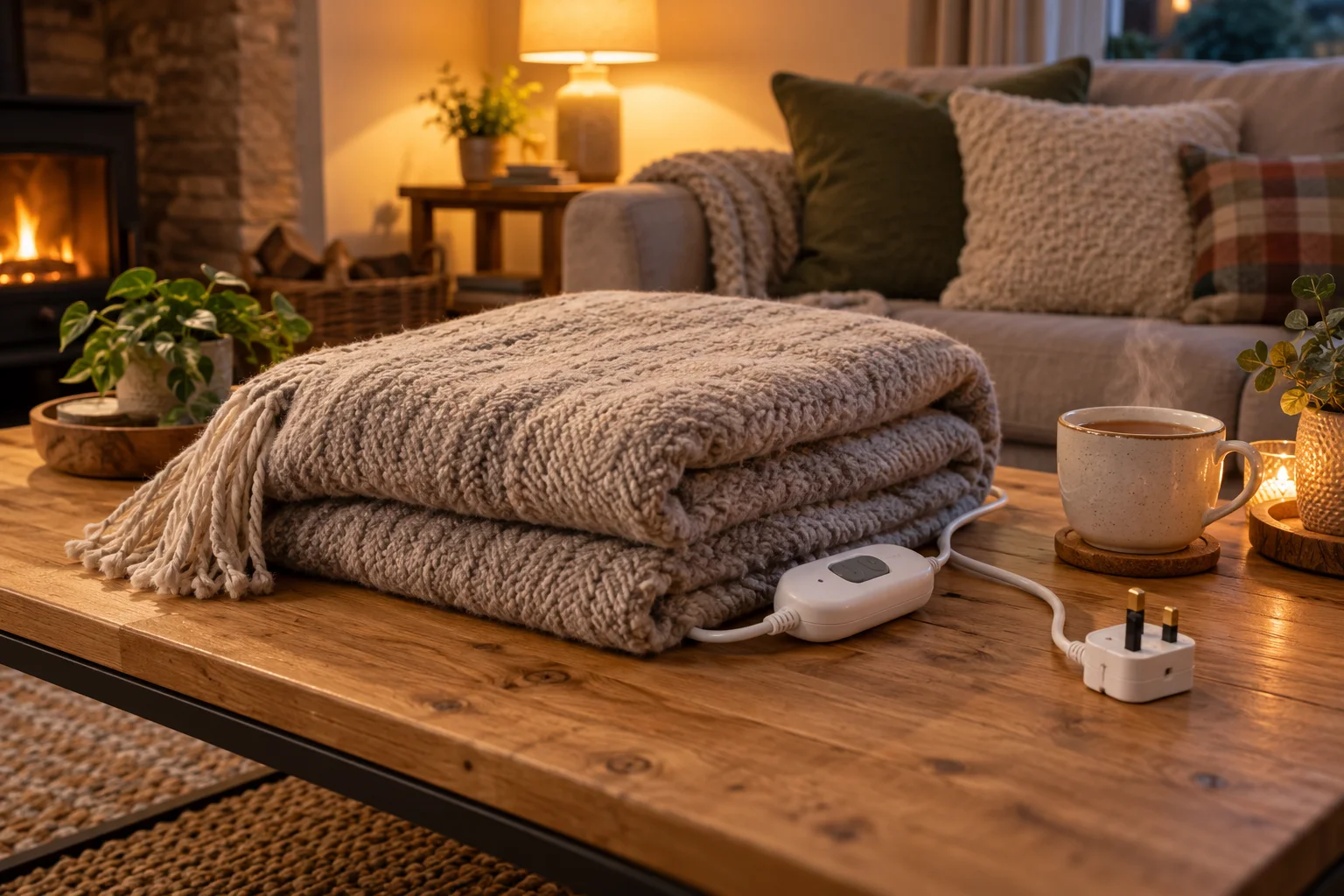
A heated throw can be a comfortable way to warm up while you read or watch television. If you’re thinking of using one regularly, it helps to know what it could add to your electricity bill, rather than relying on a “pennies per hour” claim.
The cost depends on the throw’s power, how long you use it and your own electricity rate. We’ll show the calculation, then put a few wattages into a table so you can work out a useful estimate for your home.
The short answer
At Ofgem’s October–December 2026 average electricity unit rate of 26.32p per kWh for a Direct Debit customer in England, Scotland or Wales, a 100W throw drawing that power continuously costs about 2.6p for one hour, or 5.3p for two hours. Over 30 evenings of two hours each, that works out at about £1.58. Your tariff and the throw’s actual draw may differ.
How to calculate your own cost
Divide the throw’s wattage by 1,000 to get kilowatts. Multiply that by the hours used to get kilowatt-hours (kWh), then multiply by the electricity unit price on your bill. For example, 100W is 0.1kW; over two hours it uses 0.2kWh if it draws 100W throughout. At 26.32p per kWh, that is 5.264p, rounded to 5.3p.
| Power draw assumed | Energy over 2 hours | Estimated cost per 2-hour evening | Estimated cost over 30 evenings |
|---|---|---|---|
| 60W | 0.12kWh | About 3.2p | About 95p |
| 100W | 0.20kWh | About 5.3p | About £1.58 |
| 150W | 0.30kWh | About 7.9p | About £2.37 |
On a phone, swipe across the table to see all columns.
Each row assumes the stated wattage is drawn continuously for two hours per evening, over 30 evenings. The figures use the 26.32p/kWh Ofgem average and exclude the standing charge, which you pay even without the throw. They are examples, not a promise of what a particular product will cost.
Why your bill may be different
The wattage on a product may describe its rated or maximum draw, not what it uses every minute. A thermostat may cycle the heat; a lower setting may use less; and preheating may use more than maintaining warmth. Your tariff could also be above or below the national average, especially on a fixed or time-of-use tariff.
If you want a closer answer, use the unit price from your own bill and the wattage on the exact throw. A suitable plug-in electricity monitor can measure energy used over a typical evening. Keep the plug and cable accessible and follow the throw’s instructions; do not add an extension lead just to make a measurement.
Can a throw replace heating the room?
A throw warms you directly, which is helpful when you are settled in one place. It does not make an unheated room safe or comfortable for everyone else, and it does not prevent cold-related problems in the home. Think of it as one way to add personal warmth, not a substitute for keeping your home safely heated.
Our best heated throws guide compares sizes and controls. If you are still deciding what kind of throw suits you, our buying guide covers the practical features to check.
Frequently asked questions
How much does a 100W heated throw cost per hour?
At the October–December 2026 Ofgem average of 26.32p per kWh, 100W running continuously for one hour would cost about 2.6p in electricity. Actual use may be lower if the throw cycles its heat or you choose a lower setting.
Does a heated throw use its rated wattage all the time?
Not necessarily. The wattage on the label is a useful upper-bound assumption for a simple estimate. A thermostat or heat setting may change the average draw, so a plug-in electricity monitor is needed to measure your own use.
Should I add the standing charge to the throw’s cost?
The standing charge is paid for the electricity connection whether the throw is used or not, so it is usually left out of the extra cost of running the throw. Your unit rate is the figure to use for this calculation.
Is a heated throw cheaper than heating a room?
A throw heats a person rather than an entire room, so the two jobs are not directly comparable. It may use less electricity than a room heater, but it does not replace keeping a home safely warm. Costs depend on your tariff and use.

 Sign up with Facebook
 Sign up with Google
