

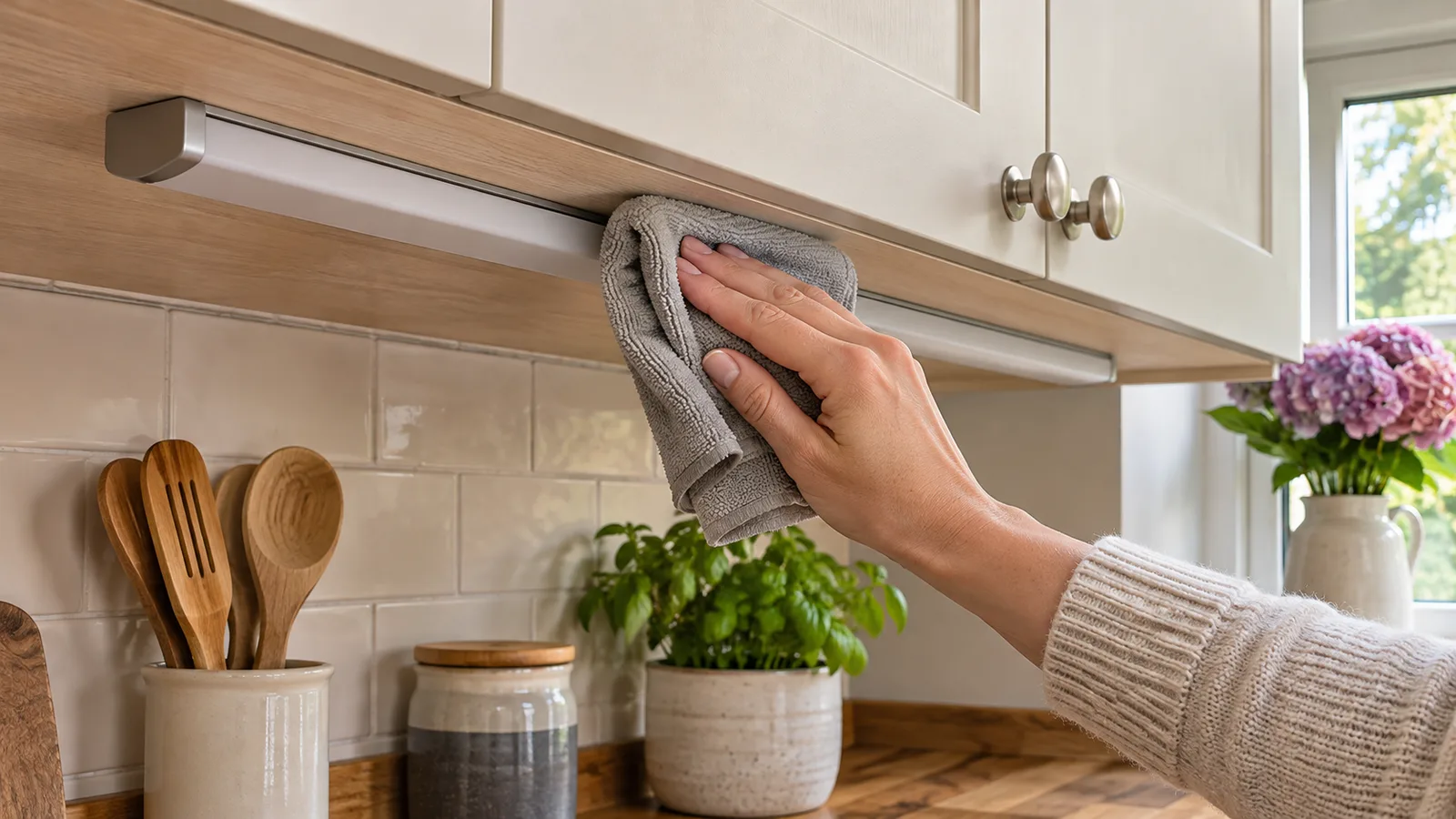
The strip under your cupboards is easy to miss during a kitchen clean, until dust or cooking residue starts to show on the cover. A gentle wipe usually takes very little time, but the right method depends on the fitting. This guide covers how to clean under-cabinet lights, check that everything is still secure and know when a fault needs more than a wipe.
Make the light safe to clean first
Switch the light off and let it cool. Unplug a plug-in kit before touching the fitting or its cable; if the light is part of fixed wiring, follow its instructions for safely isolating it, and don’t open or work on the electrical connections. Keep water and cleaning sprays away from sockets, drivers, connectors and charging ports. Electrical Safety First warns against cleaning an electrical appliance while it’s plugged in.
Use a stable step stool if the cabinet is awkward to reach, and clear the worktop so you’re not leaning over a hot hob or sharp utensils. The aim is to clean the outside, not dismantle the light.
Wipe the cover and fitting gently
Begin with a soft, dry microfibre cloth to lift dust from the diffuser — the cover that spreads the light — and from the outside of the housing. The manufacturer’s manual for one under-cabinet light illustrates a dry cloth and rules out liquid cleaners and abrasive pads. Another fitting may have different instructions, so check your manual before using a damp cloth or cleaning product. Don’t assume that a wipe suitable for the cabinet surface is suitable for the light.
Don’t spray cleaner directly onto a strip, bar or spot. Avoid scrubbing at adhesive strips or pulling a diffuser away from the fitting unless the manual tells you it’s removable. If grease doesn’t lift easily, check the maker’s care instructions before trying a stronger product.
Check strips, bars and rechargeable lights in place
Run your eye along a strip or bar while it’s off. Is the cover seated properly? Are the mounting clips or adhesive pads still holding? Have steam and repeated wiping loosened anything near the kettle or hob? Don’t push a loose fitting back against a damaged cable or improvise a new connection. Use the maker’s mounting instructions for a simple loose clip; ask a qualified electrician about any problem with fixed wiring.
For a removable rechargeable light, look for dirt around the charging port and make sure it’s dry before charging. Check the supplied manual before removing a cover or battery; many integrated LED and rechargeable units aren’t intended for user repair. Our rechargeable under-cabinet light guide explains what to check in the charging kit when choosing one.
Look for wear before turning the lights back on
Check the plug-in kit’s lead, plug, driver and visible connectors for damage, fraying, cracking or signs of heat. Electrical Safety First’s plug-and-cable checks explain why worn parts matter. If anything looks damaged, leave the light off and have it assessed or replaced; don’t tape over a cable or keep using a flickering fitting.
If the light has simply become dimmer or uneven, first check its controls, charging state and the troubleshooting steps for that exact model. An integrated LED may not have a replaceable lamp. The product manual or manufacturer can tell you whether a part is serviceable. When you’re ready to replace a whole fitting, our guide to choosing under-cabinet lighting helps you decide what suits the worktop and power arrangement.
Keep the routine simple
A quick dry wipe when you clean the worktop area, followed by an occasional look at the fixings and visible cable, is more useful than waiting for grime to build up. There’s no universal cleaning interval: a light beside the hob may need attention sooner than one over a quiet stretch of counter. Keep the manual somewhere you can find it, particularly if you’ve used linked fittings, a separate driver or a rechargeable model with specific charging instructions.
Frequently asked questions
Can I spray kitchen cleaner onto an under-cabinet light?
Don’t spray a fitting directly. Clean its exterior in the way the manufacturer specifies, keeping liquid away from ports, connectors, drivers and sockets.
Can I use a damp cloth on an LED strip?
It depends on the product. Some manuals permit a lightly damp cloth; others say dry cloth only. Check the exact strip and its cover before cleaning.
What if an under-cabinet light flickers after cleaning?
Switch it off and check the maker’s troubleshooting guidance. If you see moisture, damage, a hot plug or a worn lead, don’t use it until the fault has been assessed.
Do I need to replace the whole light when an LED fails?
Not always, but many integrated LED fittings don’t have a user-replaceable lamp. Check the exact model’s manual or ask its manufacturer which parts can be replaced safely.