

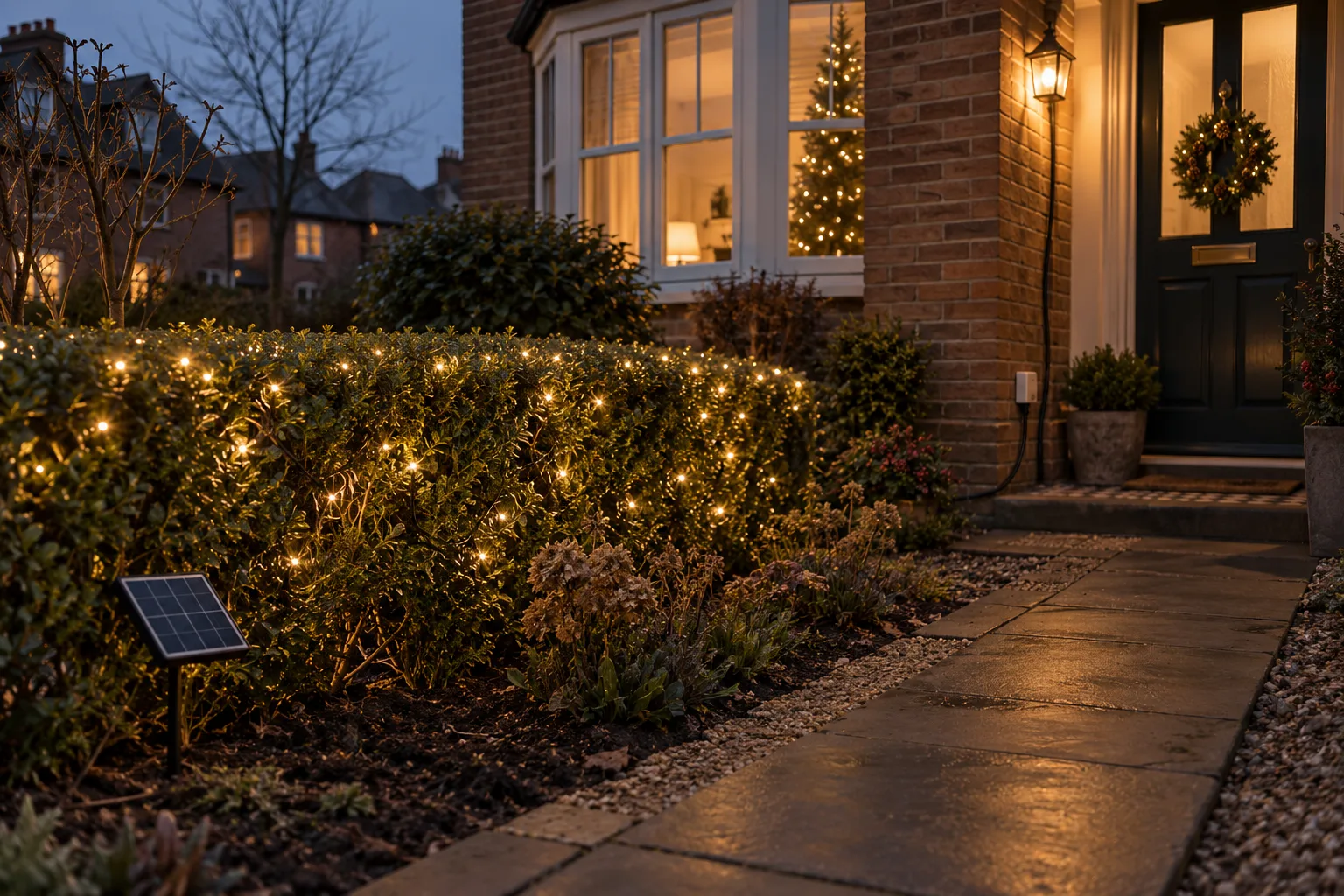
Trying to decide between mains and solar Christmas lights? A plug-in set can be a straightforward choice if there’s a suitable socket nearby, while solar lights give you more freedom to decorate further down the garden. The catch is getting enough daylight to charge them during a UK winter.
We’ll look at the practical differences, from finding a safe cable route to what you can expect from solar on cloudy days. If you’re ready to choose, our outdoor Christmas lights guide includes both options.
When mains lights are a good choice
Mains lights are a practical option around the front door or on a tree near the house, provided the cable can reach a suitable socket without crossing a path. They’re also more reliable if you want your lights to come on each evening without depending on daylight to charge them.
Check the cable length before buying: a long string of lights can still have a short lead between the plug and the first bulb. Measure that distance separately to make sure it will reach.
Electrical Safety First says outdoor mains lighting should use RCD protection, and anything plugged in outdoors must be connected through a 30mA RCD-protected socket. The light string’s outdoor rating does not automatically cover its transformer or plug. Read the exact instructions and keep those parts in the permitted location. If the route needs a permanent new socket or wiring, use a qualified electrician rather than improvising with an extension lead.
When solar lights are a good choice
Solar lights are handy for a tree, shrub or fence further from the house, where reaching a socket would be difficult. Just make sure the panel can sit somewhere with plenty of daylight, away from overhanging branches or anything else that could shade it. Check that the cable between the panel and the lights is long enough, too.
The main drawback is charging them in winter. With shorter UK days and cloudy weather, they may shine less brightly or switch off earlier than you’d like. The running time advertised won’t necessarily reflect what you’ll get on a dull December day.
How the two options compare
| What matters | Mains lights | Solar lights |
|---|---|---|
| Best position | Near a suitable socket and safe cable route | Where the panel can see daylight, even if the lights sit in shade |
| Evening reliability | Consistent while powered and working correctly | Varies with charge, battery and daylight |
| What to measure | Lit run plus separate lead to the socket | Lit run plus cable from the panel to the lights |
| Outdoor checks | Ratings for string, connectors and transformer; RCD-protected supply | Ratings for string, panel and battery housing |
On a phone, swipe across the table to see all three columns.
A few decisions that are easy to miss
Choose the position before the power type
Mark the first bulb and the last bulb where they will actually sit. For a tree, imagine the lights running inwards through the branches, not just around the outside. For a hedge, decide whether you want a string along the top or a net across the face.
Check controls and replacement parts
Look for a timer and a steady-on mode if that is the look you want. With solar, find out whether the rechargeable battery can be replaced and how the panel is mounted. With mains, check how the transformer is protected and whether the cable and connectors are intended for your planned exposure. Keep the instructions for next year.
Do not let convenience override safety
Neither power source makes an indoor-only string suitable for rain. Electrical Safety First’s Christmas-light guidance covers outdoor marking, damaged cables and RCDs; our outdoor-light safety guide puts those checks into a practical order. Switch off and unplug mains lights when you go out or go to bed, as Electrical Safety First advises.
Frequently asked questions
Are solar Christmas lights as bright as mains lights?
Brightness depends on the particular LEDs, battery and charge, so power type alone will not tell you. Solar output can drop after a dull day; compare the exact sets and their instructions.
Will solar Christmas lights work in a UK winter?
They can still charge from daylight, but shorter days, cloud and shade may reduce the charge. Put the panel in the best daylight available and expect the display to vary.
Do mains outdoor Christmas lights need an RCD?
Electrical Safety First says lights plugged in outdoors must use a 30mA RCD-protected socket. Check the exact product instructions and ask a qualified electrician if you are unsure about your supply.
Can I put an indoor transformer outside in a waterproof bag?
No. Keep plugs and transformers where the manufacturer says they belong; an improvised bag or tape is not a substitute for an approved outdoor arrangement.
The choice for your garden
If a safe socket is close, mains is usually the more dependable option for a display you want every evening. If the feature is further away, solar can work well when the panel has a clear daylight position and you are happy for the display to vary. Choose the position and measure the route first; then pick the power source that fits it.
 Sign up with Facebook
 Sign up with Google
