

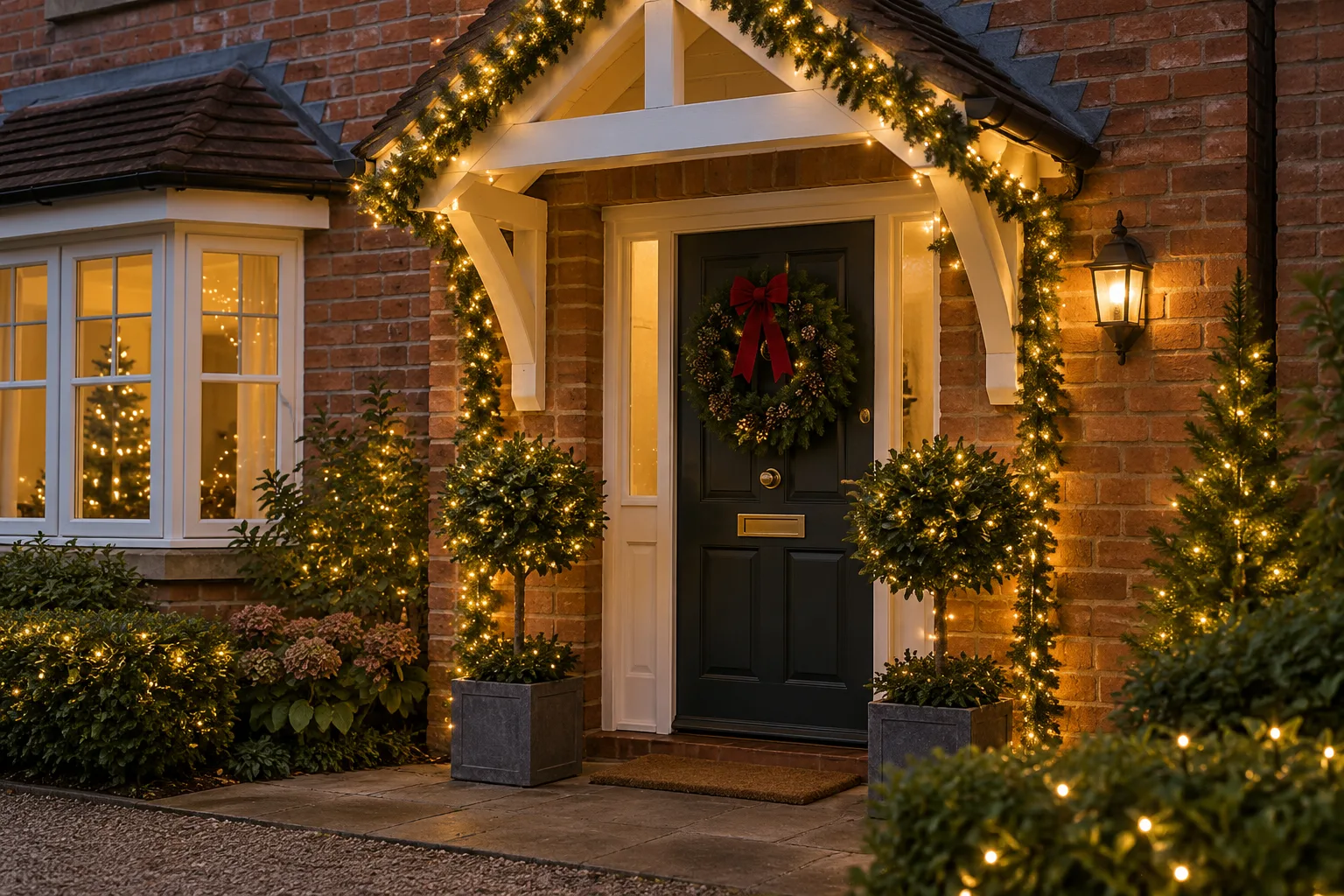
Whether you’re wrapping fairy lights around the front door or brightening up the garden, check they’re suitable for outdoor use before you buy. You’ll also need enough cable to reach a suitable socket and somewhere safe for the plug and transformer.
This guide explains outdoor ratings, power options and how to put your lights up safely. If you’re ready to choose a set, browse our outdoor Christmas lights guide.
1. Choose lights that are actually made for outdoors
Start with the packaging and instructions for the exact set. Look for an outdoor-use marking or a water-drop symbol. An IP code tells you about protection against dust and water; for outdoor lights, the last number is the one to watch. A 3 covers rain-like spray, 4 covers splashes and 5 covers jets of water. Electrical Safety First’s Christmas-light safety guide says outdoor lights should have a water-protection digit of at least three. A set under a porch won’t face the same weather as one on an exposed fence, so follow the instructions for where you plan to put it.
Check the whole set, not just the string. IP44 lights may come with an IP20 transformer: that final 0 means no water protection, so the transformer must stay indoors. An IP65 light string doesn’t make its plug, connections or battery box IP65 too. Put each part where its instructions say it belongs; a plastic bag or tape around a plug isn’t a safe substitute.
2. Plan the power route before hanging anything
Measure the part that lights up and the separate lead back to the power supply. Find a route that avoids steps, doors and paths people use. Check where the socket is and whether it has RCD protection. Electrical Safety First says mains equipment plugged in outdoors needs a 30mA RCD-protected socket. If you’re unsure what protection you have, ask a qualified electrician before using it.
Keep plugs and transformers indoors unless the instructions for that exact set give another safe outdoor arrangement. Don’t overload sockets or daisy-chain extension leads. If you genuinely need an outdoor-rated extension, make sure it’s correctly rated, fully uncoiled and undamaged, and use it as directed. Electrical Safety First’s garden-safety guidance has more detail on garden cables and connections.
3. Match the light shape to the surface
| Where you are lighting | Usually easier to fit | Check before buying |
|---|---|---|
| Front door | Short string or door-frame kit | Lit length, lead length and suitable hooks. |
| Gutter or porch edge | Icicle lights | Safe access and non-damaging fixing points. |
| Hedge or shrub | Net lights | Mesh width and height against the plant. |
| Fence or wall | Curtain, vine or straight string | Drop length, support and wind exposure. |
| Patio or pergola | Festoon bulbs | Support points and cable sag. |
On a phone, swipe across the table to see all three columns.
If the lights won’t reach the last hook, don’t pull the cable tight. Choose a different length or route instead. Leave high gutters and any permanent wiring to a competent professional.
4. Put the lights up without damaging them
Unpack the set and look closely at the cable, plug, bulbs and connections before you put it up. Don’t use anything damaged. Choose hooks or clips that suit both the surface and the lights. Never put a nail through a cable, trap it in a door or window, or let it rub on a sharp edge. Keep cables where no one will trip over or crush them.
Only join sets if the maker expressly says those exact sets are compatible and gives a maximum. Similar-looking connectors aren’t enough. Disconnect the power before changing any replaceable bulbs, and follow the instructions supplied with the lights.
5. Decide between mains, battery and solar
Mains lights give you a dependable display if you have a safe route to a socket. Battery lights can work for a small feature without a trailing lead, but check the battery box and plan for replacements. Solar lights avoid a socket, though the panel needs daylight; on short, cloudy winter days, they may be dimmer or run for less time than an ideal-condition listing suggests.
The whole set still needs to suit its outdoor spot, whether it uses mains, batteries or solar power. The panel or battery box may have different weather protection from the light string, so check each part in the instructions.
6. Check the display during use and store it dry
Take another look at the lights after strong wind and check regularly for loose hooks, worn cables or signs of water damage. Electrical Safety First advises switching them off and unplugging them before bed or when you leave. Take them down as the instructions say, let them dry and store them without sharp bends somewhere clean and dry.
Frequently asked questions
Can I use indoor Christmas lights outdoors?
Only if the maker explicitly marks that exact set for outdoor use. Putting a cover over the plug won’t make indoor-only lights suitable for the garden.
Is IP44 enough for outdoor Christmas lights?
It can be, if the maker says the set suits the spot you’ve chosen. Check every part: an IP44 string may come with an IP20 transformer that has to stay indoors.
Do I need an RCD for outdoor Christmas lights?
Yes, for mains-powered outdoor equipment. Electrical Safety First advises using an RCD-protected supply and says anything plugged in outdoors needs a 30mA RCD-protected socket. If you’re unsure about your socket, ask a qualified electrician.
Can I leave outdoor Christmas lights on overnight?
Electrical Safety First advises turning lights off and unplugging them before bed or when you go out. A timer helps, but you still need to follow the instructions and check the set for damage.
Can I connect different light sets together?
Only if the maker expressly permits those exact sets to be joined and gives a safe maximum. Don’t join unrelated lights or daisy-chain extension leads.
Enjoying your outdoor lights safely
Pick lights made for the spot you want to brighten, and make sure the lead reaches a suitable power source without crossing a path. Keep every connection where the maker says it belongs. A simple display you can put up and check safely will serve you better than a bigger one held together by stretched cables.


 Sign up with Facebook
 Sign up with Google
