
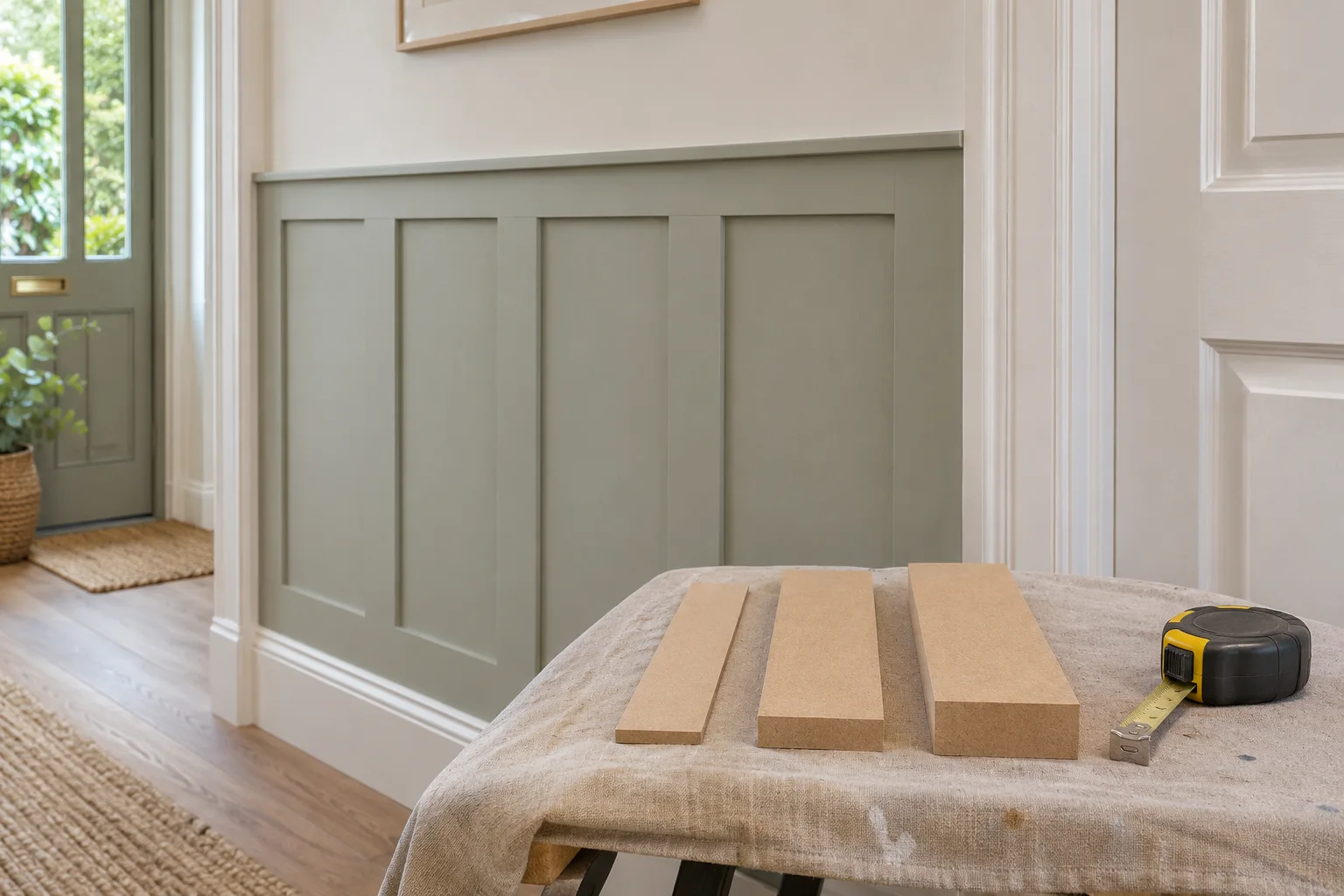
A Shaker wall can look quite different once the strips sit beside your skirting and door frame. Even a few millimetres of extra depth changes the shadow line, so the best MDF thickness for panelling depends on the detail you want and the product you’re fitting.
We’ll compare 6mm, 9mm and 12mm MDF for applied strips and explain why a full sheet is a different fixing decision. You’ll be able to check the projection against your existing trim before ordering, rather than choosing a thickness from a photo alone.
6mm, 9mm and 12mm at a glance
| Thickness | Visual effect on applied strips | What to check |
|---|---|---|
| 6mm | Shallower projection and a quieter shadow | Whether the profile still reads clearly against your skirting and top trim |
| 9mm | Noticeable but not very deep relief | How the strip meets door architraves and any existing trim |
| 12mm | Deeper raised edge and stronger shadow | Whether joins, caps and skirting can finish the extra depth neatly |
On a phone, swipe the table sideways to see every column. These are design comparisons for applied strips, not blanket strength ratings. Panelling Direct offers all three thicknesses within one 1220mm strip range, so you can compare like-for-like width and finish options.
For Shaker strips, compare the whole wall detail
Lay a short offcut or a sample beside the skirting and door frame before buying a full set. A 6mm strip can give a subtle border in a small room; 12mm makes the raised grid more prominent. The useful choice is the one that leaves a clean meeting point at the top rail, corners and existing trim. A wider strip can also look more substantial without changing its thickness. Our measuring and cut-list guide helps you set out the openings before you choose pack quantities.
Sheets and routed panels need their own specification
A full MDF sheet covers a larger area and may have routed grooves cut into its face. Its thickness, size and weight must be considered as a complete panel, not judged from a strip comparison. Follow the exact sheet maker’s fixing method and check whether the wall can carry it; adhesive-only fitting is not automatically appropriate. One easy-fit panel range offers 6mm and 9mm options, illustrating that sheet specifications vary by product.
Match board grade and finish to the room
Thickness does not make standard MDF moisture resistant or waterproof. For a more humid room, check the board grade, the maker’s permitted use and the specified edge and finish treatment. Keep MDF out of direct water exposure unless the product is explicitly designed as a waterproof system. Our MDF style and cost guide explains the difference between strips, joined boards and routed sheets.
Checks before you order
Confirm the exact thickness, width, length, primed state and any supplied trim. Compare a sample with the room’s skirting, sockets and door frame, then make a wall-sized cut list rather than guessing from pack coverage. If you will cut or sand MDF, use the HSE’s wood-dust control advice. If your chosen fixing uses pins or screws, check for hidden cables using Electrical Safety First’s DIY guidance.
Frequently asked questions
Is 6mm MDF too thin for wall panelling?
Not automatically. Some manufacturers sell 6mm MDF strips for interior wall panelling. Check the exact strip or panel specification, layout and fixing method for your wall.
Is 9mm or 12mm better for Shaker panelling?
Neither thickness is universally better. Compare the depth beside your existing trim and use the board maker’s fitting guidance; 12mm creates a deeper visible edge than 9mm.
Does thicker MDF make panelling waterproof?
No. Thickness and moisture performance are separate properties. Check the exact board grade, room suitability and finishing instructions.