
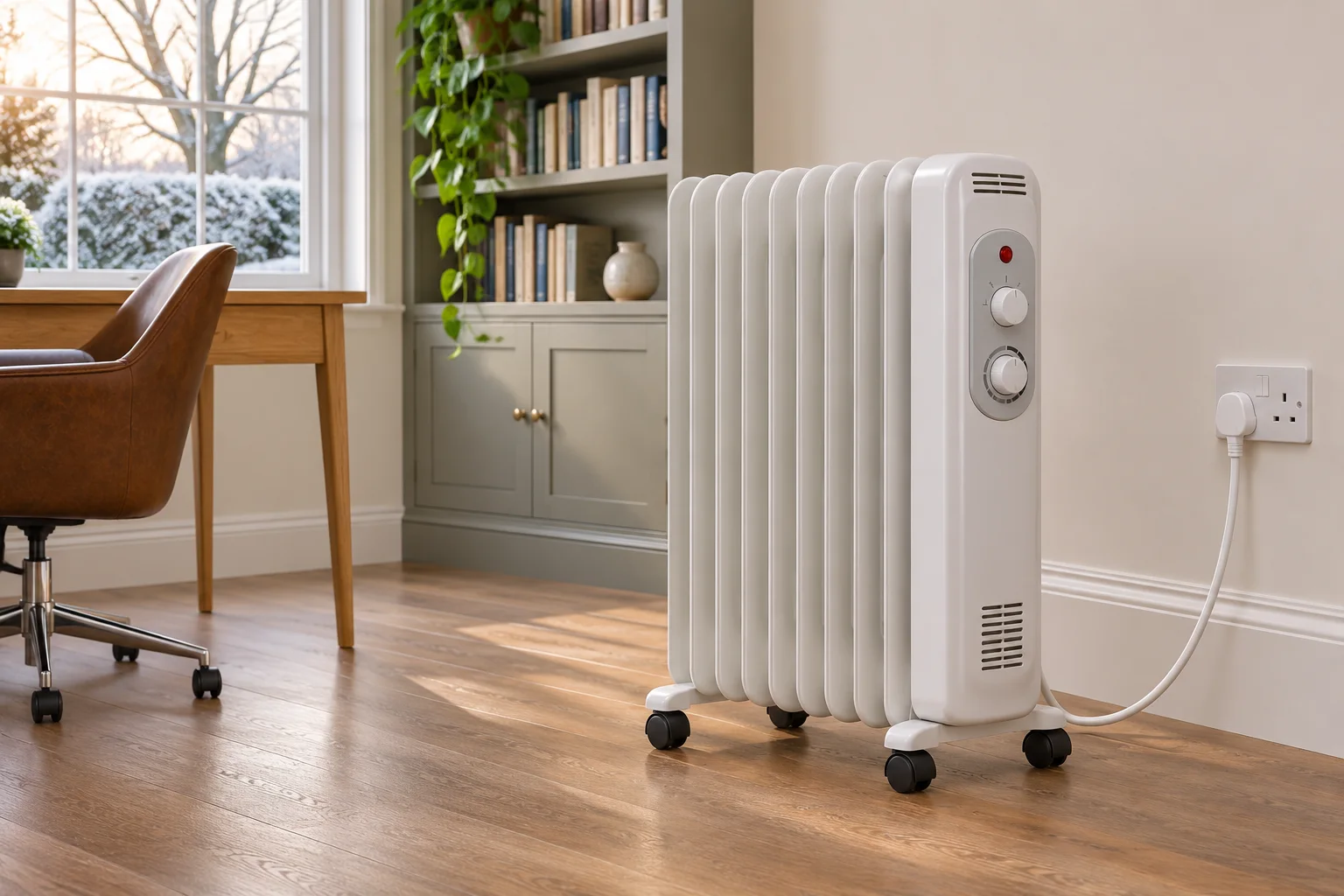
An oil-filled radiator can bring extra warmth to a chilly home office or a room you only use occasionally. Choosing one is easier when you know what to look for, from the heat output your room needs to controls that fit your daily routine.
Our oil-filled radiator buying guide explains the sizes, settings and features worth considering before you buy. When you’re ready to compare models, browse our best oil-filled radiators or our compact options for small rooms.
Start with the room, then look at wattage
Wattage tells you the heater’s maximum electrical input and broadly its maximum heat output. A 500–800W mini may provide a top-up for a small occupied room. A 1500–2500W model can supply more heat, but no wattage alone promises a comfortable temperature: insulation, draughts, windows and outside temperature all matter.
A heater advertised for a particular square metre figure may have been assessed under conditions unlike your home. Treat that number as a starting point, not a guarantee. If the room is large or loses heat quickly, a mini radiator is likely to disappoint.
Pay for controls you will use
Thermostat and power settings
A thermostat senses temperature at or near the heater and cycles its element on and off. It is not a precise measure of the temperature where you sit. Separate 600W, 900W or 1500W settings limit the maximum input while selected; turning a thermostat down does not turn a 1500W element into a guaranteed 600W heater.
Timer and remote
A timer can stop heating at a planned time, while some models can also start automatically. A remote is convenient if the radiator is across the room. Neither feature removes the need for safe positioning or supervision. Check the exact manual: timer options can differ even between similar-looking models.
Measure the radiator with its feet or wheels
Look at the assembled length, width and height rather than the fin body alone. Castors make a heavy full-size model easier to reposition after it has cooled; fixed feet can be enough for a small radiator you rarely move. Leave space for the cable to reach a wall socket without crossing a walkway.
Do not plan to tuck the heater under a desk or next to curtains. Electrical Safety First advises at least one metre between a portable heater and combustible materials. The fins and nearby surfaces can become hot, so the safe space matters more than squeezing the unit into a gap.
Work out a useful running-cost estimate
Divide the heater’s wattage by 1,000 to get kilowatts, then multiply by the hours used and your electricity unit rate. At a hypothetical 30p per kWh, a 1500W radiator drawing full power for an hour would use 1.5kWh and cost 45p. A 500W unit at full power for that hour would use 0.5kWh and cost 15p, but it supplies less heat.
Use the rate on your own bill rather than the example. The thermostat may cycle, so an actual bill can differ. Oil continues to release warmth for a while after switch-off, but it does not create free heat or make the heater inherently cheaper per unit of electricity than another resistance heater.
Give it room to work safely
Electrical Safety First recommends a direct wall socket rather than an extension lead, a level surface, and at least one metre from combustible materials. Do not cover the heater or drape clothes over it. Do not leave it running unattended or while you sleep. Switch it off and let it cool before moving it, and follow the manufacturer’s instructions for the exact model.
How we checked
We compared current UK product information for output, controls, assembled size and mobility, and checked portable-heater safety advice against Electrical Safety First. This guide explains the buying decisions; it is not a hands-on test of any radiator. Exact specifications and stock can change, so verify the current model and manual before buying.
Frequently asked questions
How much does an oil-filled radiator cost to run?
Multiply its rated kilowatts by the hours it draws power and your electricity unit rate. A 1.5kW heater drawing full power for one hour uses 1.5kWh. A thermostat may switch it on and off, so this is a full-power estimate.
Is a higher wattage radiator more efficient?
Higher wattage means it can put out more heat while it is drawing full power, but it also uses more electricity at that moment. It does not by itself make electric heat cheaper per unit.
Do I need to add oil?
No. The oil is sealed inside a domestic oil-filled radiator. Stop using a damaged or leaking unit and follow its manual.
Can I put one in a bedroom?
Only where it can stand safely with the specified clearance and a direct wall-socket connection. Electrical Safety First advises not leaving portable heaters running while you sleep or unattended.