

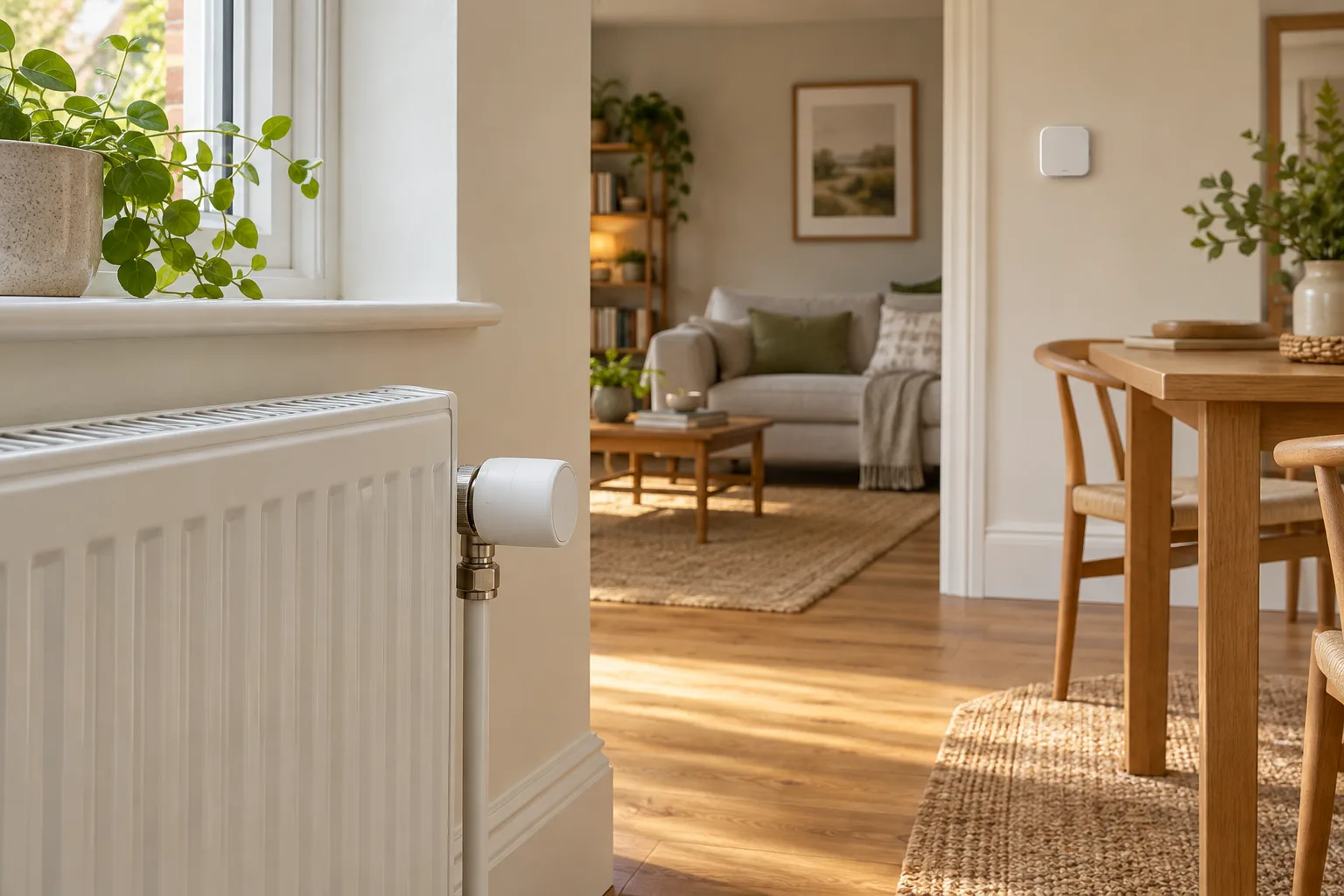
You might want the bedroom cooler overnight without changing the temperature in the living room. Or perhaps the main problem is that the whole heating system comes on at the wrong times. Those are related, but they are not the same job.
Here is how smart radiator valves and a smart thermostat differ, and when it makes sense to use one, the other or both. The central question is whether you need to control individual radiators, the boiler’s heating schedule, or a coordinated system that does both.
What each control actually changes
A smart radiator valve opens or closes the hot-water flow into its radiator to manage that room. A smart wall thermostat measures a location in the home and tells the boiler or central heating controls when to run. A radiator can receive heat only when hot water is available. A valve head linked to an app is therefore not automatically able to start the boiler.
Some compatible ecosystems connect room demand to a central thermostat or receiver. Hive explains that its valves can regulate rooms with a Hive Hub, while Heat on Demand needs Hive Active Heating. tado° shows separate X setups for radiator heads and boiler control. Check the exact generation and hardware in your home; “works with” is not enough detail.
When a smart thermostat is the better first purchase
If your main frustration is switching the whole heating on and off, a suitable smart thermostat may solve more than individual valve heads. It can give you a central schedule and, depending on the system, remote control. Without room valves, however, radiators still follow their own existing TRV settings while the boiler runs. A warm thermostat room can also end a heating cycle before a cooler distant room reaches the temperature you hoped for.
Changing a wired thermostat or boiler receiver is not the same as clipping on a valve head. Check boiler and heating-control compatibility, hot-water arrangements if relevant, and installation requirements before ordering. Use a qualified installer for wiring when required.
When smart valves are enough on their own
If your current central schedule is already sensible and you mainly want to stop heating a spare room unnecessarily, app-controlled radiator heads may be enough. They can restrict flow into those radiators and follow room schedules while the main heating is running. That is different from asking for extra boiler time when one room is cold.
This route often makes sense for a small trial, or for homes where you cannot change central controls. But you still need a compatible TRV body and whatever hub or Thread equipment the exact head requires. Our buying guide covers those checks.
When both work together
A coordinated setup suits households that want a room to call for heat at a time when the usual central thermostat would not. The room valve measures or helps regulate its radiator, while a compatible central thermostat or receiver decides whether the boiler should run. This can give more precise room schedules, but it costs more and needs careful configuration.
Do not assume that adding one smart valve to an unrelated thermostat creates this link. The hub, thermostat, boiler controller and valve generation need to support the same arrangement. With some systems, radiators without smart heads may warm whenever another room calls for heat, so leave their conventional TRVs set appropriately and follow the manufacturer’s room-planning advice.
A simple way to decide
| Your main aim | Start by looking at |
|---|---|
| Change when the whole home heats | Compatible smart thermostat or boiler controller |
| Limit heat in selected rooms during the existing schedule | Smart radiator heads and their required hub |
| Let individual rooms request heat | One coordinated valve-and-boiler-control ecosystem |
Check the heating system you own before choosing products. If the answer is room control, compare our six smart radiator valve options by included hardware and expansion needs. Neither type guarantees a particular bill reduction; choose it because it solves the control problem you actually have.
Frequently asked questions
Do smart radiator valves work with any smart thermostat?
No. Check the manufacturer’s exact hub, generation and boiler-control compatibility. Two devices having apps does not mean room heat demand will pass between them.
Can I use smart radiator valves without changing my thermostat?
Often yes, if the heads fit and you have the required hub or controller. They can regulate their radiators while your existing central heating is running, but may not be able to start it.
Do I need a smart valve on every radiator?
Not always. It depends on which rooms you want to schedule individually and how the central thermostat measures heat. Check the maker’s guidance for rooms without smart heads.
Is it safe to replace a thermostat myself?
Thermostat and boiler-receiver wiring requirements vary. Follow the exact manufacturer instructions and use a qualified installer where electrical or heating-system work is required.



 Sign up with Facebook
 Sign up with Google
