
The floor head that came with your wet and dry vacuum may be fine for a quick tidy-up, then awkward when you try to reach behind a radiator or clean the car. Before buying a bundle of extras, it helps to know which bags, filters and tools will actually fit your machine—and which ones suit the job.
Start with the exact model number
Before buying spare bags, filters or attachments, check your vacuum’s model number—you’ll usually find it on the machine’s label or in the manual. Use this to find the correct part number in the manufacturer’s compatibility guide. Bags and filters need to fit securely, and hoses and nozzles need the right connection.
Parts can vary even within the same brand. For example, Kärcher’s WD range guide shows different bags and filters for the WD 2 Plus and WD 3 compared with the WD 4–6 models. Check your exact model before ordering, especially if you have an older machine.
Choose bags and filters for the task
A dry collection bag keeps ordinary debris together and can make emptying tidier. It is a consumable, so consider availability and ongoing cost before you buy a vacuum. Remove a dry bag before liquid pickup unless the exact manual says otherwise. The filter arrangement may also change between jobs; some models keep one filter in place while others use a dedicated wet filter.
Nilfisk’s Buddy II manual, for example, identifies an optional filter kit and a four-pack of dust bags. Check the manual for the exact Buddy II variant and supplied parts before buying either. A bag or a filter described as “HEPA” is not, on its own, proof that a general-purpose vacuum is suitable for hazardous renovation dust. HSE guidance calls for a correctly selected classified extraction unit for many on-tool construction-dust tasks.
Pick nozzles and hoses that solve a real problem
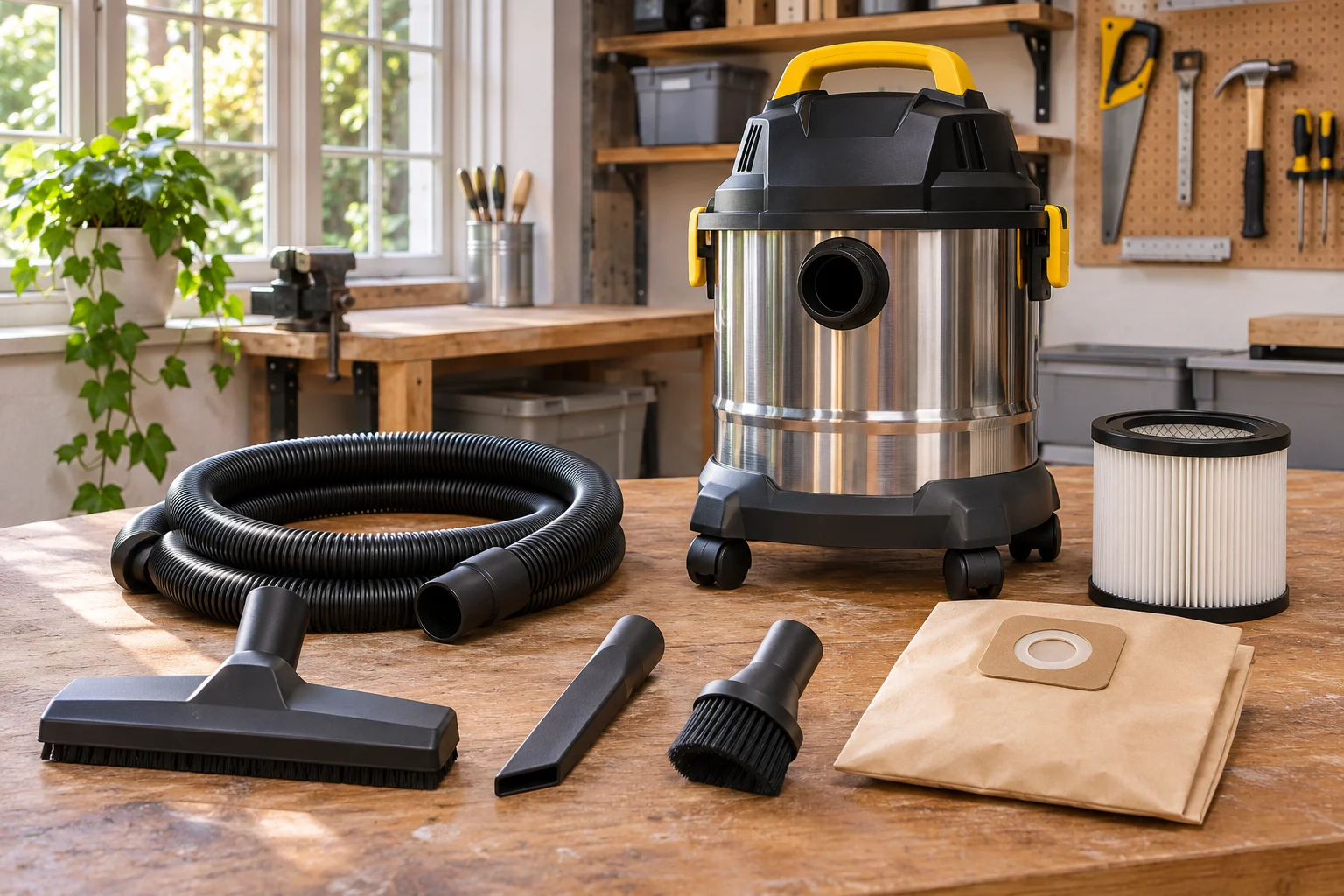
A crevice tool is useful beside skirting boards and between car seats; a wider floor head makes a larger clear-up less fiddly. A soft brush can protect delicate surfaces where the manufacturer permits its use. Check whether a floor head is intended for wet pickup, dry debris or both, and whether the supplied head already changes between modes. Keep extensions and hose length practical: extra reach can help, but a kinked or poorly fitting hose can make the vacuum frustrating to use.
If a tool is missing, buy for the job you do rather than the biggest accessory set. Nilfisk lists a wet/dry nozzle as an optional Buddy II accessory in its manual, while Bosch describes a range of nozzles and on-board storage across its Home & Garden wet/dry range. Neither statement means the same attachment fits every model.
Check power-tool adaptors separately
An adaptor needs to match both the tool’s dust port and the vacuum hose. Bosch describes a universal adaptor for connecting its Home & Garden tools to compatible Bosch vacuums, but “universal” here is a product name, not a guarantee for every brand and port. Check the actual connection and the tool and vacuum instructions before buying. A power-tool socket may start the vacuum automatically, but it says nothing by itself about whether the machine has the right dust classification for the material you are cutting or sanding.
A small, useful kit beats a drawer of spare parts
For ordinary permitted household and DIY clean-up, start with the correct replacement bags and filter for your model, then add a crevice tool or brush only if the included tools leave a gap. Keep the part numbers with the manual so replacements are easier to find. If you are still choosing a machine, check its supplied attachments in our buying guide and compare the main wet and dry vacuum picks before paying for extras.
Frequently asked questions
Are wet and dry vacuum bags interchangeable?
Not necessarily. Match the bag to the exact vacuum model and manufacturer part number so it fits and seals at the inlet.
Do I need a different filter for wet pickup?
It depends on the machine. Some models keep the same filter in place; others require a wet filter or a different setup. Remove a dry collection bag for liquids unless the manual says otherwise.
Will a universal power-tool adaptor fit every tool?
No. Check both the tool port and vacuum-hose connection against the adaptor’s stated compatibility, even when its name says “universal”.
Does a HEPA filter make my vacuum safe for construction dust?
No. The complete extraction setup must be suitable for the material and task. HSE guidance calls for correctly selected M- or H-class units for many on-tool construction-dust jobs.