
Best Heated Clothes Airers UK: 6 Practical Picks

Share
X
Copy Link

A heated clothes airer can make indoor laundry more manageable when outdoor drying is unreliable. Gentle heat through the rails helps items dry more consistently than on an unheated rack, while a fitted cover retains warmth around the load. A complete warm-air pod instead circulates heated air around hanging garments.
It is not a tumble dryer, and results depend on spacing, fabric weight, room temperature and ventilation. Choose around the unfolded footprint, usable rail space and the amount of washing you normally dry—not the largest-looking frame.
Our top pick
Dry:Soon Standard 3-Tier
The linked model is the Standard, not the Deluxe as previously labelled. Its 21m of rails make it the broadest choice for mixed laundry if its footprint fits. Choose the Mini for less floor space, BLACK+DECKER for a supplied cover or the complete pod for hanging garments.
Best Heated Clothes Airers UK at a glance
| Product / best use | Open / folded size | Space / load | Power / cover |
|---|---|---|---|
|
Dry:Soon Standard 3-Tier Best overall rail space |
H137 × W73 × D75cm Folded: 8cm deep |
21m / 15kg | 300W / No; separate cover |
|
Dry:Soon Mini 3-Tier Best compact tower |
H113.5 × W60 × D63cm Folded: 8cm deep |
13m / 15kg | 198W / No; separate cover |
|
BLACK+DECKER 63091 3-Tier Best covered tower |
H140 × W73 × D68cm Folded: Flat; full size not confirmed |
21m / 15kg | 300W / Yes |
|
PIFCO 3-Tier 36-Bar Best stated load limit |
H148 × W70.5 × D73cm Folded: Not confirmed |
Not confirmed / 30kg | 300W / Not confirmed |
|
Minky SureDRI 12m Winged Best winged layout |
Not confirmed Folded: Not confirmed |
12m / 16kg | Not confirmed / No |
|
Dry:Soon Heated Drying Pod Best for hanging clothes |
Approx. H146 × W62 × D62cm Folded: Not confirmed |
12 hangers; rail metres N/A / 10kg | 1000W / Yes |
On a phone, swipe the table sideways. Drying metres and load limits measure different things; “not confirmed” means we could not verify the figure for this exact offer.
What matters most
Choose by your usual laundry and the open footprint: compact tower, covered family rack, wider winged rack or hanger-based warm-air pod. Kilogram ratings are maximum loads, not a promise of fast drying. We compared current UK listings and manufacturer or retailer specifications; we have not tested these products hands-on.
Best overall rail space
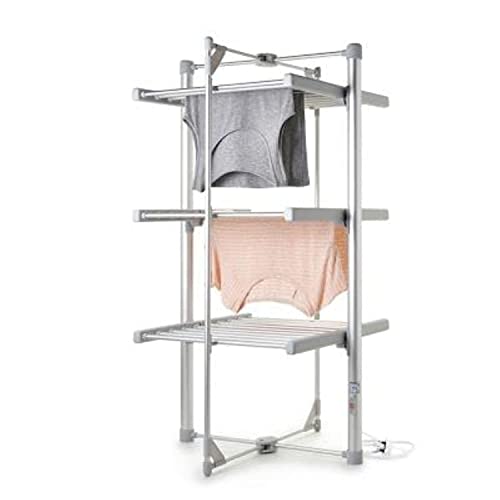
1. Dry:Soon Standard 3-Tier
Lakeland’s Standard model, not the Deluxe, is the exact linked airer. Its 21m of heated rails and folding shelves suit regular mixed family loads.
Practical check: Choose Standard-specific accessories; do not assume Deluxe covers fit.
Choose it ifYou want generous rails and can spare a 73 × 75cm footprint.
Main compromiseNo built-in timer or cover in this exact listing.

Best compact tower
2. Dry:Soon Mini 3-Tier
The Mini keeps three-tier drying in a 60 × 63cm footprint. Its stated 15kg load limit matches the Standard, but 13m of rails leave less space between bulky garments.
Practical check: Check height under cupboards and buy a Mini-specific cover if needed.
Choose it ifYour normal loads are modest and floor space is tight.
Main compromiseEight metres less rail length than the Standard.
Best covered tower
3. BLACK+DECKER 63091 3-Tier
This exact 63091 offer includes a fitted cover and wheels, making it a one-box option for a household that wants covered three-tier drying.
Practical check: Confirm the selected variation still includes cover and wheels; bundles vary.
Choose it ifYou want the cover supplied with the rack.
Main compromiseThe 73 × 68cm footprint still needs loading and ventilation clearance.

Best stated load limit
4. PIFCO 3-Tier 36-Bar
The exact offer states 36 heated bars and a 30kg maximum. This is a reason to consider it for heavier mixed loads, though a weight limit does not guarantee enough air gaps.
Practical check: Do not assume another PIFCO bundle’s cover or folded size applies to this model.
Choose it ifYour priority is the higher stated load limit.
Main compromiseRail metres and cover inclusion are not confirmed for this offer.

Best winged layout
5. Minky SureDRI 12m Winged
This is a complete electrically heated winged rack, unlike the SureDRI Heat Pod accessory. The wide, lower layout suits garments you prefer to spread over rails.
Practical check: Do not transfer dimensions from Argos’s different cover-inclusive Minky pack.
Choose it ifYou have floor width for open wings.
Main compromiseThe Amazon offer explicitly excludes a cover; open dimensions are unconfirmed.

Best for hanging clothes
6. Dry:Soon Heated Drying Pod
This is a complete drying system with stand, hanger rail, fan and enclosure—not an accessory needing an existing airer. It suits shirts and dresses rather than towels across rails.
Practical check: Allow hanging height and keep the fan intake unobstructed.
Choose it ifYou mainly dry garments on hangers.
Main compromiseIts 1000W instantaneous draw is higher than the rail racks here.

How heated clothes airers work
Most rail-style models warm the metal bars rather than blowing hot air through the load. Items touching the rails receive the most direct heat, so repositioning thick garments can help them dry evenly. A fitted cover retains warmth around a rack; a complete warm-air pod uses a fan and hanger rail. Both still need sensible loading and supervision.
Expect drying time to vary. A lightly loaded rack of spun synthetics behaves very differently from tightly packed towels or denim. Use the washing machine's appropriate spin cycle first and leave air gaps instead of treating every centimetre of rail as usable capacity.
Tiered, winged or pod-style?
Three-tier racks use height efficiently and suit smaller footprints, although long garments may need one side left clear. Winged racks are easy to load with flat items but occupy more floor width. Pods enclose hanging clothes and can be useful for shirts, but storage and garment length need consideration.
Think about what you actually wash. Families drying school uniform and mixed small items may value many rails; households drying shirts may prefer hangers; bedding is often awkward on any compact heated rack and may be better spread across a larger conventional airer.
Measure the open footprint
Product photographs rarely show how much circulation space an open airer consumes. Mark the width and depth on the floor, then include space to walk past, open appliance doors and reach cupboards. Also check the height beneath wall units or sloping ceilings.
Review the folded dimensions and storage route too. A narrow folded frame is only useful if it fits through the intended gap and can be carried there safely. Covers, clips and pods also need a dry storage place between uses.
Drying laundry without creating damp
Water removed from clothes enters the room air unless it is extracted or collected. A heated airer can speed evaporation, but it does not remove that moisture from the home. Use adequate ventilation or a suitably sized dehumidifier and avoid drying in an unventilated bedroom.
Watch for persistent condensation on windows, musty smells or damp surfaces. These suggest the room needs better moisture management. Our guide to the best dehumidifiers for drying laundry explains compressor and desiccant options for different room temperatures.
Running costs and safe use
Power ratings differ, and cost depends on wattage, run time and your electricity tariff. Calculate an estimate from the current product rating rather than relying on old pence-per-hour claims. A low-powered rack left on for a long time can still use meaningful energy.
Place the airer on a stable dry surface, keep the cable where it cannot be tripped over and follow the manufacturer’s rules for covers, loading and supervision. Do not use damaged cables, external timers or improvised covers unless the instructions explicitly permit them.
Loading a heated airer effectively
Start with the slowest-drying pieces near the warmest rails and give cuffs, waistbands and pockets room to breathe. Avoid folding thick items into several wet layers. Rotate laundry if one side remains damp, and remove dry pieces to improve airflow for the rest.
Do not assume a stated kilogram capacity describes comfortable real-world drying space. Wet weight, garment shape and rail spacing matter. A smaller, loosely arranged load will often dry more predictably than an overloaded rack.
What a heated airer will not do
A heated rack does not extract moisture, press clothes or reproduce the fast tumbling action of a dryer. Thick seams, pockets and folded areas may remain damp after lighter fabric feels dry. Check garments before putting them away; storing slightly damp laundry encourages odour and mildew.
It is also not a room heater. Some warmth reaches the surrounding air, especially under a cover, but the appliance should be chosen and operated as laundry equipment. Deal separately with an unusually cold, poorly ventilated or damp utility room.
Using an airer in a small utility room
Plan a temporary drying zone rather than permanently sacrificing the route through the room. The rack should not block the washing-machine door, sink, boiler access, consumer unit or escape route. If it must move between loads, check its weight and whether castors or folding sections lock securely.
Wall cupboards above a rack can restrict loading and trap humid air. Leave the clearances required by the instructions and protect joinery from persistent condensation. A humidity monitor can help reveal whether ventilation or dehumidification needs attention, although inexpensive readings are only indicative.
Planning a practical utility room
Drying and ironing equipment works best when the room layout supports it. Our utility room ideas guide covers appliance positions, storage, worktops, ventilation and compact layouts. Measure the product in both working and stored positions before ordering.
Frequently asked questions
Are heated clothes airers cheaper to run than tumble dryers?
They commonly use less power at any one time, but they also run for longer. Compare each appliance's wattage, expected run time and your tariff rather than relying on a universal cost claim.
Do heated clothes airers cause condensation?
They release moisture from laundry into the room. Ventilate appropriately or use a dehumidifier, and respond to persistent condensation or damp.
Is a cover worth buying for a heated airer?
A purpose-made compatible cover can retain warmth around the load. Never improvise a cover if the manufacturer does not allow it.
Can you leave a heated airer on overnight?
Follow the product instructions and safety warnings. We would not assume any electrical drying appliance is suitable for unattended use.
How long does laundry take to dry on a heated airer?
It varies with fabric, spin speed, loading, room temperature, airflow and whether a compatible cover is used.
What size heated airer should I buy?
Measure the open and folded dimensions, then choose enough usable rail space for your normal load without blocking circulation or appliance doors.
Our verdict
Dry:Soon Standard 3-Tier is our most broadly useful rail-based choice in this shortlist. The alternatives solve different capacity, space and budget needs, so use the comparison to narrow the field and verify the exact Amazon variant before ordering.
For layout and storage inspiration, return to our utility room ideas guide.
As an Amazon Associate I earn from qualifying purchases.
Published: September 17, 2026

 Sign up with Facebook
 Sign up with Google
