

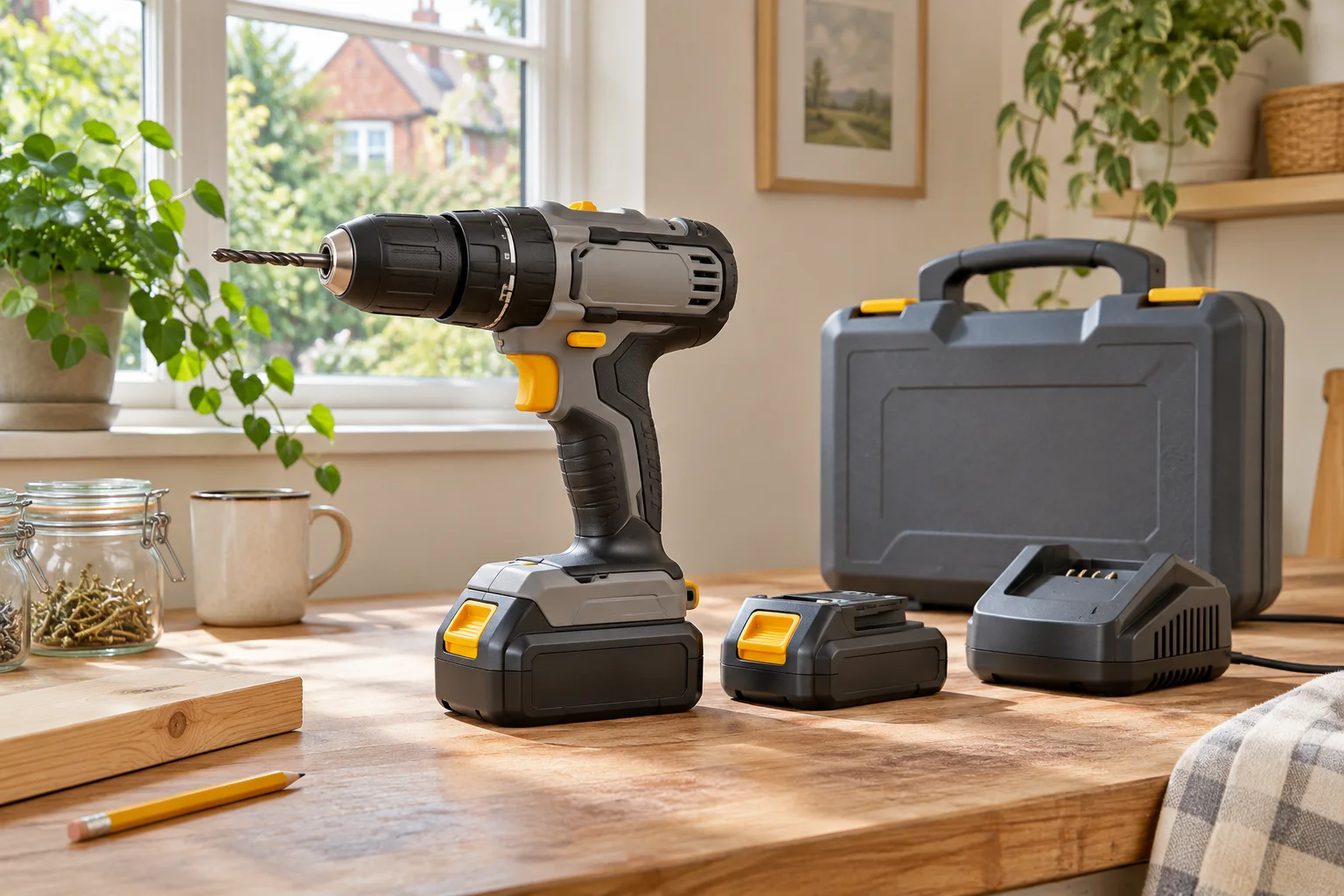
A cordless drill is useful for all sorts of jobs around the home, from assembling furniture to putting up shelves. With so many models and kits to choose from, it helps to know which features will make those jobs easier.
Our cordless drill buying guide explains what to look for, including drill types, battery options and what comes in the box. We’ll help you choose a drill that feels comfortable to use and comes with what you need to get started.
Choose the drill for the work
| Tool | Good for | Where it stops |
|---|---|---|
| Drill driver | Furniture, timber, metal and driving screws. | No hammer setting for brick. |
| Combi drill | The same jobs, plus occasional small holes in ordinary brick with a masonry bit. | Not the tool for repeated large holes in hard masonry. |
| SDS rotary hammer | Repeated holes in hard masonry or concrete. | Heavier and less convenient for everyday screwdriving. |
On a phone, swipe the table sideways to see every column.
A combi drill's hammer setting adds a small tapping action as the bit turns. Use it for suitable masonry, not for timber or metal. If you're installing several heavy wall fixings in concrete, check the material and use an appropriate rotary hammer and fixing rather than forcing a combi drill through the job. Electrical Safety First explains the different drill types.
Check the whole kit, not just the drill
A “bare tool” normally comes without a battery or charger. That's useful if you already own compatible batteries, but it isn't a ready-to-use first drill. For a new toolkit, check the exact package for a battery, charger and case. Two batteries are convenient on a longer job because one can charge while you're using the other; one may be plenty for short household tasks.
Battery capacity is shown in amp-hours, often written Ah. A larger battery can usually run longer between charges, but it also adds weight to the tool. Compare the batteries supplied with the exact kit rather than assuming that two drills with the same voltage will feel or last the same. Bosch's cordless-drill guide explains battery capacity and typical applications.
Think about the tools you might buy later
Many cordless ranges let you share batteries across compatible tools. If you already have a battery and charger, staying in that range can save buying them again. Check the named platform, though: two batteries from the same brand aren't automatically interchangeable. If you're starting from scratch, choose the drill that suits your jobs first, then consider whether its range includes tools you might genuinely use.
Handling matters more than a headline torque figure
Torque is turning force. More can help with demanding screws or larger holes, but the maximum figure alone doesn't tell you how controlled a drill feels. Look for a comfortable grip, a trigger you can use gently, two speed ranges and a clutch with adjustable settings. The clutch helps stop a screw before you drive it too far into soft timber or damage a fixing.
Think about where you'll work as well. A compact drill is easier to hold inside a cupboard or above your head; a heavier kit may make sense for longer, tougher work. A 13mm chuck accepts a wider range of ordinary round-shank bits than a 10mm chuck, but only if you need those larger bits. For the motor choice, see our brushless versus brushed drill guide.
Match the bit and fixing to the material
A wood bit has a point that helps start the hole accurately. Metal bits are designed to cut metal. Masonry bits are made for brick or similar materials, with the correct drill mode. Plasterboard needs a fixing selected for its construction and the weight being held, not a standard plug chosen only because it fits the hole. Our drill accessories guide explains a sensible starter set. Bosch explains bit types for common materials.
Before drilling into a wall
Check what may be hidden behind the surface, including cables and pipes. A suitable detector can help, but don't assume a clear reading proves the wall is safe. Avoid drilling close to likely cable runs from switches and sockets; if you're uncertain, stop and get competent advice. Secure loose workpieces and wear eye protection. Electrical Safety First's DIY guidance covers hidden cables and safer preparation.
How we put this guide together
We focused on the decisions that change everyday use: the material you need to drill, the kit contents, handling and battery compatibility. The technical and safety guidance here comes from manufacturer information and Electrical Safety First, not hands-on testing of every drill. For six complete kits with their differences explained, see our best cordless drills comparison.
Frequently asked questions
Is a combi drill a good first cordless drill?
Yes, if you want one tool for screws, wood, metal and occasional small holes in ordinary brick. If you won't drill masonry, a simpler drill driver may suit you just as well.
Do I need two batteries?
Not necessarily. Two make longer jobs easier because one can charge while the other is in use. For occasional short tasks, one battery can be enough if the kit includes a suitable charger.
What does “bare tool” mean?
It means the drill is supplied without a battery or charger. Check the exact package before ordering, especially if it will be your first cordless tool.
Can I use a combi drill in concrete?
A combi drill may handle some small holes in suitable masonry, but hard concrete and repeated larger holes are better approached with an appropriate SDS rotary hammer. Check the material, bit and fixing before starting.
Which drill should you choose?
For a first home toolkit, start with the work you'll do most often and buy a complete kit that fits it. A combi drill is versatile, but comfortable handling and compatible batteries matter more than buying the highest specification you can find.



 Sign up with Facebook
 Sign up with Google
