

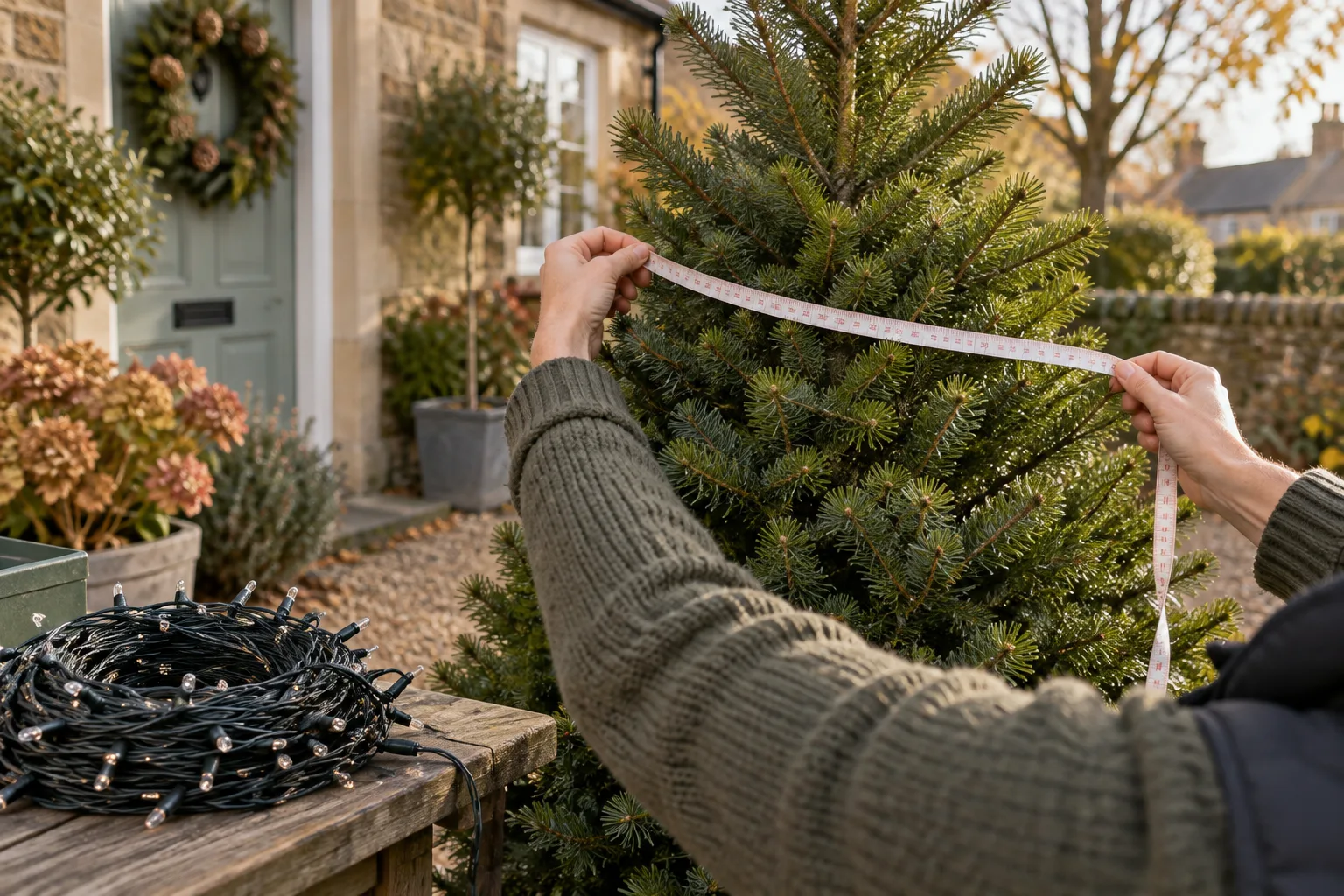
Not sure how many metres of Christmas lights you need for your garden? It depends on what you’re decorating and how you’d like it to look. Winding lights around a tree will use more cable than running a single string along a fence.
Start by measuring the route you want the lights to follow, then check the set’s lit length—the section with bulbs. You’ll also need enough lead length, the cable between the first bulb and the plug or solar panel, to reach your power source. Our outdoor lights for trees and hedges include both measurements to help you choose.
For an outdoor tree: follow the route you want to light
Take a piece of garden string and wind it loosely around the tree in the pattern you would use for the lights. Start near the bottom and work upwards, leaving space between turns. Measure the string after taking it off. This includes the smaller circles near the top and is more useful than multiplying the tree’s height by a generic number.
If you want lights tucked back among branches rather than only around the outline, follow that inward route with your string too. Do not pull it tight: you need slack to move around a branch without straining a wire. A second person can help hold the line while you measure a taller tree. Do not climb or use a ladder beyond your competence just to dress a high branch.
For a hedge: decide between a net and a string
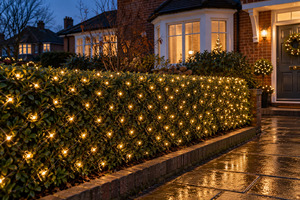
For a net, measure the width and the visible height of the hedge face. A 3m by 2m net covers a different shape from a 6m by 4m net, even if both have plenty of LEDs. Do not assume you can gather a very deep net into a neat narrow strip. On an irregular hedge, a string may let you trace the top and front more naturally.
For a string, run the garden string along the exact horizontal or zigzag route you want to light, then measure it. If you are wrapping around a three-dimensional shrub, include the back only if it will actually be seen. This can save cable and make the effect more even from the viewpoint that matters.
For a door, fence or roof edge: trace the full line
Measure each straight run and turn: across the top of a doorway, down both sides, or along the fence and around the corner. Add those lengths before choosing a set. Icicle and curtain lights have two dimensions, so check both the horizontal lit run and the drop. A 10m horizontal run with short drops is not interchangeable with a wide curtain that hangs much lower.
Now measure back to the power source
From the first planned bulb, follow a safe route to the socket or solar panel. Go around doors, steps and paths rather than measuring a straight line through them. Check whether the retailer’s stated lead reaches that route on its own. If it does not, choose a different set or position; do not assume an ordinary indoor extension lead is suitable outdoors.
For mains lights, the plug and transformer need a location allowed by the exact instructions, and outdoor equipment needs RCD protection. Electrical Safety First says to use only lights designed for outdoor use and to check the wiring for damage. Our outdoor-light safety guide covers those checks in more detail.
Choosing the size when you are between two sets
If the measured lit route is close to the end of one set, moving up to the next available lit length gives you room to shape the display. Check where any unused illuminated section will go: it should not be pinched in a door or tightly bundled against dry foliage. Avoid joining two unrelated sets merely to gain another metre; only connect compatible sets when the maker permits it and states a safe limit.
Product pages can use “length” for the lit section, the lead or the overall cable. Read the measurements on the exact colour and LED-count variant rather than relying on the product family’s headline image. Keep a note of your route measurement for next year.
Frequently asked questions
How many metres of lights do I need for an outdoor tree?
Wind a piece of garden string loosely along the route you want the lights to follow, then measure it. Add the separate distance from the first bulb to the power source; do not count lead length as illuminated length.
How much extra light length should I allow?
If your measurement sits between two available lit lengths, the longer set gives room to shape the display without pulling the cable tight. Check where surplus lit cable can sit safely and do not bury it in a tight coil.
Can a net cover an uneven hedge?
A net is easiest on a fairly regular face. Measure its visible width and height; an irregular or tapering hedge may be easier to light with a flexible string.
Does a 10m light set include the lead to the plug?
It depends on the product. Some listings give 10m of illuminated string plus a separate lead; others give an overall length. Check both measurements on the exact variant before buying.
Measure once, then choose
Use a piece of string to trace the lights themselves, measure the separate route to the power source, and compare both figures with the exact set. That small bit of planning is easier than discovering the plug is just out of reach after the lights are already in the tree.
 Sign up with Facebook
 Sign up with Google
