
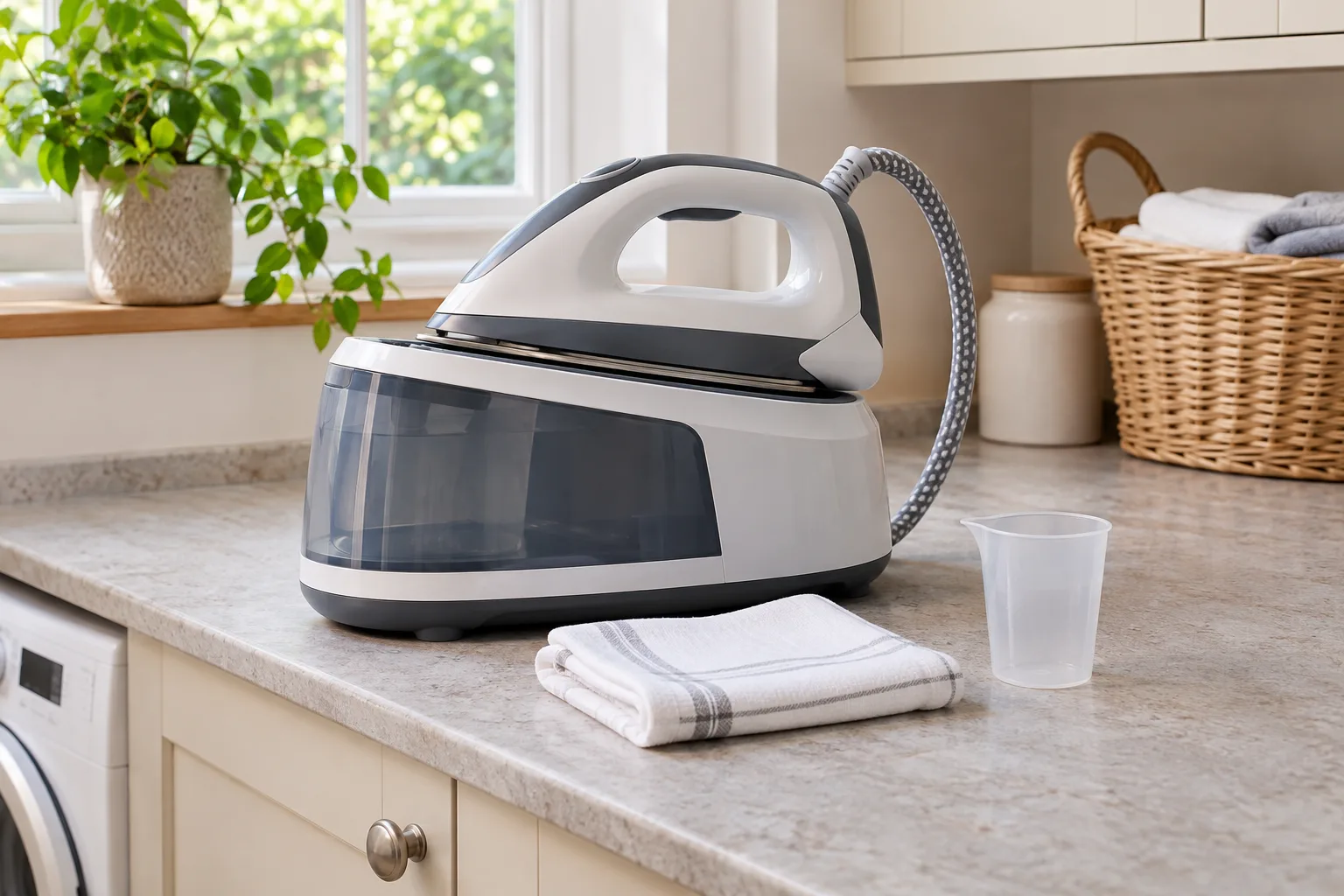
It’s frustrating to find a mark on a shirt you’ve just ironed. If your steam generator iron is leaving marks or the descale light has come on, start with the manual for your model. Some irons have a limescale collector you can rinse, while others have a cleaning cycle.
Here’s how to clean and maintain a steam generator iron, from wiping the soleplate (the part that touches your clothes) to looking after the water tank and knowing what to do when it’s time to descale. If you’re shopping for a replacement, see our guide to the best steam generator irons or our picks for hard-water areas.
First, identify how your model removes scale
Look for the full model number on the base and search the manufacturer’s manual or support page. A marketing phrase such as “anti-calc” does not tell you whether to remove a collector, open a drain or run a hot cleaning cycle. Even one brand can use several systems: Philips separates Easy De-Calc and Smart Calc Clean by model series.
| What your model has | What the care task generally involves | Check in its manual |
|---|---|---|
| Removable scale collector | Take out the collector and clear its collected scale after the unit has cooled. | How long to cool, how to remove and rinse it, and how to refit it securely. |
| Drain or Easy De-Calc knob | Drain water and scale from the base into a suitable container. | Cooling time, where to position the base and how to close the drain. |
| Prompted Calc Clean cycle | Run the model’s automatic cycle using its supplied tray or container. | Water level, controls, heat-safe surface and when it is safe to move the tray. |
On a phone, swipe the table sideways to see all three columns. These are system types, not interchangeable instructions.
How to descale without guessing
For a removable collector or drain
Turn the iron off, unplug it and let it cool fully before opening anything connected to the boiler. Place it where you can safely catch the water and scale, then follow your model’s removal, rinsing and refitting steps. Do not unscrew a hot or pressurised opening. For example, Philips tells owners of its specified Easy De-Calc models to wait two hours after use; that timing is not a substitute for another model’s manual. Tefal lists a removable scale collector on the GV9230, but its instructions should govern how to clean that particular collector.
For a prompted cleaning cycle
Do not treat this as a cold drain procedure. Put the supplied tray on a stable, heat-resistant surface, keep children and pets clear, and run the exact sequence in your manual. Philips’ Smart Calc Clean instructions describe a powered cycle with a container; hot water and steam may be released. Other models can have different controls and water levels. Let everything cool before emptying or storing the tray.
Follow the reminder or interval for your own iron. If a light stays on, recheck whether its prescribed process completed; do not repeatedly run a different maker’s cleaning steps or pour in a chemical descaler to silence it.
Clean the soleplate, tank and outside
After ironing, switch off and unplug the appliance. Once the soleplate and base are cool, wipe the soleplate with a soft, damp cloth if the manual permits it. Avoid abrasive pads, sharp tools and cleaners the maker does not approve: a damaged soleplate can snag fabric. Wipe the outside of the base with a damp cloth, keeping water away from electrical openings.
For the water tank, use the manufacturer’s emptying and storage instructions. Some models ask you to empty unused water; others have different guidance. Never immerse the iron or base, and do not open a sealed boiler to “flush” it. Let the hose and cable cool before winding them loosely for storage.
What water should you put in the tank?
There is no safe one-rule-fits-all answer. Check the water section of your exact manual before using tap, filtered or demineralised water. As one clear example, Morphy Richards recommends deionised, distilled or demineralised water on its EasySteam 333030 product page for extra protection against limescale. Do not assume that recommendation applies to every generator. Do not put vinegar, fragrance, detergent or descaling chemicals in the tank unless the maker explicitly instructs you to do so.
If you have hard water, build the required cleaning task and any special-water cost into your buying decision. Our buying guide covers the maintenance trade-off alongside steam, tank size and storage.
If you see brown marks, flakes or weak steam
Stop using the iron on good clothes and consult the exact model’s troubleshooting page. A scale reminder or deposits may point to overdue cleaning, but marks can also come from residue on the soleplate or unsuitable water and additives. Carry out only the maker’s approved cleaning process, then test on an old cloth if the instructions recommend it.
If steam is still weak, water leaks, the appliance trips the electrics, or marks keep returning, stop and contact the manufacturer or an approved repair service. Do not dismantle the base or improvise a boiler rinse. A damaged cable, hose or plug is a reason to stop using the appliance.
An easy maintenance routine to keep
- Before each session: use the water type your manual allows and check that the tank and any collector or drain are secure.
- When prompted: complete your model’s scale-care process, using its tray or collector and the required cooling or heat precautions.
- After ironing: switch off, unplug, let it cool, and follow the maker’s tank-emptying and storage instructions.
- When performance changes: check the soleplate and the manufacturer’s troubleshooting advice before trying anything else.
A short routine is more useful than a universal “descale every month” rule. The right interval and method are the ones for your exact model.
Frequently asked questions
How often should I descale a steam generator iron?
Follow the reminder and the schedule in your exact model manual. Hard water can make scale build up faster, but there is no reliable interval for every steam generator.
Can I put vinegar or descaler in a steam generator iron?
Do not add either unless your exact model manual explicitly allows it. Some makers expressly prohibit vinegar and chemical descaler in the tank.
What water should I use in my steam generator iron?
Check the model instructions. Water guidance differs: Morphy Richards recommends plain deionised, distilled or demineralised water for the EasySteam 333030, while other manufacturers and models may specify something else.
Why is my iron still leaving brown marks after descaling?
Stop ironing good clothes and check the model’s troubleshooting advice. Deposits may remain in the steam path, but marks can have other causes. If the problem persists, contact the manufacturer rather than opening a sealed or pressurised base.