

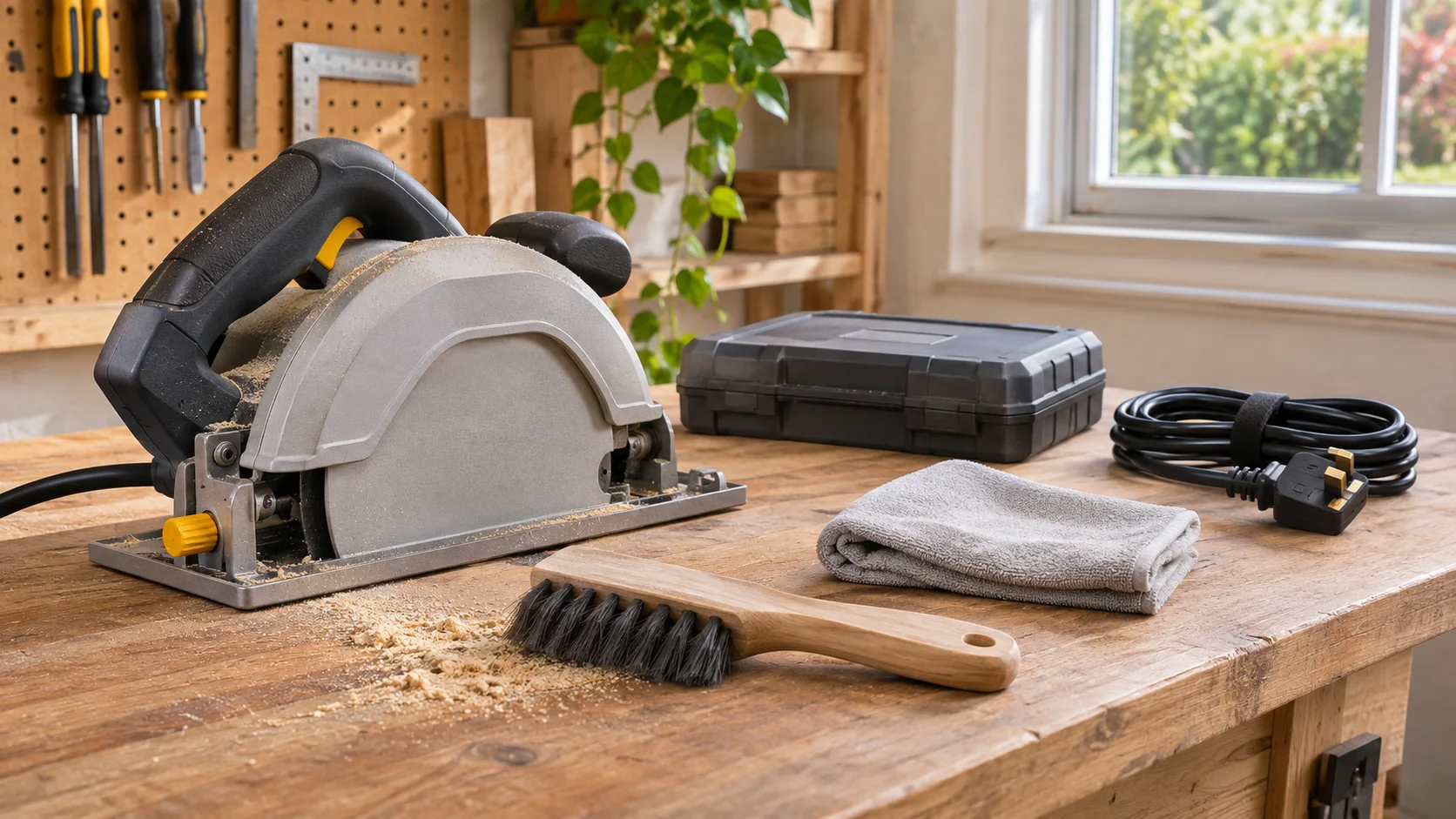
Once you’ve finished cutting timber for shelves or cupboards, sawdust often collects around the guard and vents. Putting the saw straight back in its case can leave that debris there until the next job.
This guide explains how to clean, check and store a circular saw without turning routine care into a repair job. Your saw’s manual takes priority for its exact blade, guard and battery procedures; the checks below help you notice what needs attention.
Make the saw safe before touching it
Release the trigger, wait until the blade has stopped completely, then unplug a corded saw or remove the battery from a cordless one. Let a hot blade cool. Keep the saw on a stable bench with the blade guarded and follow the isolation steps in its manual before cleaning or changing a blade.
Do not reach beneath the guard while the saw can be powered. A damaged lead, loose part or guard that does not close freely is a reason to stop using the tool and arrange the inspection or service described by its manufacturer. Makita’s circular saw manual calls for checking that the lower guard closes before every use.
Brush off dust without pushing it into the saw
Use a soft brush or a dry cloth on accessible surfaces: the base plate, outside of the guard, dust port and ventilation openings. Keep the motor housing dry and do not poke into it with a sharp tool. Bosch’s circular saw instructions say to keep the ventilation slots and the area around the retracting guard clean, removing chips with a paintbrush.
Check the dust-extraction adapter and hose for a blockage, following their own instructions. If you find a jam beneath the guard, use the maker’s procedure to expose and clear it only after disconnecting power; do not force the guard open or dismantle parts the manual does not tell you to remove. Avoid spraying liquid cleaner into the motor or guard mechanism.
Cleaning the saw after a job is different from controlling wood dust while cutting. For indoor cutting, HSE guidance for construction work recommends suitable on-tool extraction and, where needed, respiratory protection. That is useful guidance for planning DIY too; a domestic vacuum should not be assumed to provide equivalent fine-dust control.
Look over the blade and the cut quality
Check the unplugged saw’s blade for missing or damaged teeth, cracks and heavy resin or glue residue. Bosch notes that residue can affect cut quality and advises cleaning blades after use. Use only a cleaning method suitable for that blade, following its maker’s instructions. Protect your hands from the teeth and do not use a blade that is damaged.
A cut that suddenly needs more force or leaves a rough edge may point to a blunt, dirty or unsuitable blade. Do not simply push harder. Check the board, support and blade specification before replacing it. Our circular saw accessories guide explains the diameter, bore and material checks needed for a replacement.
Check the guard, base and controls
With the saw isolated, check that the lower guard moves freely and returns promptly under its own spring, as the manual describes. Inspect the base plate for damage, make sure the depth and bevel locks hold securely, and look for a damaged cord or plug on a corded saw. Do not defeat the guard or use the saw if it sticks; Makita’s manual says a faulty guard or spring must be serviced before use.
These are checks, not an invitation to adjust the motor, wiring or guard spring yourself. If something is bent, loose or not working normally, use a qualified or manufacturer-authorised repair route. Makita’s general tool-safety advice also recommends repairing damaged guards and keeping handles dry and free of oil and grease.
Put the saw away ready for the next project
Wipe accessible dust from the saw, let it dry if it has been in a damp work area, and store it in a dry place where children cannot reach it. Keep the blade protected and the cord loosely coiled, without a tight bend where it enters the tool. Put loose blades in their sleeves or cases rather than leaving exposed teeth in the box.
For cordless models, follow the battery and charger instructions for temperature, charge and storage time; those details vary by system. Ryobi’s UK support advice recommends a cool, dry place and avoiding extremes of temperature and humidity. Do not leave a battery in a damp shed or assume that a single charge level suits every brand.
A quick after-use checklist
- Wait for the blade to stop; unplug the saw or remove its battery.
- Brush accessible dust from the guard area, base, vent openings and dust port.
- Inspect the blade, lower guard, locks and any power lead for damage.
- Store the saw and spare blades dry, with the cutting edges protected.
- Check the exact manual before lubricating, dismantling or repairing anything.
If you are comparing a replacement tool rather than maintaining the one you own, our circular saw buying guide covers the cut depth, power and blade choices. The circular saw comparison shows six current models for different renovation jobs.
Frequently asked questions
Should I oil the lower guard?
Do not add oil or lubricant to the guard unless the manual for your exact saw tells you to. If it sticks, unplug the saw or remove its battery, clean accessible debris as instructed and have it serviced if it still does not return freely.
Can I use a household vacuum to clean sawdust from the saw?
Use a soft brush or the cleaning method in your saw manual for accessible dust. For dust produced while cutting, check the saw’s extraction port and use suitable equipment; an ordinary household vacuum is not automatically suitable for fine wood dust.
How do I know when to replace a circular saw blade?
Inspect the blade for damaged teeth, cracks and heavy resin build-up. If a clean, suitable blade still cuts poorly, follow its maker’s replacement guidance. Never run a damaged blade, and check the saw’s blade-size and speed requirements before fitting another.
Where should I store a cordless circular saw?
Store the saw dry, with its blade guarded and out of children’s reach. Remove the battery if the manual directs you to, and follow the battery maker’s temperature, charge and long-storage instructions rather than assuming every system needs the same routine.