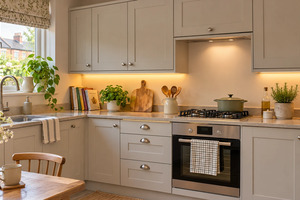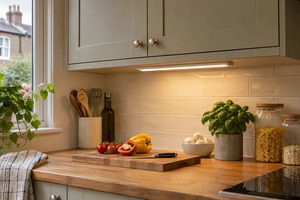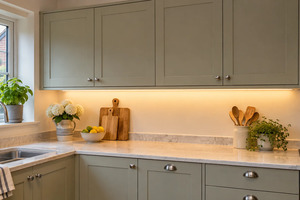

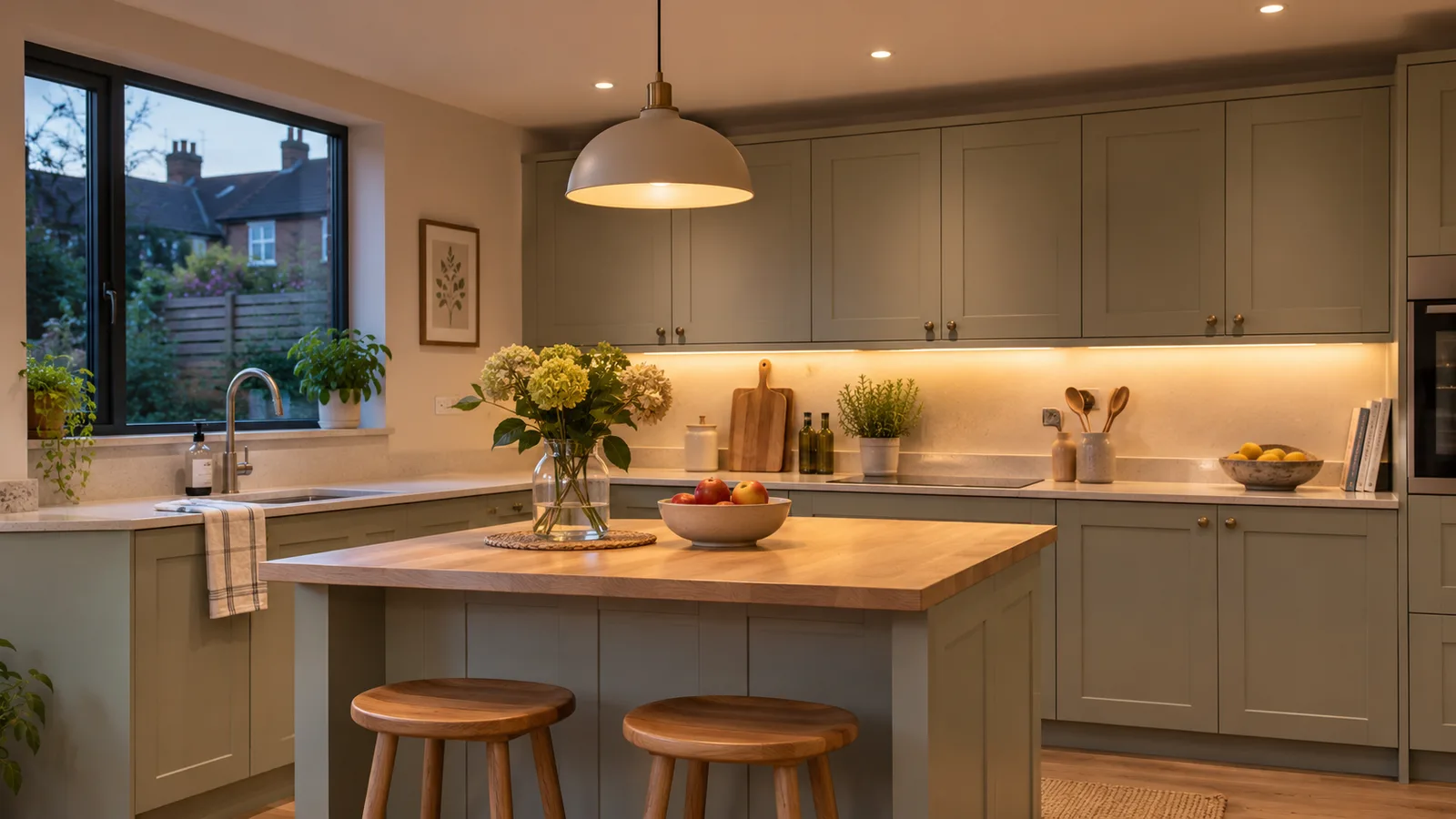
Under-cabinet lighting is practical when you’re preparing food, but it also helps set the mood once the cooking’s done. Whether you’re planning a new kitchen or updating your current one, choosing it alongside your pendants and ceiling lights can make the whole room feel more welcoming. Here’s how to coordinate under-cabinet lighting with your kitchen, from finding a colour that suits your cabinets and worktops to choosing controls that let you adjust the lighting throughout the day.
Look at the room at the times you actually use it
Notice what happens on a weekday morning when you’re preparing breakfast, and again after dark when the kitchen is more of a place to sit. Under-cabinet lights have a practical job over the worktop, while a pendant, ceiling light or wall light can help the room feel comfortable. They don’t all need to be equally bright at once.
If the cabinets are still being planned, mark the work areas and the lights that will serve them on one drawing. Our guide to choosing under-cabinet lighting covers task lighting and softer background light in more detail. In an existing kitchen, simply try switching on different combinations before buying anything new; it’s a quick way to see where the room feels patchy or overlit.
Keep the white light in the same family
Two white lights can look quite different when they’re on together. Colour temperature is measured in kelvin (K): lower numbers look warmer, while higher numbers look cooler. If your pendants give off a soft warm light, a very cool strip under the cabinets may feel out of place in the evening. You don’t need identical numbers on every box, but it’s worth comparing the light in the room rather than choosing from a product photo alone. Philips Hue’s kitchen-lighting guide recommends keeping the colour temperature consistent for a cohesive feel.
Think about what you do at the counter too. A clearer white may suit a busy preparation area; a warmer setting can feel gentler when you’ve finished cooking. A colour-adjustable fitting gives you room to change your mind, but check whether it can be adjusted after installation or only before it’s fitted. Sensio’s under-cabinet lighting guide explains that distinction between fixed and adjustable white.
Let the worktop and splashback guide the look
A glossy splashback or polished stone worktop reflects a visible row of LED points more readily than a matt surface. If you can, hold a sample of the finish in the planned position and look at it with the lights on. A diffused strip can give a smoother line; separate spots create pools of light. Neither is automatically better, but the pattern should suit the room and cover the places where you chop, read recipes or wash up. Sensio compares the effect of strip and spot fittings.
The fittings themselves matter visually as well. A slim light tucked behind a cabinet lip can be almost invisible when it’s off; a surface-mounted bar may be noticeable from a nearby dining area. Check the view from the doorway and the seats you use most, not just from directly in front of the worktop. Our cabinet-by-cabinet sizing guide helps you map continuous runs and the gaps between them.
Plan how the lights work together
Separate controls are useful if you want the worktop brightly lit while cooking but only the pendants on during dinner. Dimming can make that change gentler, provided the light and its driver or control are compatible. If a compatible wall dimmer is part of the plan, our LED dimmer switch picks compare controls and finishes. Some smart systems can group different kitchen lights, but a simple wall switch or accessible plug can be just as practical. Check the exact product’s controls rather than assuming a light will remember a preferred setting.
If you’re planning hidden wiring, drivers or a shared switching arrangement, decide on the layout before cabinetry goes in and discuss the fixed electrical work with a qualified electrician. A plug-in or rechargeable addition can be simpler for an existing kitchen. Our mains-versus-rechargeable guide explains the trade-offs.
Test the combination before you commit
Put a sample light, or a temporary lamp at roughly the right position, in the kitchen after dark. Look at the worktop, the splashback and the room from where you eat. Check whether you can comfortably see what you’re doing and whether the cabinet light clashes with the rest of the room. It’s easier to adjust the plan now than after a long run has been attached.
For broader inspiration, our kitchen lighting scheme ideas look at the room as a whole. Once the arrangement feels right, our under-cabinet lighting picks show the practical differences between strips, bars and spots.
Frequently asked questions
Do all kitchen lights need the same colour temperature?
No. They don’t have to match exactly, but lights that are on together should look comfortable side by side. Compare them in the kitchen after dark if you can.
Can under-cabinet lights be warmer than the ceiling lights?
Yes. A warmer setting can suit a softer evening scene while brighter ceiling or worktop lighting serves preparation. Check that the work area is still well lit when you need it.
Will a glossy splashback show LED dots?
It may make individual points more noticeable. A diffused fitting or a different position can soften the effect; check a sample with the light on before buying a full run.
Do I need smart controls to coordinate the kitchen lights?
No. Separate switches or a dimmable fitting can be enough. If you choose smart controls, confirm that the light, driver and controls are compatible.