

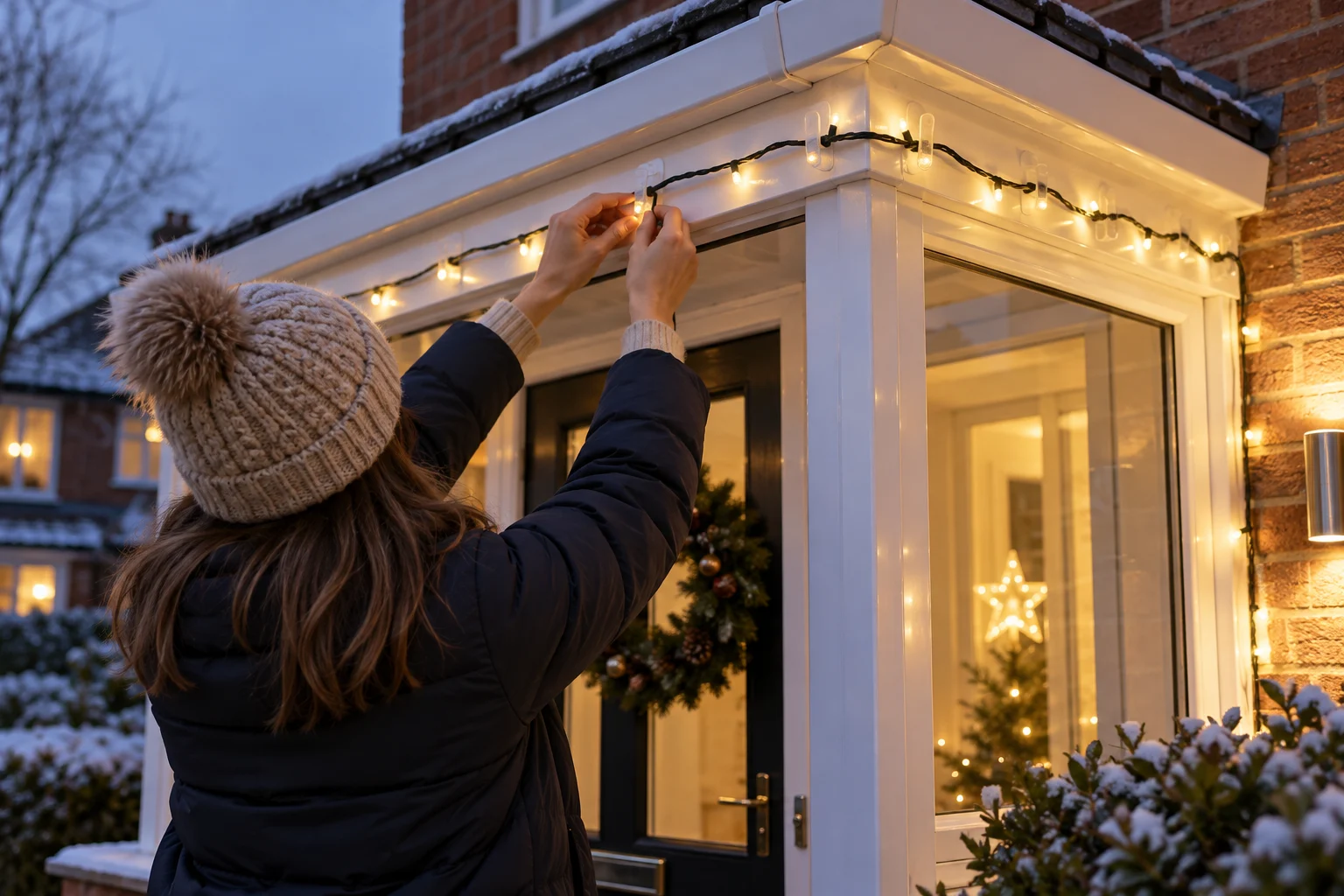
Putting up Christmas lights is a lovely way to make your home feel festive, but you don’t want to be left with holes or peeling paint when they come down. The right clips or hooks can help you hang them neatly without drilling into the house or damaging the cables.
We’ll look at ways to attach lights to gutters, porch frames, railings and fences, and what to check before using each way of securing them. If you’re still choosing your lights, our outdoor Christmas lights guide has plenty of options.
Start with the surface, not the clip
Look at where the lights would sit in daylight. Is the gutter securely attached? Is the frame smooth and sound, or is the paint flaking? Can a soft tie loop around a rail without pulling against a hinge? A clip or hook is only as dependable as the surface beneath it. If the gutter or trim is loose, repair it before adding anything.
For sound gutters: removable gutter hooks
Gutter hooks are shaped to sit on a compatible gutter lip, so they can support a light string without screws. Check the hook fits your gutter profile and follow its load and spacing instructions. Do not force clips onto brittle plastic, wedge them under roof tiles or block the gutter’s drainage. If you cannot reach the gutter safely, hang the lights lower down or get appropriate help.
For smooth frames: outdoor decorating clips
Adhesive clips can be useful on smooth uPVC, glass or sound painted trim when the specific product approves that surface. For example, 3M’s outdoor decorating clips are intended for smooth surfaces and explicitly exclude brick and unfinished wood. Follow the maker’s cleaning, temperature, spacing and removal instructions. Test a discreet spot first: “removable” is not a promise that weak paint or old finishes will come away untouched.
For rails and fences: soft ties or suitable hooks
A reusable soft tie can loop around a sound metal rail or fence slat without making a hole. Fasten the tie around the supporting cable, not directly against an LED or plug connection, and leave the wire free of sharp bends. On a fence, check for splinters and rough edges that could rub against the insulation. Do not use staples, nails or screws through a light cable.
Plan the lead before fitting the first clip
Mark where the first bulb will sit, then follow the lead back to power. Keep it away from door edges, windows that close, steps and walking routes. Do not trap it under a door, stretch it tight around a corner or leave a connection lying in water. If the supplied lead cannot reach safely, move the lights or choose another set rather than improvising with unsuitable indoor equipment.
Only use lights marked for outdoor use and follow the instructions for every component, including plugs and transformers. Electrical Safety First advises a 30mA RCD-protected socket for lights plugged in outdoors and checking cables for damage. Our outdoor Christmas lights safety guide has a fuller pre-installation check.
Take them down with the same care
Switch off and unplug the lights before removing them. Release clips or ties as the maker directs rather than tugging the cable. Check for any damaged insulation as you coil the set loosely for storage. If an adhesive clip resists, follow its removal method; forcing it can pull away the finish you were trying to protect.
Frequently asked questions
Will outdoor adhesive clips damage paint?
No removable clip or hook is guaranteed damage-free. Use clips only on surfaces the maker lists, follow cleaning and temperature instructions, and test a small inconspicuous area first.
Can I put light clips on brick?
Do not assume adhesive clips will hold on brick. For example, 3M says its outdoor decorating clips are for smooth surfaces, not brick or unfinished wood. Look for a suitable existing rail or sound gutter instead.
Can I staple Christmas lights to a fence?
Do not put staples, nails or screws through the light cable. Use clips or hooks suitable for the surface to support the string without pinching its wires.
How do I run the lead through a door?
Do not trap or crush a cable in a closing door or window. Choose a set and power position that give you a safe route allowed by its instructions; ask a qualified electrician if a permanent supply is needed.

 Sign up with Facebook
 Sign up with Google
