

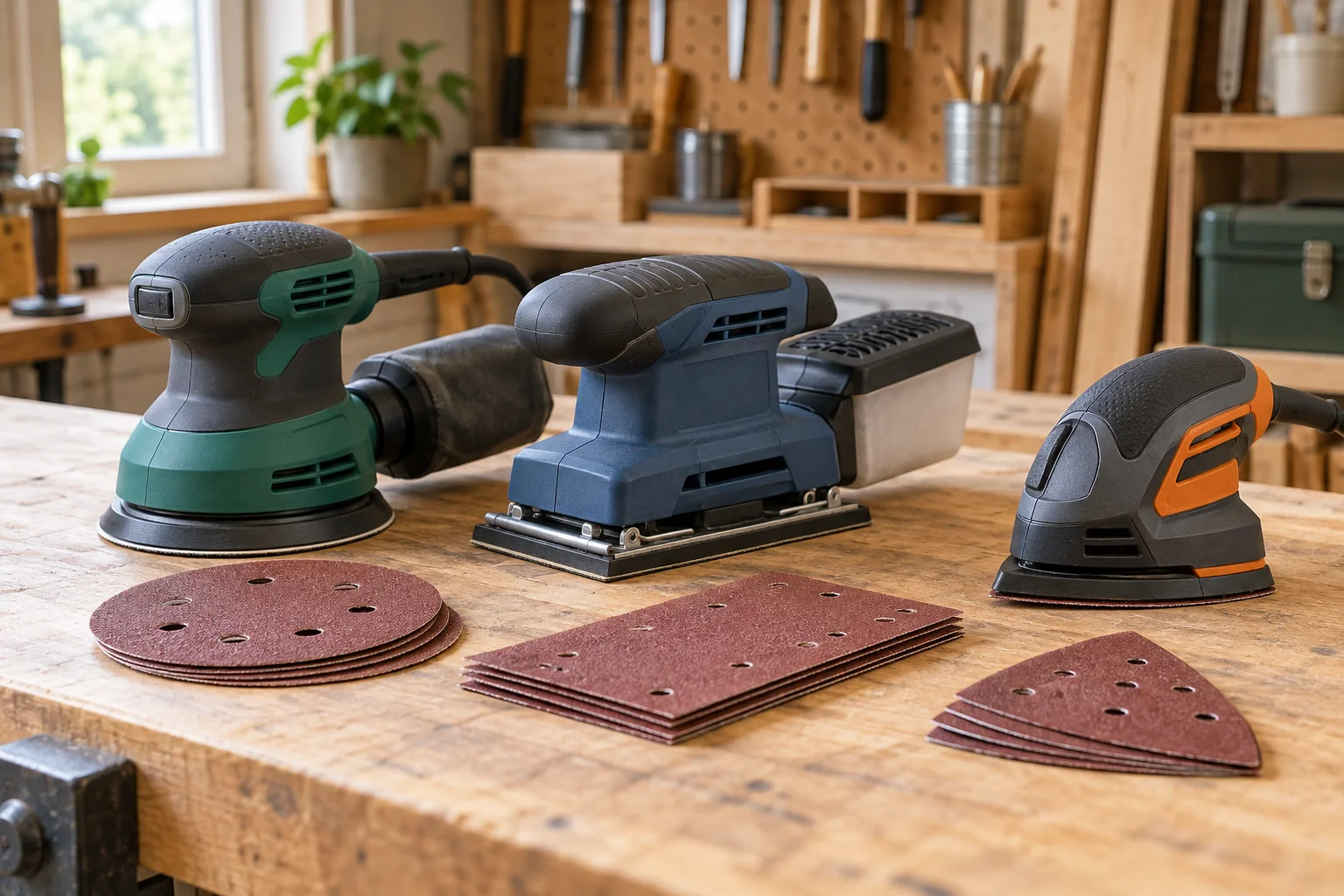
Whether you’re freshening up an old table or preparing doors for a new coat of paint, the right sander can make the job much easier. Some are better for large, flat surfaces, while others help you get into corners and around smaller details.
We’ll explain the differences between random orbital, sheet and detail sanders, with examples of where each comes in handy. That way, you can choose one for the jobs you’ve got planned and work out whether you’ll need more than one.
The three pad shapes at a glance
| Type | Where it helps | Where it struggles |
|---|---|---|
| Random orbital: round pad | Open timber, furniture tops, door panels and gentle curves | Square corners and narrow recessed details |
| Sheet orbital: rectangular pad | Flat panels, straight edges and finish preparation | Curves, tiny areas and deep corners |
| Detail or multi-sander: triangular tip | Inside corners, mouldings and small awkward patches | Working quickly across a large flat surface |
On a phone, swipe across the table.
Random orbital: the versatile round-pad choice
A random orbital sander makes two movements at once: its round disc spins while moving in small orbits. This helps break up a repeated sanding pattern. It can prepare a dining table top, the broad face of a door or a gently curved furniture side with one tool. The round pad also makes it relatively easy to find a range of hook-and-loop discs.
Keep the pad flat and move steadily without leaning hard on an edge. A round disc stops short of a square inside corner, so plan to finish that part separately. See our buying guide for choosing pad size, speed and dust extraction, or the six-sander comparison if you are ready to compare models.
Sheet orbital: a rectangular pad for flat work
A sheet sander has a rectangular base moving in small orbits. That shape suits flat panels and lets you work nearer a straight edge than a round disc. Some machines take pre-cut sheets; others clamp a section cut from a larger sheet. Check the exact pad size and paper attachment before assuming your existing abrasives will fit.
It is not the answer to every corner: the body and pad still need room, and forcing the edge into a recess can leave an uneven patch. For a large flat door, the choice between sheet and random orbital is often about the finish and handling you prefer, not a rule that one is always better.
Detail sander: a pointed tip for awkward places
The small triangular pad reaches into inside corners and around some mouldings where a round pad cannot. It is useful on a cabinet frame, window detail or a recessed door panel. The trade-off is pace: covering a whole tabletop with that small tip would take much longer and could make it harder to keep the finish even.
Some multi-sanders swap between triangular and rectangular plates. Confirm which plates and abrasives come with the exact kit before buying; a picture of several attachments does not mean every version includes them.
Which would we use for common jobs?
A chest of drawers or painted cabinet
Use a round pad on the open drawer fronts and top if the coating is safe to sand. Finish inside corners, profiled edges and delicate areas by hand or with a detail tool. Take extra care with veneer: it may be thin enough to sand through. Our furniture-sander picks compare the handling differences between six round-pad models.
A flat interior door
Either a random orbital or sheet sander can prepare broad flat areas. The rectangular sheet pad can work close to long straight edges; the round pad can move easily across open panels. Recessed corners and mouldings are separate jobs. Keep the cable and extractor hose clear of the door and work area.
Chairs, spindles and curved rails
A broad powered pad may be too awkward for narrow rails or turned details. Hand sanding with a suitable abrasive is often more controlled; use a small detail tool only where its pad genuinely fits the shape.
Dust and old finishes need the same care whichever tool you choose
All three types produce fine dust. HSE’s wood-dust advice recommends dust extraction and respiratory protection for dusty sanding work. A fitted dust bag helps but is not a substitute for checking the right controls for the material and scale of the job.
Do not dry-sand an older coating until you know it is safe to disturb. HSE specifically identifies dry-sanding old paint as a lead-exposure risk. Pause and check the finish, rather than assuming a new sander or an extractor makes an unknown coating safe.
Frequently asked questions
Is an orbital sander the same as a random orbital sander?
No. A sheet orbital sander usually moves a rectangular sheet in small orbits. A random orbital sander also spins its round disc, giving it a different sanding action. Names vary between retailers, so check the pad shape and tool specification.
Which sander is best for furniture?
A random orbital sander is a useful choice for open tabletops, drawer fronts and gentle curves. A detail sander or hand sanding is often needed for tight corners, carvings and rails. Check the coating before sanding an older piece.
Can a random orbital sander get into corners?
Its round disc cannot reach into a square inside corner. Use a suitable detail sander or sand the corner by hand, taking care not to damage neighbouring edges.
Should I use a sheet sander or random orbital sander on a door?
For broad, flat panels, either can work. A sheet sander has a rectangular pad that can work nearer straight edges; a random orbital sander is versatile on open panels and gentle curves. Recessed corners still need a smaller tool or hand sanding.
Will one sander do every job?
Usually not. One manageable random orbital sander covers many open surfaces, but corners and shaped details often need another method. It is better to finish those areas by hand than force a round pad into them.
Is sanding dust a concern with all three types?
Yes. All can make fine dust. Use suitable extraction and protection for the material, and check older coatings before disturbing them. A small dust bag does not capture everything.
Our recommendation
If your projects are mostly open furniture and door panels, begin with a manageable random orbital sander and plan a separate way to finish corners. Choose a sheet sander when broad flat work and straight edges dominate. A detail sander earns its place when awkward recesses are a regular part of the job, not as a replacement for the larger pad.



 Sign up with Facebook
 Sign up with Google
