

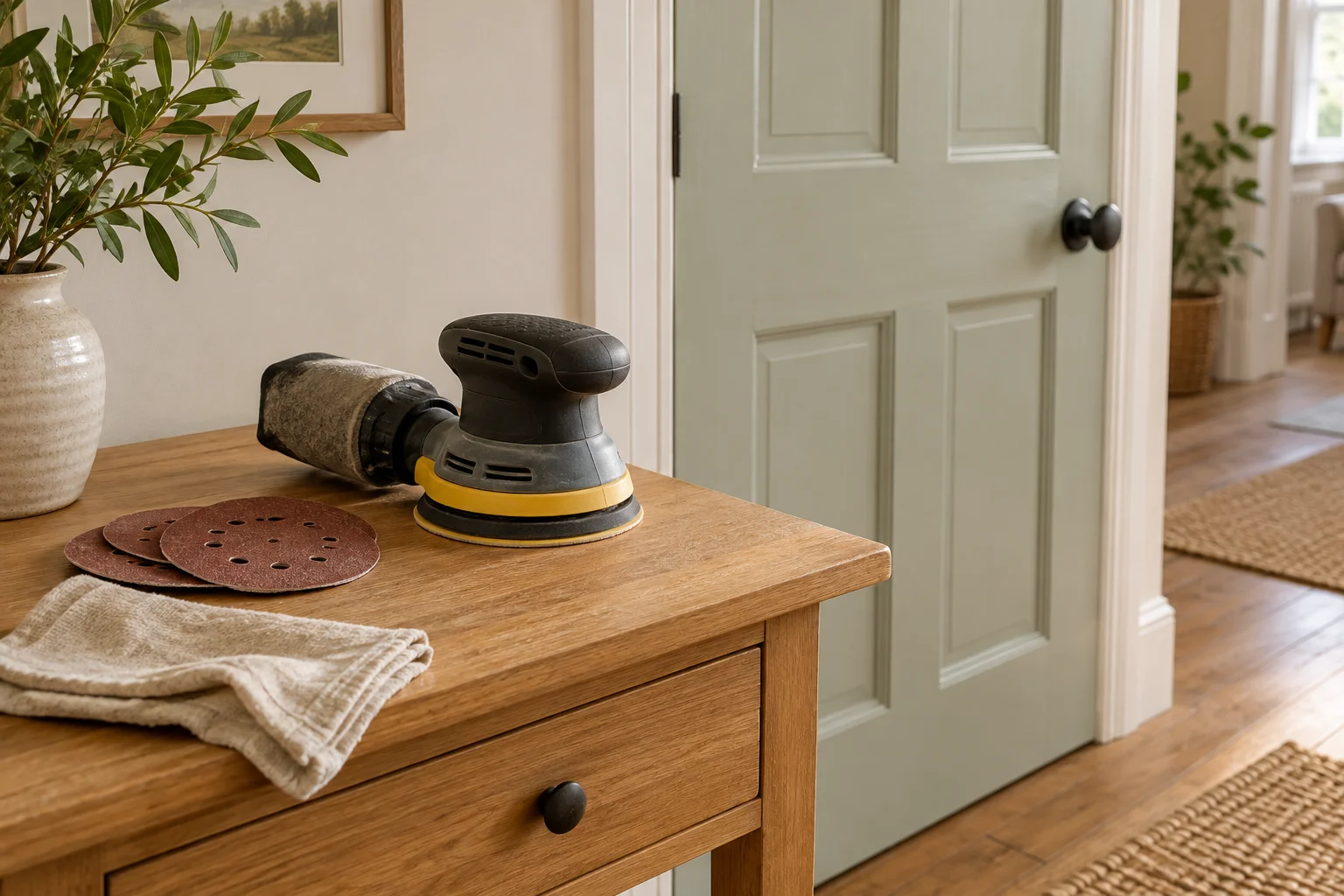
If you have a door to repaint or a tired piece of furniture to freshen up, a random orbital sander can make the preparation feel much more manageable. The best choice depends on what you’ll be sanding and how often you’ll use it.
This guide explains the decisions that matter for everyday renovation work: how the pad fits the surface, what speed control changes, where the dust goes and whether a cord or battery will be easier to live with. For specific models, see our random orbital sander picks.
Start with the job, not the wattage
A broad, flat tabletop asks something different of a sander from a narrow chair rail. A round-pad random orbital sander can work on open flat areas and gentle curves, but its disc cannot reach right into a square corner. If most of your work is inside corners, small mouldings or tight door panels, read our sander-type comparison before choosing.
Think about how often you will use it as well. For the occasional drawer front, a straightforward machine may be enough. If you plan to prepare several doors or a whole furniture set, comfortable handling and a way to connect extraction become more valuable.
125mm or 150mm pad?
The pad size is the diameter of the round sanding disc. A 125mm machine is easier to guide across a door panel or the top of a small chest of drawers. A 150mm pad covers more of a broad, open surface in each pass, but the tool is usually bulkier and there is less room to work near details. Neither size removes the need to finish corners by hand or with another tool.
Check the replacement discs before buying. The diameter must fit, and the dust holes should line up with the pad. Hook-and-loop discs are quick to change, but a disc with the wrong hole pattern can reduce collection even if it sticks on.
What speed and orbit size mean in practice
Variable speed lets you turn down the tool for a more controlled pass on a delicate surface or turn it up when the material and abrasive allow quicker work. It does not make every finish safe to sand: follow the surface or coating instructions and try an inconspicuous patch first.
You may also see an orbit diameter in the specifications. That describes the small circular movement of the pad, not its overall size. A wider orbit tends to remove material more assertively; a smaller one can feel easier to manage for fine preparation. Compare it alongside grip, abrasive choice and dust collection rather than treating one number as a guarantee of a smooth finish.
Plan where the dust will go
Many sanders have a small bag or box, which is convenient for a brief job. It will not capture every fine particle. For repeated or dusty work, check the exact sander’s extractor port and whether you need an adapter for a suitable vacuum or dust extractor. Align the disc holes with the pad and empty or clean the collection system as instructed.
HSE advice on wood dust calls for extraction and, for dustier sanding jobs, respiratory protection. The right controls depend on the material. If you are dealing with older paint, HSE warns about dry-sanding coatings that may contain lead; establish what you are disturbing before reaching for a power sander.
Corded or cordless?
A corded sander is ready for a long session without battery changes, provided a socket and the lead can be kept safely out of the work. Cordless is handy for a door in place or a piece moved outside to work, but check whether the exact offer includes a battery and charger. A “body-only” tool can make sense if you already own the compatible battery system; otherwise, compare the total kit you need.
Feel, balance and the small practical details
Look at the grip you would actually use on a vertical door or a furniture side. A low-profile palm grip can help you keep the disc flat; an extra front handle can offer steadier two-handed control across a tabletop. Weight, vibration, the lead length and a switch you can reach all become noticeable during longer jobs. Manufacturer figures are a starting point, not a substitute for how a tool feels in your hand.
Before ordering, check what is in the box: sanding discs, dust bag or box, case, extractor adapter and—if cordless—the battery and charger. Also check that replacement discs and pads for the exact model are easy to find. Our furniture-focused comparison looks at six different ways those choices play out.
Frequently asked questions
Is a 125mm random orbital sander enough for DIY?
For furniture, doors and similar home jobs, a 125mm pad is a manageable starting point. A 150mm pad covers broad, open surfaces faster but is less convenient around small panels and edges.
Do I need variable speed?
It is useful when one machine will handle different materials or delicate finishes. A fixed-speed model can still work well on ordinary timber if you choose the right abrasive and follow the tool and finish instructions.
Will the dust box catch all the sanding dust?
No. A dust box can help with small jobs, but it will not remove all fine dust. Check whether the sander accepts suitable on-tool extraction and follow the precautions for the material you are sanding.
What does orbit diameter mean?
It is the size of the small circular movement of the sanding pad. A larger orbit can remove material more quickly; a smaller one can be easier to control for a fine finish. Abrasive choice and technique matter too.
Can I use a random orbital sander on old painted furniture?
First establish what the coating is and whether it is safe to disturb. Older paint may contain lead; do not dry-sand a coating you suspect may be lead-based. Follow HSE guidance or seek competent advice before starting.
Which sanding discs should I buy?
Match the disc diameter and hole pattern to your exact pad, then choose the grit for the surface and finish. A variety pack can help you find a suitable progression, but check the finish manufacturer’s instructions first.
What we would choose
For a mix of doors, furniture and painted timber, a comfortable 125mm random orbital sander with practical dust collection is the sensible baseline. Pay for variable speed if you will move between different surfaces; pay attention to extractor compatibility if sanding will be a regular job. Choose a bigger pad or a different sander only when your work gives it a clear advantage.



 Sign up with Facebook
 Sign up with Google
