

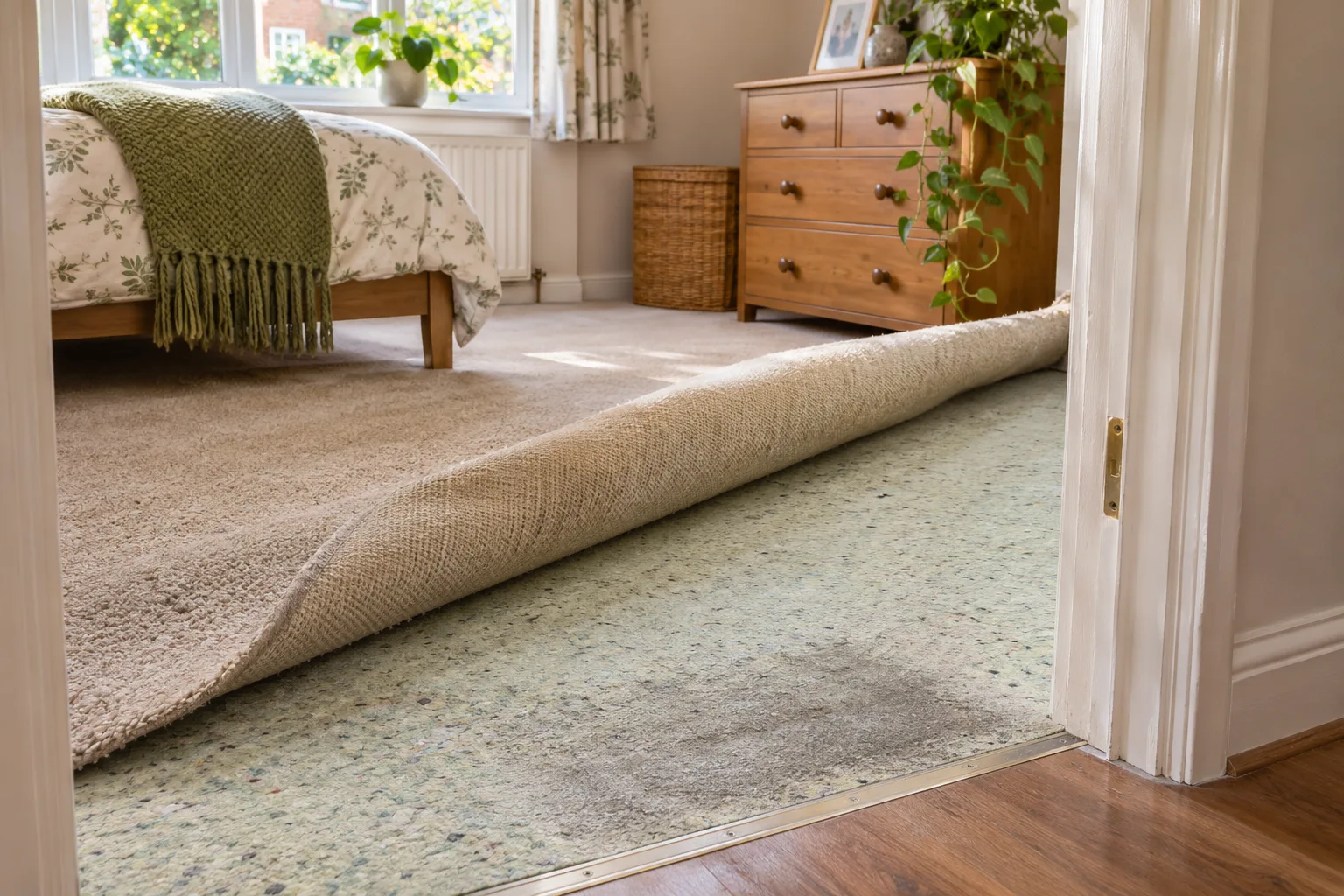
Lifting an old bedroom carpet can reveal underlay that still looks tidy at the doorway. The more revealing spots are usually the route around the bed and anywhere furniture has stood for years. Can you reuse carpet underlay when the new carpet goes down? Sometimes, but its condition and the new carpet’s fitting requirements decide.
Here’s a simple inspection to do with your fitter, plus the questions to ask about comfort, moisture and warranty before you keep an existing layer.
When can you reuse carpet underlay?
A relatively recent underlay can be worth keeping if it is still dry, level and springy across the whole floor, and if the new carpet and fitting method allow it. Tapi’s underlay advice says that underlay laid in the last couple of years may be suitable for reuse after assessment, while recommending replacement in most older cases. Age alone is not a guarantee: a busy hallway can wear faster than a lightly used spare bedroom.
Ask the fitter to assess it once the old carpet is lifted. They can see the underlay’s joins, the subfloor beneath and whether its thickness will work at doors and thresholds. Our underlay thickness guide explains why a deeper layer is not automatically a better fit.
Five things to check before keeping it
- Flattened walking routes. Press the middle of the room and the doorway, then compare with an area that sat under furniture. A permanent hollow or firm, compressed strip means support has changed.
- Crumbling or torn edges. Lift a corner gently. If the material breaks up, sheds heavily or has ragged joins, it may not give the new carpet an even base.
- Damp or persistent odour. Do not cover a damp layer or an unexplained smell with new carpet. Ask the fitter to identify the cause and check the subfloor; replacement alone will not fix moisture underneath.
- Lumps and open joins. Run a hand over the surface. Raised seams, gaps or uneven wear can show through or affect the feel of the new carpet.
- Stairs and other busy spots. Check every tread and nosing, not just the landing. Support and the fitter’s fixing method are particularly important here; see our stairs-and-landings guide.
The edge near a skirting board often escapes foot traffic, so it is a poor sample of the whole room. Tapi specifically warns that an apparently sound lifted edge can hide compression elsewhere.
Check the new carpet and its warranty
Before deciding, ask the carpet retailer or manufacturer whether its guarantee permits existing underlay, and let the fitter see the carpet backing. Tapi’s purchase terms warn that reusing underlay may cause abnormal pile flattening; some of its guarantees also depend on new, appropriate underlay and accessories. That is a condition of those terms, not a universal rule for every carpet brand.
Confirm whether the carpet calls for a particular underlay or installation method, and whether the old underlay is compatible with it. Interfloor’s fitting guidance shows that stretch-fit and double-stick installations are different systems. Do not assume an existing layer suited to one will suit the other.
A sensible keep-or-replace decision
Keep it only when the fitter can confirm even support, a dry subfloor, suitable joints and compatibility with the new carpet and its warranty. Replace it if it is crushed, crumbling, damp, uneven or the fitting requirements have changed. You do not need to replace a sound layer automatically, but saving the cost of a new roll is a poor trade if the new carpet sits badly on top.
If replacement is needed, compare the exact roll by room use and firmness rather than thickness alone. Our best carpet underlay comparison covers six options, while the measuring guide helps you plan how much to buy.
How we put this guide together
We compared retailer guidance on reusing existing underlay and carpet warranty terms with manufacturer fitting advice. This is an inspection checklist, not a substitute for a fitter seeing the lifted floor or a hands-on test of your existing underlay.
Frequently asked questions
Can you put a new carpet on old underlay?
Sometimes. The existing underlay needs to be dry, even, resilient and compatible with the new carpet and fitting method. Ask the fitter to inspect it and check the carpet warranty before agreeing to reuse it.
How can I tell whether carpet underlay is worn out?
Look for flat traffic lanes, crumbling edges, permanent dents, uneven joins, dampness or a persistent odour. The doorway edge alone can look sound while the middle of the room is worn.
Should you reuse underlay on stairs?
Only if a fitter confirms that its condition, support and fitting method are suitable for the new stair carpet. Repeated pressure at the step edges makes a quick visual check especially important.