
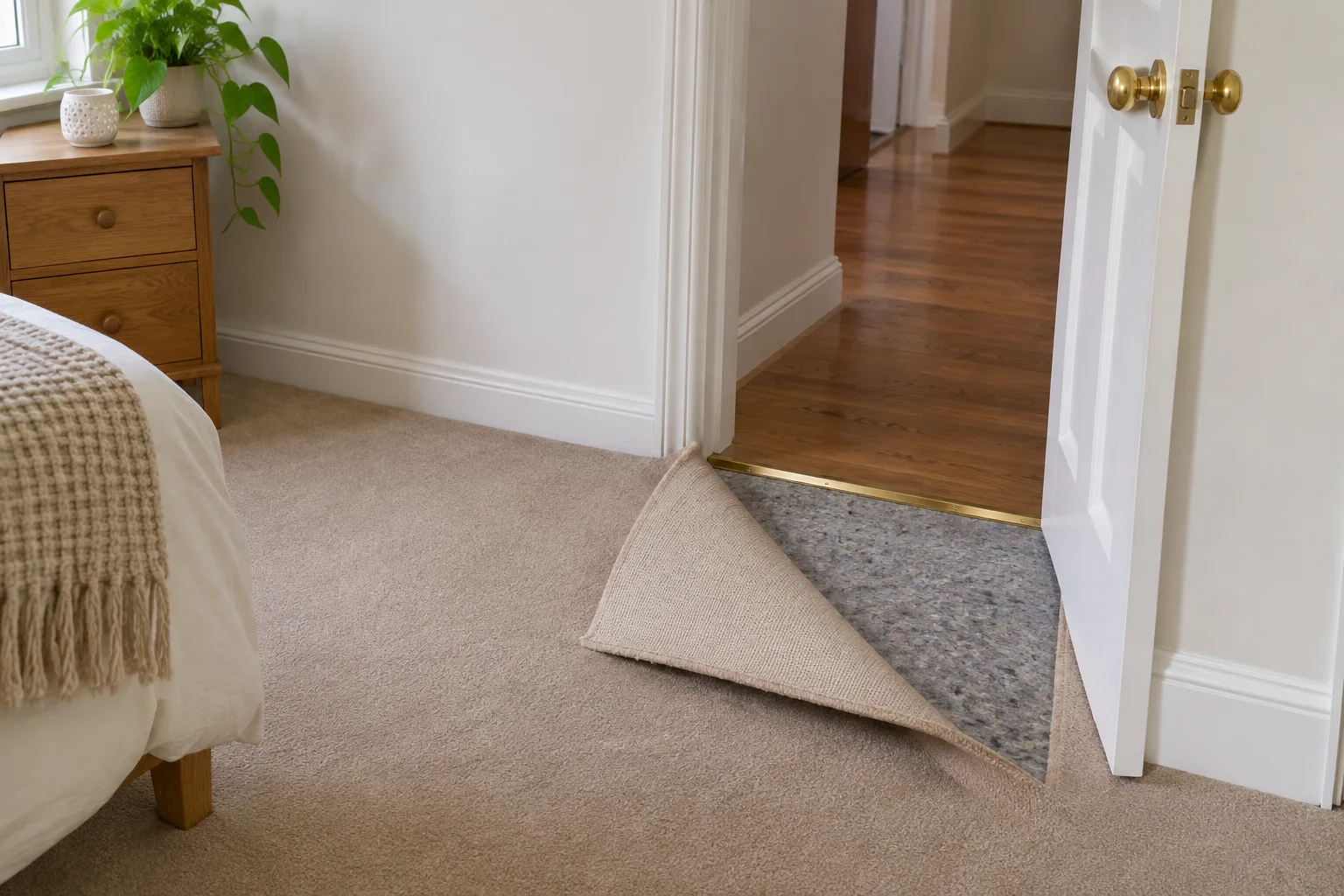
A new bedroom carpet can feel lovely underfoot, but the underlay has to fit beneath the door too. On stairs, a thick, springy layer may not give the carpet the firm support it needs around each tread.
This guide explains what thickness carpet underlay you need for different rooms, and why the number in millimetres is only part of the choice. We’ll look at firmness, door clearances and fitting details, then show when to ask your carpet fitter to check the whole floor build-up.
What thickness carpet underlay works in each room?
These are useful starting ranges, not fixed rules. The right product depends on the carpet backing, how the room is used and the manufacturer’s end-use rating. Interfloor’s selection guide describes carpet underlay commonly falling around 8–12mm, while its product range includes thinner specialist options.
| Where it goes | What to consider |
|---|---|
| Bedroom | A more cushioned feel can be welcome, provided the carpet and door have enough clearance. |
| Living room | Balance comfort with the support needed for regular use and furniture. |
| Stairs and landing | Choose a resilient, stair-suitable underlay; firmness and fitting matter more than maximum thickness. |
| Underfloor heating | Check the combined thermal resistance of carpet and underlay, not thickness alone. |
Why thicker does not always mean better
Two 8mm underlays can feel quite different. A dense rubber product may give firmer support than a softer foam of the same thickness. Underlay also compresses with use, so the maker’s intended traffic level and recovery information matter. Interfloor recommends dense, durable underlay for stairs and landings rather than judging by thickness alone (see its room guidance).
There is no need to buy the thickest roll for every room. A spare bedroom may suit a softer feel, while a busy passage needs a product intended to handle repeated footsteps. Our best carpet underlay comparison shows how six different constructions and thicknesses suit different places.
Check doors, thresholds and the whole floor height
Measure the existing gap beneath any door before choosing a thick underlay, but allow for the carpet as well. The finished height depends on the carpet pile and backing, underlay, grippers and threshold trim. A door that just clears the bare subfloor may rub once everything is fitted. Ask the fitter to check the combined build-up at the doorway and where the new carpet meets another floor. Do not assume trimming a fire door is safe or permitted; ask a competent installer about its specification first.
Stairs need a closer fit
Each tread and nosing puts pressure on a small area. Interfloor describes Treadmore as made for stairs, landings and heavy foot traffic; its published thickness is 7.95mm. That is a useful example of why “more millimetres” is not the same as a better stair choice.
If you have a runner, turns or an unusual stair edge, ask the fitter which underlay and fitting method will hold the carpet securely. Our stairs and landings underlay comparison looks at six actual options and their trade-offs.
If the room has underfloor heating
Thickness alone will not tell you how freely heat passes through. Look for the underlay’s tog rating, add it to the carpet’s rating, and compare that total with the limits for your heating system and carpet. A lower tog means less resistance to heat flow. For example, Interfloor’s Heatflow Carpet is designed as a low-tog carpet underlay. Check that you have the carpet version, not a similarly named wood or laminate product. For electric mat or dry systems, follow the heating manufacturer’s instructions and fitter’s advice before choosing any underlay.
A simple check before you order
Take the carpet’s exact name and backing, the underlay’s product sheet and a note of every doorway to your fitter. Ask whether the underlay is rated for the room’s traffic and fitting method, whether the finished height will clear doors and thresholds, and whether any warranty or heating-system requirement changes the choice. If you are measuring rolls too, our underlay quantity guide shows why area alone may not tell you how many to buy.
How we put this guide together
We compared published product guidance from Interfloor with the practical differences between room use, product thickness and fitting methods. The ranges here are decision aids, not a test of particular rolls or a substitute for an on-site fitting check.
Frequently asked questions
Is 12mm carpet underlay too thick?
Not always. It can suit a room where cushioning matters, but the carpet, door clearance and the underlay’s intended use must all fit the job.
Should stairs have thinner underlay than a bedroom?
Often a firmer, stair-suitable product is more important than maximum thickness. Check the exact stair product and fitting method with your fitter.
Does thicker underlay make underfloor heating less effective?
Thickness alone is not a reliable guide. Compare the carpet and underlay’s combined tog with the heating-system and carpet limits.