
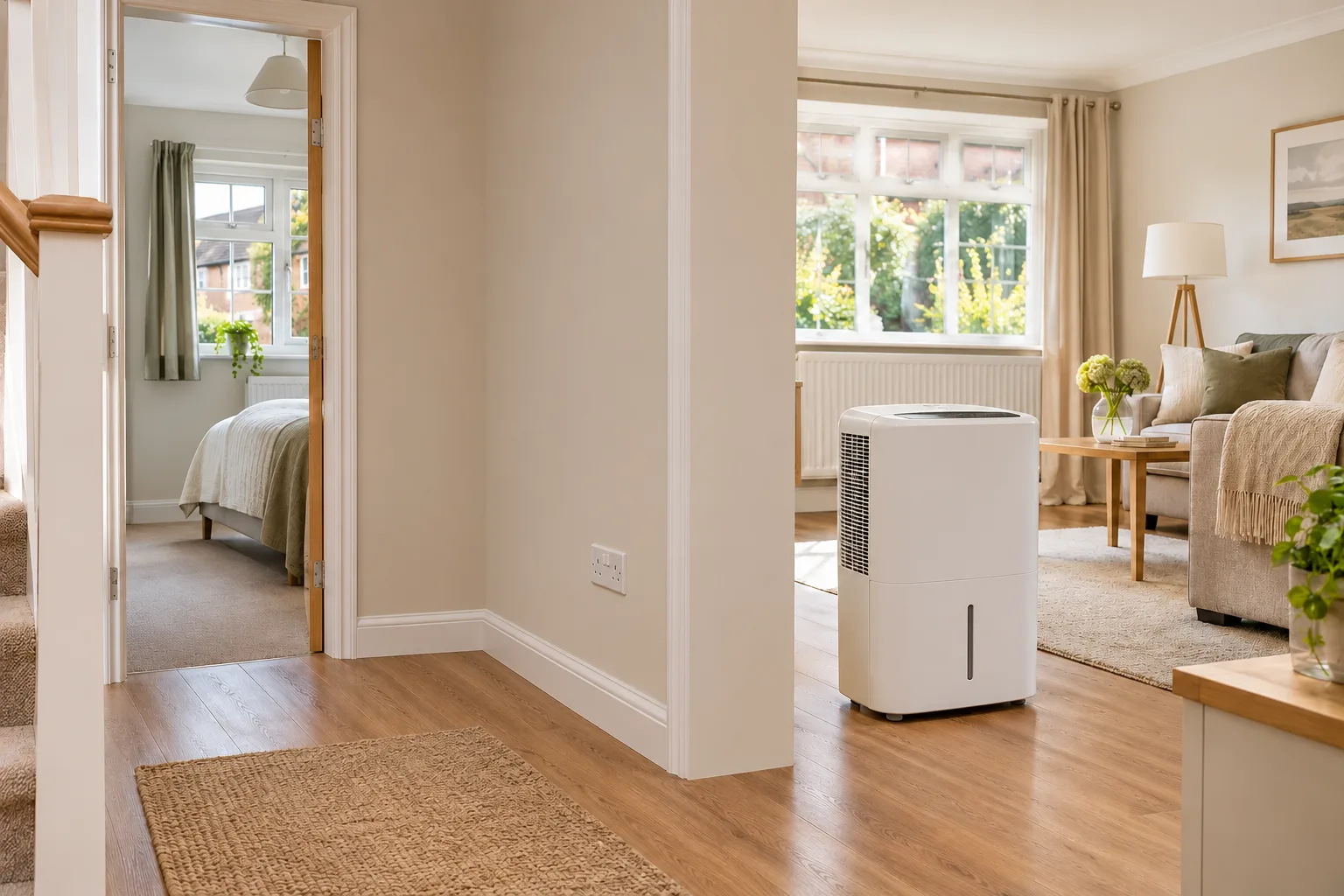
If you’re trying to clear condensation in a bedroom, you may need a different size dehumidifier than you would for drying washing in a chilly utility room. Start with where you’ll use it, how warm the room gets and how much moisture you need to deal with.
This guide will help you work out what size dehumidifier you need, whether it’s for one room or several. We’ll explain what the litres-per-day rating means, how it differs from the amount of water the tank holds and how to use the manufacturer’s room-size guidance. For help comparing features, see our dehumidifier buying guide, or browse our best dehumidifiers to compare six models.
The two litre figures mean different things
Extraction rate, in litres per day (L/day), is the maximum water a machine can remove over 24 hours under stated test conditions. You will usually collect less in a typical home, particularly when the air is cooler or drier. Tank capacity, in litres (L), is simply what the container holds before you empty it. A 20L/day machine can have a 4L tank; it does not promise five full tanks every day. EcoAir’s sizing guide explains the distinction.
Size the space you actually want to dry
Start with the room or connected area the machine will serve, not just the total floor area of the house. A closed bedroom is a different task from several open rooms and a landing. Measure approximate length and width, note doors and airflow, then compare the model’s own recommended room area. The manufacturer’s guide is a starting point, not a guarantee of a particular drying time.
| Your situation | Useful starting class | What to check next |
|---|---|---|
| One small heated room | Compact 6–12L/day compressor | Room-area guidance, night noise and tank access |
| Several heated rooms or a busy family home | 12–25L/day compressor | Airflow between rooms, moisture load and where it will stand |
| Regularly cold utility room or outbuilding | Cold-rated desiccant | Exact operating range, power and safe placement |
These are broad starting classes, not a formula that guarantees a result. Meaco’s help centre suggests 10–12L for smaller homes, 12–20L for an average family home and 20–25L for larger or damper homes. A single room can need less, while a particularly damp or open space can need more. Compare brands’ test conditions before treating two headline ratings as directly equivalent.
Cold rooms change the comparison
A compressor unit relies on a cold surface to condense moisture, so its output can drop as a room cools. A desiccant model absorbs moisture differently and can be a better starting point for a space that stays unheated. Check the exact product’s operating temperature, power use and the room’s real winter temperature. Our cold-room dehumidifier picks compare six models rated for low temperatures. Avoid assuming that a 10L desiccant and a 10L compressor will collect the same amount in your room.
Three common sizing decisions
Condensation in one bedroom
Begin with the bedroom’s area, whether the door will stay closed and how quiet the machine needs to be. A compact model may be easier to place and empty than a large whole-home unit. Measure the space it will occupy, including the clearance in the manual.
Moisture across several heated rooms
A larger class gives more potential extraction, but it still needs airflow. Think about whether you will leave it in one central position or move it, and whether doors are usually open. Castors and a larger tank can matter as much as the headline L/day figure.
A chilly utility room
Check how cold it gets before comparing litres. A cold-rated desiccant is often more suitable than simply buying the largest compressor you can find. Its electrical power and warm exhaust air are part of that choice, especially if it runs for long periods.
Choose a tank you can live with
A bigger tank can mean fewer trips to the sink, but it is heavier when full. If a suitable drain is nearby, continuous drainage may be worth checking. The hose is not included with every machine, and its route must follow the manufacturer’s instructions. Tank size does not make a dehumidifier extract moisture faster.
If the main job is drying washing rather than managing general humidity, the laundry dehumidifier guide compares that use separately.
How we put this guide together
We checked manufacturer explanations of extraction tests, room guidance and tank sizes, then used those to build practical examples for different home layouts. The ranges are starting points based on published information, not measurements in your home or hands-on testing.
Frequently asked questions
Does 20L mean I will empty 20 litres every day?
No. It is a maximum daily extraction rating under stated test conditions, not a typical collection or tank size.
What size dehumidifier do I need for one bedroom?
Start with the bedroom area and temperature, then compare the maker’s room guidance. A compact 6–12L/day compressor can be a starting class for one heated room, with noise and floor space also important.
Is a larger tank the same as a more powerful dehumidifier?
No. The tank stores collected water; the extraction rating describes the machine’s maximum moisture removal under test conditions.
Should I size a dehumidifier by bedrooms or square metres?
Both can help as rough guides, but neither captures temperature, open doors or the amount of moisture present. Match the exact model’s room guidance to the area it will actually serve.