
A small airer can be perfect for a few shirts but frustrating when towels fill every rail. A large one may hold the washing yet make a narrow utility room awkward to use. The best choice is one that handles your regular load and still fits the room when it’s open.
Use this guide to estimate the rail space you need, then check the actual footprint and storage position. For a wider look at covers, timers and rack types, see our heated clothes airer buying guide. Our product comparison shows how those choices play out in real models.
Start with the load that needs drying indoors
Look at a typical winter wash rather than the washing machine’s maximum capacity. Count how many shirts, trousers, towels and small items you normally need to dry together. Bulky fabric needs space around it; two large towels can occupy more useful rail length than several light garments.
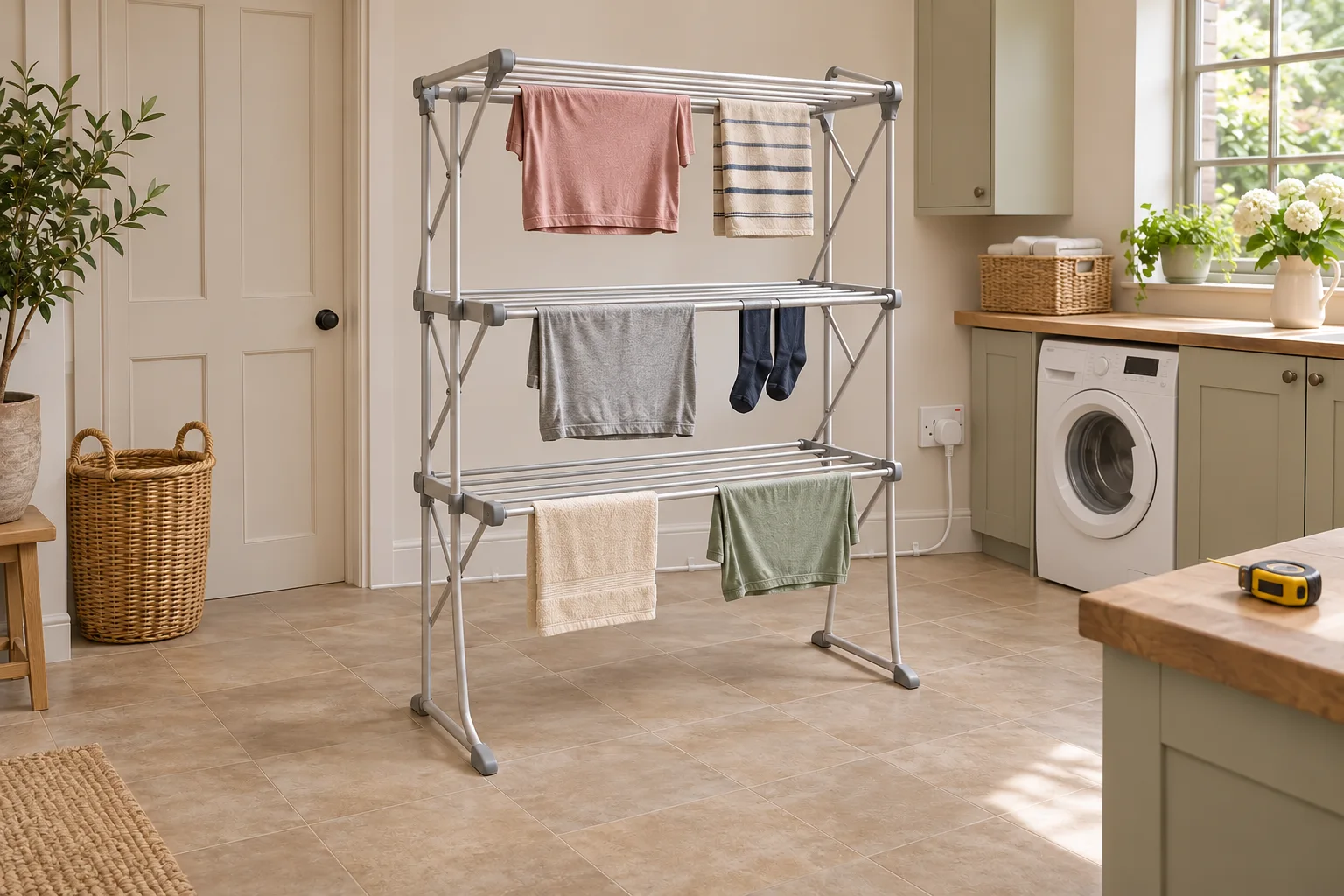
A quick example: if you regularly dry six shirts, two pairs of trousers, two towels and smaller items, a tiny 2m rail rack is unlikely to hold everything with good airflow. A tiered rack with around 12–14m of rail space is a more sensible comparison point, but check its shelf lengths and whether long items can hang without folding. This is a starting estimate, not a guaranteed load count.
Measure the airer fully open
Mark the proposed footprint on the floor with a tape measure. Include opened wings, feet and any cover, then open nearby doors and drawers. Leave a comfortable walking route and the clearances in the maker’s instructions. A frame that folds to 8cm deep is still a substantial object while in use and needs a full-height storage spot afterwards.
Two real examples show why capacity and footprint differ: Lakeland’s Dry:Soon Mini has 13m of rails in an open 60 × 63cm footprint and folds to 8cm deep; Rediffusion’s RED248 offers about 14.1m in an open 62 × 58cm footprint and includes a cover. These are maker figures for those exact models, not a rule that every 13–14m rack fits that space.
Understand metres, kilograms and the actual shape
| Figure | What it tells you | What it does not tell you |
|---|---|---|
| Drying metres | Total length of bars or line | How much bulky laundry will fit with air gaps |
| Kilogram limit | Maximum wet load the frame is designed to hold | How many usable hanging positions you get |
| Open dimensions | Space the frame occupies in use | Extra clearances needed around clothes and doors |
| Folded dimensions | Storage shape after use | Whether it works in your room when open |
On a phone, swipe the table sideways to compare every column.
Do not load a frame up to its kilogram limit if clothes are pressed tightly together. Some makers also set a maximum per shelf or wing; the RED248 instructions distinguish the overall limit from how weight is spread.
Match the shape to what you wash
A narrow rack can handle a few shirts and small items without occupying much floor. A tall tower trades height for rail length but needs access to every shelf. A winged rack can be easier for long towels yet wider when open. A covered pod hangs garments vertically; its advertised kilogram capacity is not comparable with metres of heated rails.
For bedding, check the actual hanging drop and whether a folded sheet will cover several rails. If you often have two loads waiting, one compact airer may not solve the backlog; staggering washes or choosing a larger format may be more realistic.
Leave room for safe use and moisture control
Keep the airer on a stable, dry floor and follow the exact manual for clearances, covers and unattended use. Do not position it so the cord crosses a walkway or damp laundry can drip onto plugs. Drying indoors releases moisture even when the rails are heated; the government’s ventilation guidance explains why airflow matters.
Before ordering, repeat the floor-marking exercise with the exact model’s current dimensions. If you cannot leave space around it while operating, the solution may be a different drying method, not squeezing in a larger rack.
Frequently asked questions
How many metres of drying space do I need?
Count the garments in your typical indoor load and allow room between them. A 2m rack is for a few essentials; around 12–14m gives more flexibility for mixed smaller loads, but the rack’s shape and bar spacing still matter.
Is a 15kg heated airer enough for a 9kg washing machine?
Not automatically. The figures describe different things, and the airer may run out of rail space before reaching its wet-load limit. Check how the load will actually be spread out.
Are three-tier airers better for small rooms?
They can offer more rail length in a smaller floor footprint, but need height and access to the shelves. Measure the open frame and a usable path around it.
Can a compact heated airer dry bedding?
Some can hold a folded sheet, but it may cover multiple heated rails and leave little room for other items. Check garment drop, bar lengths and the maker’s load guidance.
Should I choose by folded size or open size?
Open size comes first because that is how the airer occupies your room while drying. Then check that the full folded height and width fit your chosen storage spot.