

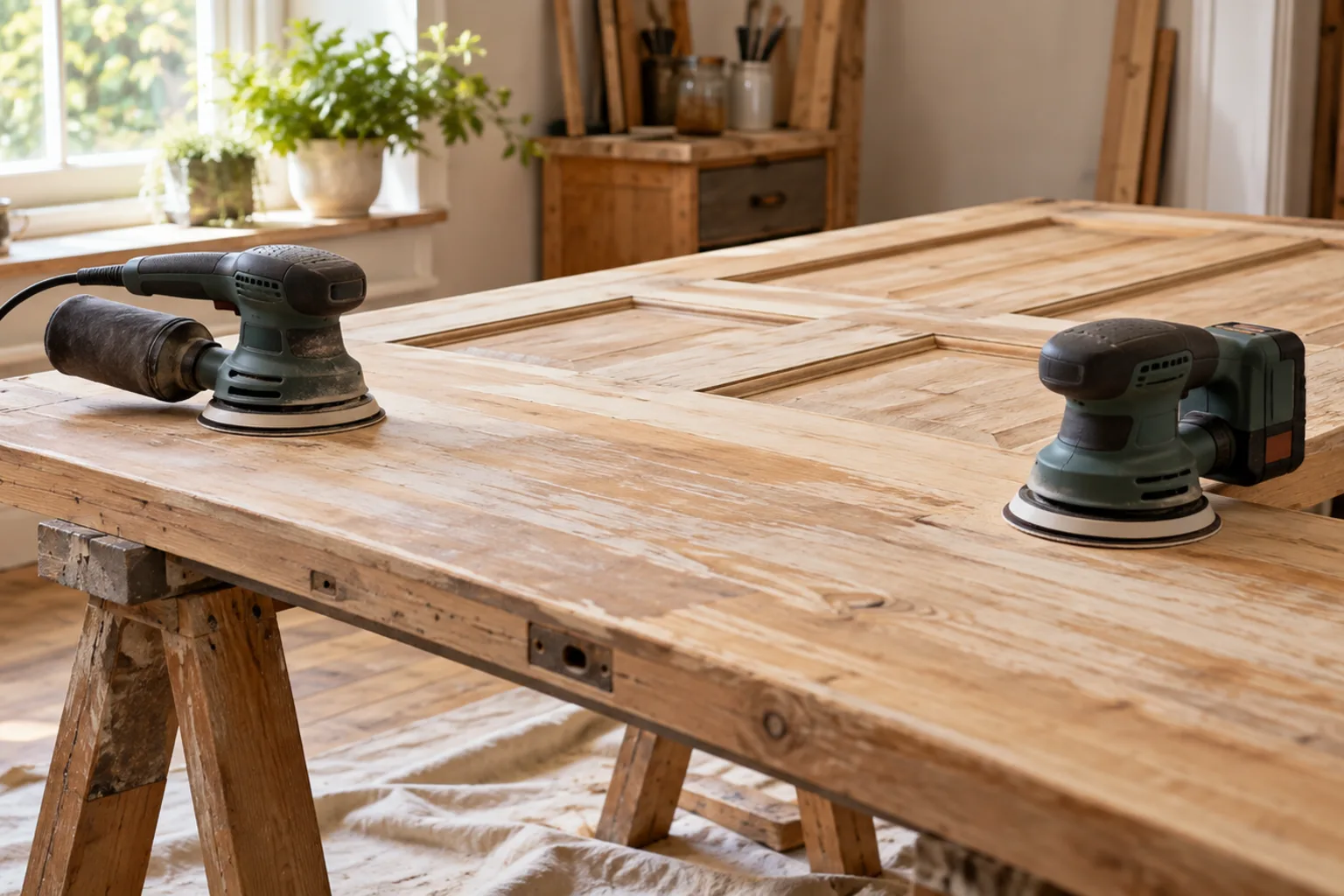
A sander is useful for all sorts of jobs around the house, from freshening up a table to getting doors ready for paint. Once you've chosen the type of sander, there's another decision: would you rather plug it in or work without a cable? The answer depends less on which sounds more convenient and more on where you'll sand, how long the job will take and whether you'll connect dust extraction.
When a corded sander is a good choice
If you’re sanding several doors or a large tabletop, a corded sander lets you keep going without stopping to charge a battery. It’s also a straightforward option if you don’t already own cordless tools, as there’s no separate battery and charger to buy.
You’ll need to keep the cable clear of the sanding pad and make sure it reaches a suitable socket without pulling tight. If you need an extension lead, check the tool’s instructions first. Using a dust extractor too? Leave enough slack in the hose so you can move the sander freely.
When cordless is worth having
A cordless sander is easier to move between a garden workbench, a room with few sockets and smaller pieces of furniture. There's no lead to drag across a chair leg or freshly prepared surface. For a quick repair or one cabinet door, that freedom can be more useful than unlimited running time.
Check what's actually in the box. Some cordless sanders are sold as bare tools, with no battery or charger. If you already have batteries in the same compatible system, that may suit you well. Otherwise, compare the cost of a complete kit with a corded model. Battery size also affects how the tool feels in your hand; a large pack can make a compact sander taller or heavier, which matters on vertical doors and narrow edges.
Runtime varies with the battery, abrasive, material and how hard the sander is working, so a single promised number won't tell you whether it will finish your job. For longer sessions, having a charged spare may be more helpful than choosing the biggest pack. Let the pad do the work rather than pressing down to make it cut faster.
Doors, furniture and timber: what changes?
| Job | The more practical starting point | Why |
|---|---|---|
| Several flat doors to prepare | Corded | You can work steadily through the broad faces and grit changes without battery breaks. |
| One chair or small table | Either | Cordless helps you move around it; corded is fine when your bench is near a socket. |
| Skirting or timber in several rooms | Depends on access | Cordless avoids repeated lead moves, but extraction and the amount of sanding may favour corded. |
| A broad tabletop or several boards | Corded | Sustained work and an extractor are likely to matter more than losing the cable. |
On a phone, swipe across the table.
These are practical starting points, not rules about motor performance. A good cordless sander can tackle substantial work, while a lightweight corded one can be easy to handle. The pad size, speed control, grip and abrasive choice still matter. Our random orbital sander buying guide explains those choices, and our random orbital, sheet and detail sander comparison helps if you're not sure which shape of tool you need.
Think about dust before deciding
A collection bag or box catches some dust, but sanding can still put fine particles into the air. For dusty work, a suitable extractor connected to the tool is a more important choice than the power supply. Check that the sander's port, hose and any adapter fit securely, and use abrasive discs with holes that line up with the pad. A cordless sander with a hose attached is still a perfectly sensible choice; it's simply less mobile than it first appears.
The HSE's guidance on cutting and sanding wood recommends suitable on-tool extraction and says respiratory protection is likely to be needed for most sanding, particularly in enclosed spaces. Follow the guidance for the material and job, as well as the instructions for your equipment. If you're working on old paint, establish whether it may contain lead before disturbing it; HSE advice on lead paint identifies dry sanding old coatings as a risk.
Which would we choose?
For a first sander mainly used on doors, tabletops and other jobs near a socket, we'd start with a corded random orbital model. It keeps the buying decision simple and makes longer sessions easier. We'd choose cordless for shorter jobs in different places, especially when compatible batteries are already in the cupboard. Neither replaces a detail sander for tight corners.
If you're ready to compare actual machines, see our six random orbital sander picks. This guide is about choosing a power setup, not a second set of product recommendations.
Frequently asked questions
Are cordless sanders as useful as corded ones?
Yes, for many furniture and home DIY jobs. The main practical limits are battery runtime, the weight of the fitted pack and whether you already own compatible batteries. Compare individual tools rather than assuming all cordless models behave alike.
Is a corded sander better for sanding doors?
It's usually convenient if you're preparing several doors near a socket, because you can keep working through the flat sections. A cordless model can be easier to move around one door, but you'll still need to manage dust and choose a suitable abrasive.
Does a cordless sander collect dust without a vacuum?
Many have a bag or box, but that doesn't remove all airborne dust. Check the exact tool and use suitable extraction and protection for the work.
Do cordless sanders come with a battery?
Not always. Check the exact variant before buying: a bare tool normally needs a compatible battery and charger bought separately.
Does a random orbital sander reach door corners?
Its round pad won't reach a square inside corner. Use an appropriate detail tool or sand that small area by hand, taking the same precautions with dust and old coatings.
Is a heavier battery better for sanding?
A higher-capacity pack may extend working time, but it can also change the tool's balance. For vertical doors or smaller furniture, handling may matter more than maximum runtime.
 Sign up with Facebook
 Sign up with Google
