
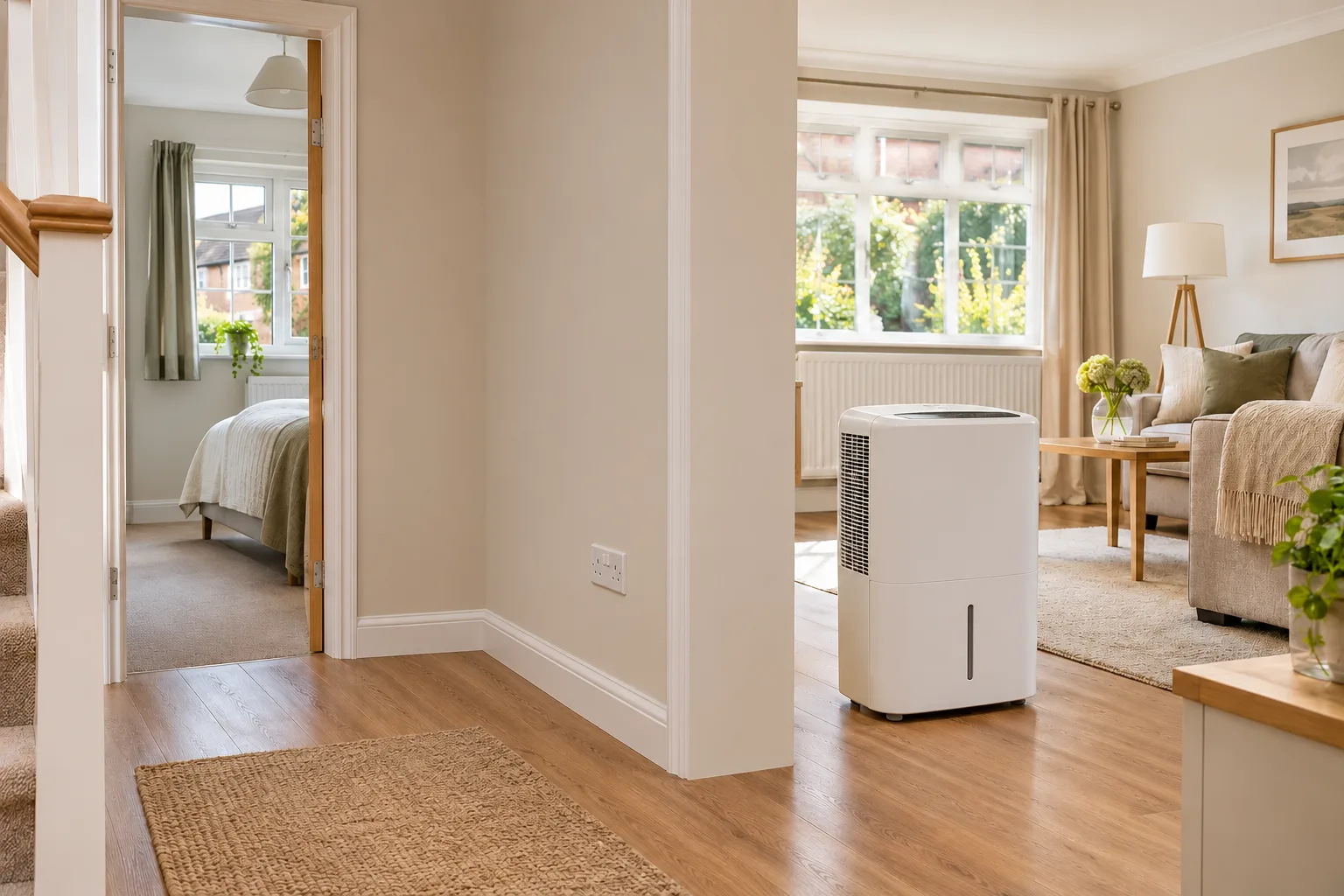
If you put the dehumidifier on whenever there’s washing on the airer, you might wonder how much those few hours add to your electricity bill. You can get a rough idea from the dehumidifier’s wattage, how long you leave it on and what you pay per unit of electricity.
We’ll show you how to work out how much a dehumidifier costs to run, with a simple example you can adapt to your own model and tariff. We’ll also explain why the actual cost can differ from your estimate. If you’re still choosing a model, take a look at our guide to the best dehumidifiers.
The quick calculation
Watts ÷ 1,000 × hours used × your electricity price per kWh = estimated cost. A kilowatt-hour (kWh) is the unit your supplier charges for. Find your rate on a recent bill, because it varies by tariff, region and payment method. Ofgem publishes default-tariff unit-rate information, but its national figure is not necessarily your rate.
Use the wattage for the machine and mode you expect to use. Do not add your whole daily standing charge to a dehumidifier estimate: that fixed charge is payable even when the appliance is off.
What does that look like over a day?
At an illustrative 30p per kWh, a machine drawing 150W for three hours costs about 14p; 300W costs 27p; and 600W costs 54p. These are arithmetic examples, not tested running costs or a claim about today’s tariff.
| Continuous power | 3 hours at 30p/kWh | 8 hours at 30p/kWh |
|---|---|---|
| 150W | 13.5p | 36p |
| 300W | 27p | 72p |
| 600W | 54p | £1.44 |
Multiply a daily figure by the number of days you expect to use it for a rough monthly estimate. For example, 27p on 20 days is £5.40. Recalculate using your actual tariff and selected setting.
Why the real bill may differ
A humidity-controlled machine can pause extraction when it reaches the target, so it may not draw its full running power for every hour it is switched on. Laundry or high-fan modes may draw more. Temperature and dampness affect how long the machine works; a chilly room can also change the extraction of a compressor model. Check the maker’s watts for each mode rather than assuming the number on the front describes every setting.
Compressor and desiccant models work differently. Desiccant designs use heat and may draw more power, while a compressor’s performance depends more on the room being warm enough. That is a reason to choose the right type for the space, not a reason to buy on watts alone. Our compressor-versus-desiccant guide explains the trade-off.
Keep the machine useful without running it needlessly
Use a sensible humidity target if your model has a humidistat, and close windows while it is actively drying the room unless you are deliberately ventilating. Address leaks and sources of persistent moisture: a dehumidifier does not fix water entering the building. Clean the filter as the manual directs and leave the specified air clearance around the appliance.
If drying washing is the main job, compare the machine’s laundry mode and the room setup in our laundry dehumidifier guide. If you are still choosing capacity, our size guide explains why litres per day is not the same as tank volume.
How we calculated the examples
We used the standard kWh calculation and a stated hypothetical tariff, not measured electricity consumption or hands-on testing. Manufacturer wattages and tariff rates vary; your meter or an appropriate plug-in energy monitor can show the actual use of a compatible appliance over time. Follow the monitor’s safety instructions and ratings.
Frequently asked questions
How much does a 300W dehumidifier cost per hour?
At an illustrative 30p/kWh, 300W running continuously costs 9p an hour. Use your own tariff for a personal estimate.
Does a dehumidifier use its rated power all day?
Not necessarily. Modes can draw different power, and automatic humidity control may pause extraction. Check the exact machine and setting.
Is it cheaper to leave a dehumidifier on all day?
There is no universal answer. A humidistat can avoid needless extraction, but leaving it on continuously can use more electricity than a shorter suitable run. Deal with the moisture source as well.