
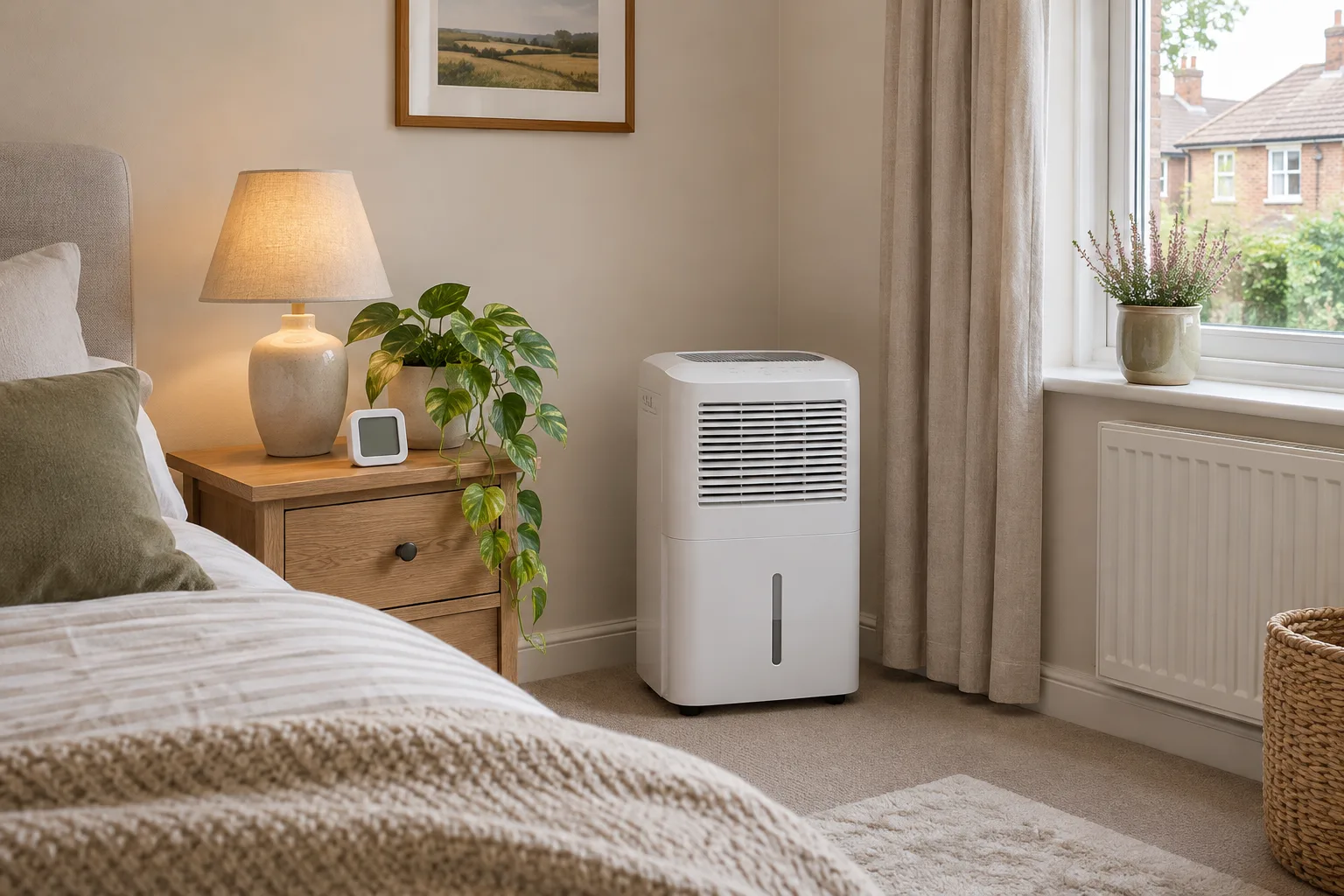
Where you’ll use your dehumidifier can make all the difference. A compressor dehumidifier is often a good fit for a heated bedroom, while a desiccant model may suit a chilly conservatory or unheated utility room better.
We’ll explain the difference between compressor and desiccant dehumidifiers and what to consider when comparing noise and running costs. Once you know which type suits your home, you can compare models in our guide to the best dehumidifiers.
How compressor and desiccant dehumidifiers work
A compressor machine draws damp air across a cold coil. Water condenses into the tank. A desiccant machine uses a moisture-absorbing material, then heats it to release the water for collection. EcoAir’s explanation of the two technologies describes the difference and the temperature trade-off.
Both remove moisture from the air; neither repairs a leak or replaces ventilation. If a wall is wet because water is entering the building, find the cause rather than buying a larger machine.
Start with the room temperature
For a heated bedroom or living room, a compressor is usually the sensible starting point. Its published extraction figure depends heavily on the test temperature and humidity, so a 12L/day rating does not mean you will empty 12 litres every day. A cooler room may see less extraction than the headline suggests.
Desiccant models are worth comparing in a cold utility room, conservatory or other space that regularly stays unheated. They can work within lower published operating ranges, but “works at 1°C” is not a promise of the same extraction at 1°C as at the test temperature. Check the exact model and winter temperature. Our cold-room dehumidifier comparison is for that particular job.
What about electricity and noise?
Desiccant machines use heat as part of the drying process and send warmer air back into the room. A compressor often draws less power in a suitably warm room, but wattage varies by model and setting. Compare the published watts for the mode you will actually run, not two headline figures measured under different conditions. Our dehumidifier running-cost guide shows the calculation.
Neither technology is automatically quiet. Fan speed, the compressor cycling on and off, and the room itself affect how a machine sounds. Look at the manufacturer’s noise figure and the setting behind it; a low-mode figure may not describe laundry mode beside a bed.
Compressor versus desiccant at a glance
| Consideration | Compressor | Desiccant |
|---|---|---|
| Best starting point | Regularly heated rooms | Spaces that stay chilly |
| How it collects water | Condenses moisture on a cooled coil | Absorbs moisture, then uses heat to release it |
| Power to compare | Rated watts at the chosen fan setting | Rated watts at the chosen fan and heater setting |
| Other trade-off | Extraction falls as air cools | Warm exhaust air and potentially higher power draw |
Manufacturer litre-per-day figures may be tested at different temperatures and humidity levels. Do not read the two ratings as a direct like-for-like performance test. Compare the stated conditions and your room.
Which should you choose?
For one warm bedroom, compare compact compressor models first, giving noise and tank access as much attention as extraction. For a chilly utility room where clothes dry, start with a desiccant rated for its actual temperature, then check power and where the water will go. For several connected rooms, the size and airflow decision matters as much as the technology; our dehumidifier size guide helps with that.
Whichever type you choose, allow the clearance specified in its manual. Do not tuck it into a tight cupboard, place it where water can reach the plug, or assume a drain hose is included. Our buying guide covers the practical controls and emptying routine.
How we put this guide together
We compared manufacturer explanations of both technologies, their published operating ranges and power information, then applied those differences to heated and unheated rooms. This is advice from product information, not hands-on testing or an assessment of your home.
Frequently asked questions
Is a desiccant always better in winter?
No. A heated room can still suit a compressor. Check the actual room temperature and the specific model’s operating range and power use.
Is a compressor cheaper to run?
Often in a suitably warm room, but not as a blanket rule. Use the wattage of the mode you will run and your electricity unit rate.
Can I compare a 12L compressor with an 8L desiccant directly?
Not from those two figures alone: the published test conditions may differ, and extraction changes with room temperature and humidity.