

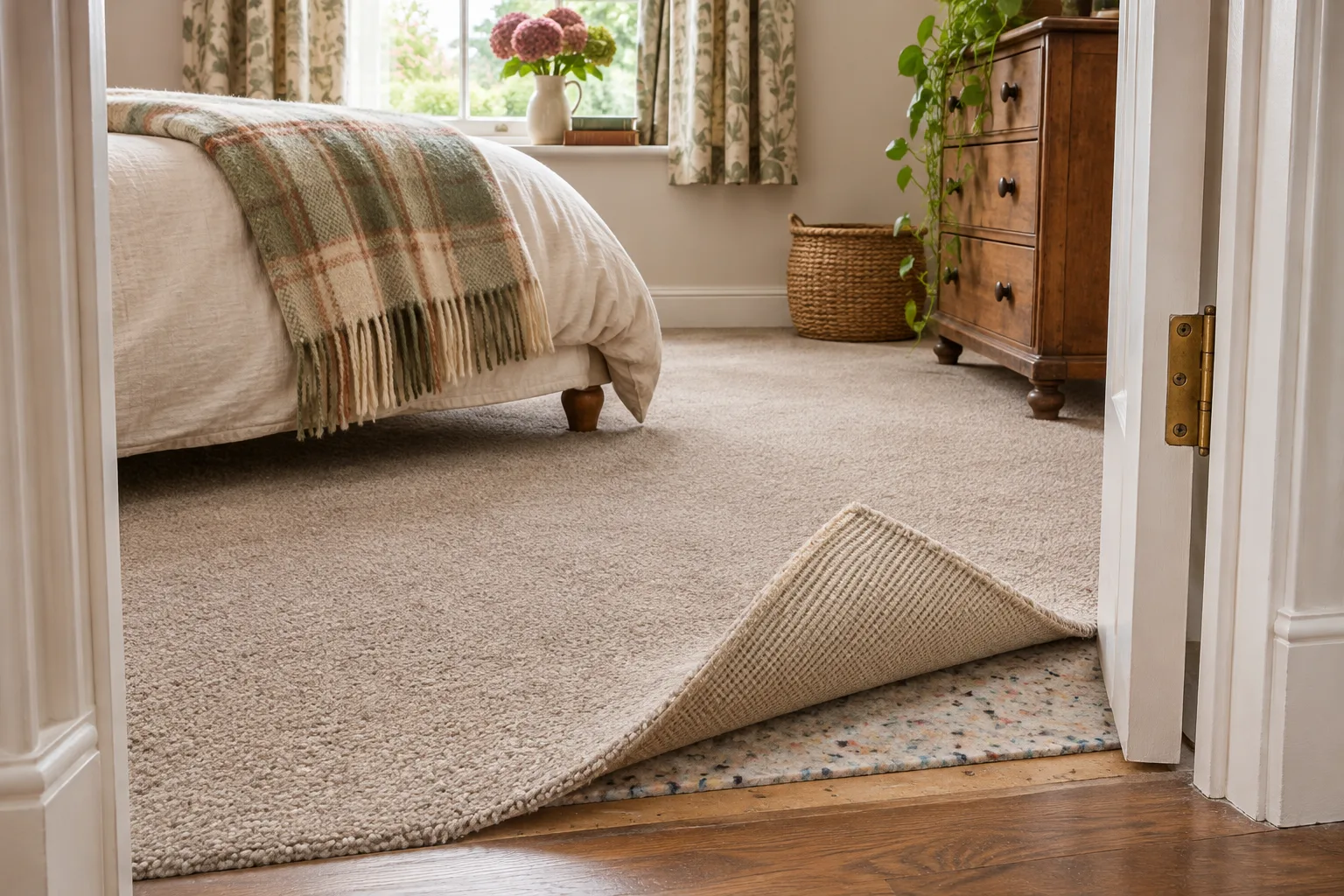
A bedroom carpet might call for a little more cushioning, while the same soft feel may not suit the stairs you use all day. That is why the material under the carpet matters as much as its thickness.
This guide compares foam, rubber and felt carpet underlay in the ways you will notice at home: feel underfoot, support in busy areas and the practical questions to ask your fitter. It will help you narrow the type before comparing specific rolls.
Foam vs rubber vs felt carpet underlay at a glance
| Material | What it can offer | What to check |
|---|---|---|
| PU foam | A cushioned feel; firmness varies by product. | Density, recovery and room-use rating. |
| Rubber | Firm support or a springier feel, depending on construction. | Crumb versus sponge rubber; fitting method. |
| Felt or felt blend | A firmer, traditional feel; blends vary. | Exact composition and carpet backing. |
These are broad descriptions, not performance promises. Two rolls made from the same material can feel different, so compare their product sheets rather than choosing by material name alone.
What is foam carpet underlay like?
Most foam carpet underlays in UK shops are made from polyurethane, often shortened to PU. Many have a soft, comfortable feel under a bedroom or living-room carpet. But foam is not one fixed level of softness: a dense rebonded foam and a more yielding product can give quite different support. Interfloor’s underlay guide describes PU foam as one construction among several, with products intended for different uses.
Ask for the exact product’s density and end-use classification. Density means how much material is packed into a given volume; it does not, by itself, guarantee the right feel or durability. Recovery after pressure and the maker’s intended traffic level help you judge whether a foam roll belongs in a quiet bedroom or a busier area.
Crumb rubber and sponge rubber are not the same
Rubber underlay comes in different constructions. Dense crumb rubber can give firmer support where feet repeatedly land in the same places. Sponge rubber can feel springier while still being made in grades for different rooms. Interfloor explains how its crumb-rubber underlay is made; its Tredaire King sponge-rubber product shows why “rubber” does not describe one single feel.
A firm rubber roll can be a good comparison point for halls and stairs, but check the exact fitting method. Some products suit stretch fitting, while others are intended for a double-stick installation, where carpet and underlay are bonded. Our stairs and landings guide explains why the step edge and carpet backing matter as much as underlay softness.
Where felt fits in
Felt underlay and felt-backed blends tend to have a more traditional, supportive character, but the mix is important. For example, Interfloor’s Kensington Deluxe combines polyester felt with crumb rubber and is designed with woven carpets in mind. It is not interchangeable with every all-felt roll simply because both use the word “felt”.
If you have a woven carpet, stitched joins or a particular carpet warranty, ask the fitter which construction and backing they recommend. Check the actual product sheet for suitability, roll dimensions and installation method before ordering.
Which type suits each room?
In a bedroom, comfort may be the priority, so compare the feel of the exact foam or sponge-rubber rolls alongside the carpet you have chosen. In a hallway or on stairs, give more weight to support and the maker’s heavy-use rating. A felt-and-rubber blend may appeal with some woven carpets, but it still needs to match the fitting plan.
For a heated floor, do not assume that a material category tells you how readily heat will pass through. Compare the underlay’s tog rating with the carpet’s and the heating-system limit. Our underlay thickness guide covers height and door clearance; the best carpet underlay comparison is the next step when you are ready to look at actual products.
What to ask before choosing a roll
Take your carpet’s name and backing to the fitter, and ask which underlay constructions its manufacturer permits. Compare the exact product’s end-use rating, firmness, recovery, thickness and fitting method. Then check the practical details: door clearance, stair edges, roll coverage and whether you have underfloor heating. If the room is awkward or the carpet has a warranty condition, the fitter’s answer is more useful than a generic material ranking.
How we put this guide together
We compared published Interfloor material and product guidance with the different decisions faced in bedrooms, halls, stairs and heated rooms. This is an explanation of constructions and buying checks, not hands-on testing of individual rolls.
Frequently asked questions
Is foam or rubber carpet underlay better?
Neither is best in every room. Compare the exact product’s firmness, end-use rating, carpet compatibility and desired feel.
Is felt underlay suitable for stairs?
Some felt-and-rubber combinations are rated for heavy use, but check the exact product and fitting method with your carpet fitter.
Does a thicker underlay last longer?
Not necessarily. Thickness tells you the initial depth, while construction, density and recovery under repeated use affect support.