

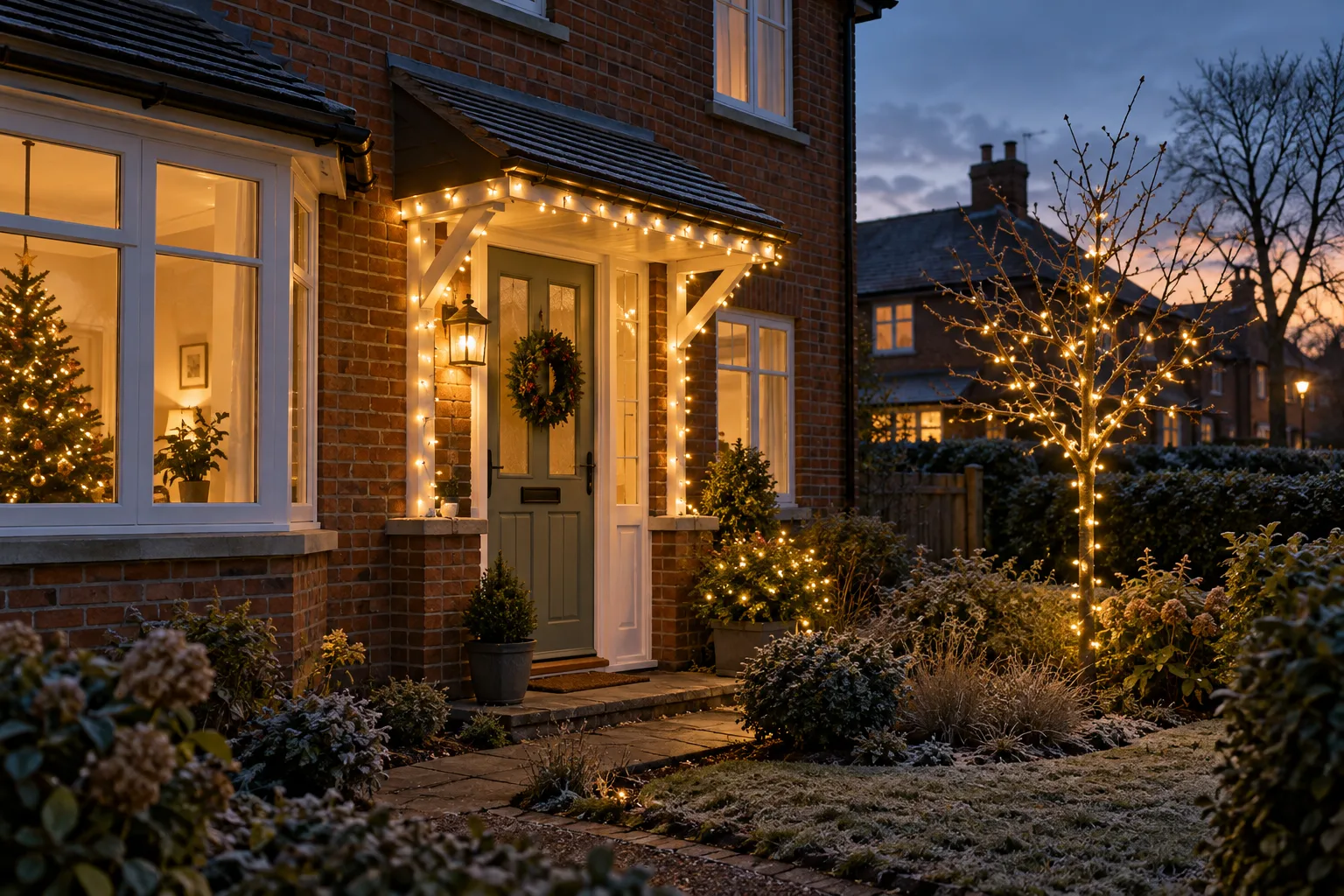
Outdoor Christmas lights can make a front door or garden feel welcoming through the darker evenings. If you’re wondering what that glow will add to your bill, the answer depends on the power your lights use, how long they’re on and your electricity rate—not simply how many LEDs are in the set.
We’ll show you a quick way to work out the cost for your own lights, with a few example figures to make the maths easier. These are running costs only, not the price of buying the lights.
How to calculate the cost of your lights
Find the set’s power consumption in watts (W), then use the unit price in pence per kilowatt-hour (kWh) from your electricity bill. A kilowatt-hour is the energy used by a 1,000W appliance running for one hour. The calculation is:
Watts ÷ 1,000 × hours on × your unit price = running cost.
For example, 10W ÷ 1,000 × six hours = 0.06kWh. At 26.32p per kWh, that’s 1.58p for one evening, or 47.4p over 30 evenings. Round only at the end so the small daily figures don’t distort the monthly total.
Ofgem gives 26.32p per kWh as the average electricity unit rate for customers on a standard variable tariff paying by Direct Debit in England, Scotland and Wales from 1 October to 31 December 2026. It is an illustration, not a universal rate: region, payment method and tariff can change what you pay. If you’re on a fixed or time-of-use tariff, use the rate that applies when your lights are on.
Example costs for 30 winter evenings
The table assumes each set runs for six hours a night at 26.32p per kWh. The wattages are illustrative examples, not measured claims about a particular product.
| Power used | Energy over 30 evenings | Estimated cost over 30 evenings |
|---|---|---|
| 5W | 0.9kWh | About 24p |
| 10W | 1.8kWh | About 47p |
| 20W | 3.6kWh | About 95p |
| 40W | 7.2kWh | About £1.90 |
On a phone, swipe across the table.
For two or more sets, add their wattages before calculating, provided they’re on for the same hours. A 10W porch set and a 20W hedge set used together make a 30W display. Different schedules are easier to calculate separately and then add up.
Where to find the right wattage
Look on the product information, packaging or instructions for power consumption in watts. Be careful with a number printed on the adaptor: its output rating may describe what it can supply, not what the lights actually draw. If the power used by the complete set is unclear, ask the retailer or manufacturer. An appropriate plug-in energy monitor can give a closer estimate, but follow its instructions and keep an indoor-only monitor indoors.
The LED count alone cannot give a reliable cost. Two strings with the same number of LEDs may use different power, and the controller or lighting mode can affect consumption. The calculation works best with the complete set’s stated or measured draw.
Ways to keep the cost down
- Choose LEDs: They generally use less electricity than older filament lights. Electrical Safety First says LED Christmas lights can use 80–90% less electricity than filament versions.
- Use a timer: A shorter evening schedule cuts the hours in the calculation. Follow the set’s instructions and switch the lights off when you no longer need them.
- Light the places you enjoy: A porch or one garden feature may give you the effect you want without running several large sets.
The electricity standing charge is not an extra cost caused by the lights; you pay it for having the supply available. Solar lights avoid mains electricity for that set, but their winter performance depends on daylight and placement. Our mains-versus-solar guide helps with that choice.
Keep the display safe as well as economical
Use only lights marked for outdoor use and check the instructions for the light string, plug, transformer and any connections separately. Our outdoor-light safety guide explains what to check before putting a set up. Electrical Safety First says an outdoor plug connection needs 30mA RCD protection and advises switching lights off and unplugging them before bed or when going out.
If you’re still choosing a style, browse our outdoor Christmas lights guide. Once you know the set’s watts and your tariff, you can put your own figures into the formula above rather than relying on a generic “cost per night”.
Frequently asked questions
How much does a 10W set of outdoor Christmas lights cost to run?
At 26.32p per kWh, a 10W set used for six hours costs about 1.6p. Over 30 evenings at six hours each, that is about 47p. Use your own tariff and the set’s actual wattage for a personal estimate.
Do more LEDs always mean higher running costs?
Not necessarily. LED count does not tell you the power used by each LED or the controller. Compare the wattage of the complete set, or measure its actual draw, rather than estimating from the number of bulbs.
Should I add the electricity standing charge?
Not when estimating the extra cost of switching on Christmas lights. You pay the standing charge for the electricity supply whether the lights are on or off. Use the unit price per kWh for this calculation.
Will a timer reduce the bill?
A timer reduces electricity use if it stops the lights running for hours they would otherwise be on. Check the set’s instructions and do not treat a timer as a substitute for following its electrical-safety guidance.
 Sign up with Facebook
 Sign up with Google
