

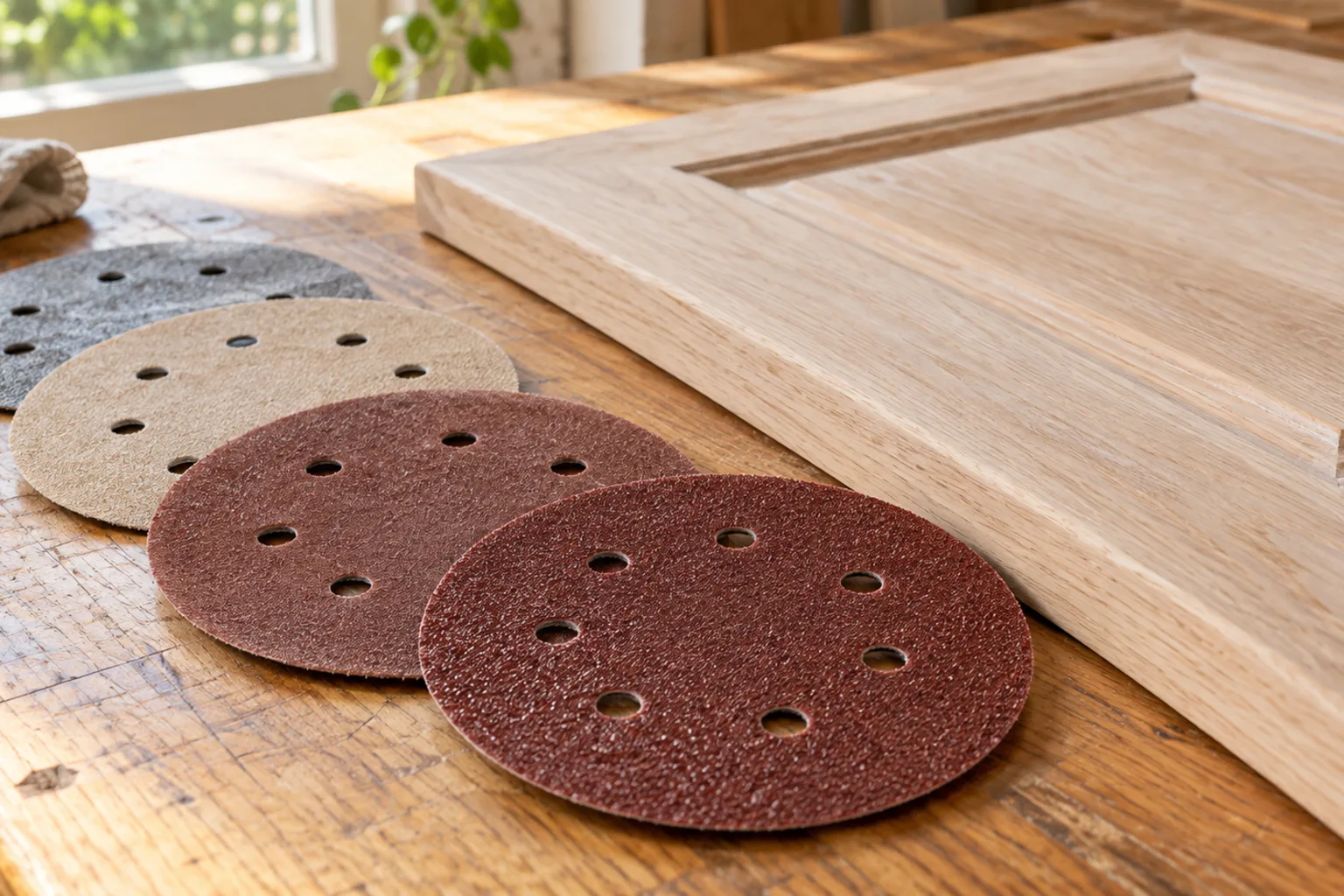
A fresh coat of paint or oil often looks only as good as the surface beneath it. When you're sanding a table or preparing a door, the abrasive makes as much difference as the sander: a disc that's too coarse can leave scratches, while a worn one takes longer without improving the finish. Here's how to choose a grit, check that the disc fits and know when to change it.
What the grit number means
The number tells you how coarse the abrasive is. Lower numbers such as P80 cut more quickly and leave more visible marks. Higher numbers such as P180 feel finer and are useful for smoothing a surface before many finishes. The “P” refers to the grit grading system. The higher the number, the finer the sandpaper.
Don't begin with a very coarse disc just because it will work faster. If the existing paint is in good condition, you may only need to smooth the surface with a finer abrasive before repainting, rather than strip it back to bare wood. On a scratched bare tabletop, you may need a coarser first pass to level the marks. Try a small, less visible area before committing to the whole piece.
A sensible grit progression
| Surface and aim | Possible starting point | What comes next |
|---|---|---|
| Rough bare timber or a marked tabletop | Around P80 if needed | Move through P120, then consider P180 for a finer surface. |
| Door with paint in good condition | A finer abrasive may be enough to prepare it for repainting | Follow the paint manufacturer's preparation guidance; there may be no need to remove paint that's still in good condition. |
| Bare furniture needing a smooth finish | P120 if the surface is already fairly even | Move to P180 where appropriate for the chosen finish. |
| Between coats of a suitable finish | A fine abrasive specified by the finish maker | Sand lightly by hand where needed; avoid cutting through edges. |
On a phone, swipe across the table.
These are examples, not a universal recipe. Different timbers and finishes respond differently, and the coating manufacturer's instructions take priority. Bosch's abrasive guidance places P80–P120 in a medium surface-sanding range and P180 among fine finishing choices. Check the result after each pass: once the previous scratches are gone, move on rather than sanding for the sake of it.
Make sure the disc actually fits
Three details matter before you order a pack:
- Diameter: Match the disc to the pad, often 125mm or 150mm on a random orbital sander. An overhanging disc can catch an edge; an undersized one leaves part of the pad exposed.
- Backing: Most current random orbital pads use hook-and-loop discs. Check your tool rather than assuming every round abrasive attaches the same way.
- Extraction holes: The holes in the disc need to line up with those in the pad, or the dust route is obstructed. Bosch's tool instructions make this point explicitly. Check the actual pattern, not just the diameter printed on the packet.
Mesh abrasives may offer another option for a compatible pad and extractor, but they aren't a reason to ignore the tool maker's accessory guidance. If you're unsure, use your sander's model number to find the specified disc type.
Furniture and doors need slightly different handling
On a flat tabletop, keep the pad level and move in overlapping passes. Vacuum away dust between grits so loose particles don't scratch the next pass. Curved edges, mouldings and thin veneers need a gentler approach; don't let the pad dig into a corner or stay in one place. For a delicate veneer, check the construction before sanding at all, because there may be very little material to remove.
For a panelled door, the broad flat sections suit a random orbital sander, but the round disc cannot reach the inside corners or narrow mouldings. Finish those areas with a suitable detail tool or by hand. Our comparison of random orbital, sheet and detail sanders explains where each tool helps; this guide is about the abrasive you put on it.
When to change the disc
A fresh disc cuts evenly. Replace it when the abrasive is visibly worn, clogged with paint or finish, torn, or no longer stays properly attached. If you find yourself pressing harder to make progress, stop and inspect the disc rather than forcing the tool. Clear the surface and use a new disc of the same grit before moving to a finer one.
Be especially careful with old coatings. If a door or furniture piece may have lead-containing paint, don't machine-sand it until you've established a safe approach. HSE guidance identifies dry sanding old paint as a risk. For wood dust more generally, use suitable extraction and respiratory protection for the job; see the HSE's sanding guidance.
A simple way to buy the right pack
Write down the sander model and pad size, then check the disc backing and hole layout against the pad. For a typical bare-wood furniture job, a small selection of medium and fine grits is more useful than a huge pack of one grade. Choose the starting grit after looking at the actual surface, and check the finish maker's instructions before deciding where to stop. If you're still choosing the machine, our random orbital sander buying guide covers pad size and speed without repeating this grit-by-grit advice.
Frequently asked questions
What grit should I use on a wooden door before painting?
It depends on the condition of the existing coating and the new paint's instructions. If the existing paint is in good condition, a finer abrasive may be enough to prepare it for repainting; damaged bare timber may need a more involved progression. Check for potentially hazardous old coatings before sanding.
Is P80 too coarse for furniture?
It can be useful on rough or marked bare wood, but it may leave scratches and remove more material than you want on a finish in good condition or thin veneer. Test a small area and move to finer grits as needed.
Should I skip from P80 straight to P180?
An intermediate grit such as P120 usually makes it easier to remove the coarser scratches. Inspect the surface between stages rather than following numbers mechanically.
Do all 125mm discs fit every 125mm sander?
No. Match the backing and extraction-hole pattern as well as the diameter. Check your tool's model and pad before buying.
Why is my sanding disc clogging quickly?
Paint, varnish or a soft finish can fill the abrasive. Stop and inspect it; replace a clogged disc, use the right abrasive for the material and avoid pressing harder. Check extraction and the material's preparation guidance too.
Can I use a random orbital disc on door mouldings?
A round, fairly flat pad doesn't follow narrow profiles or reach inside corners well. Use an appropriate detail abrasive or hand sanding for those areas, taking care not to round crisp edges.

 Sign up with Facebook
 Sign up with Google
