
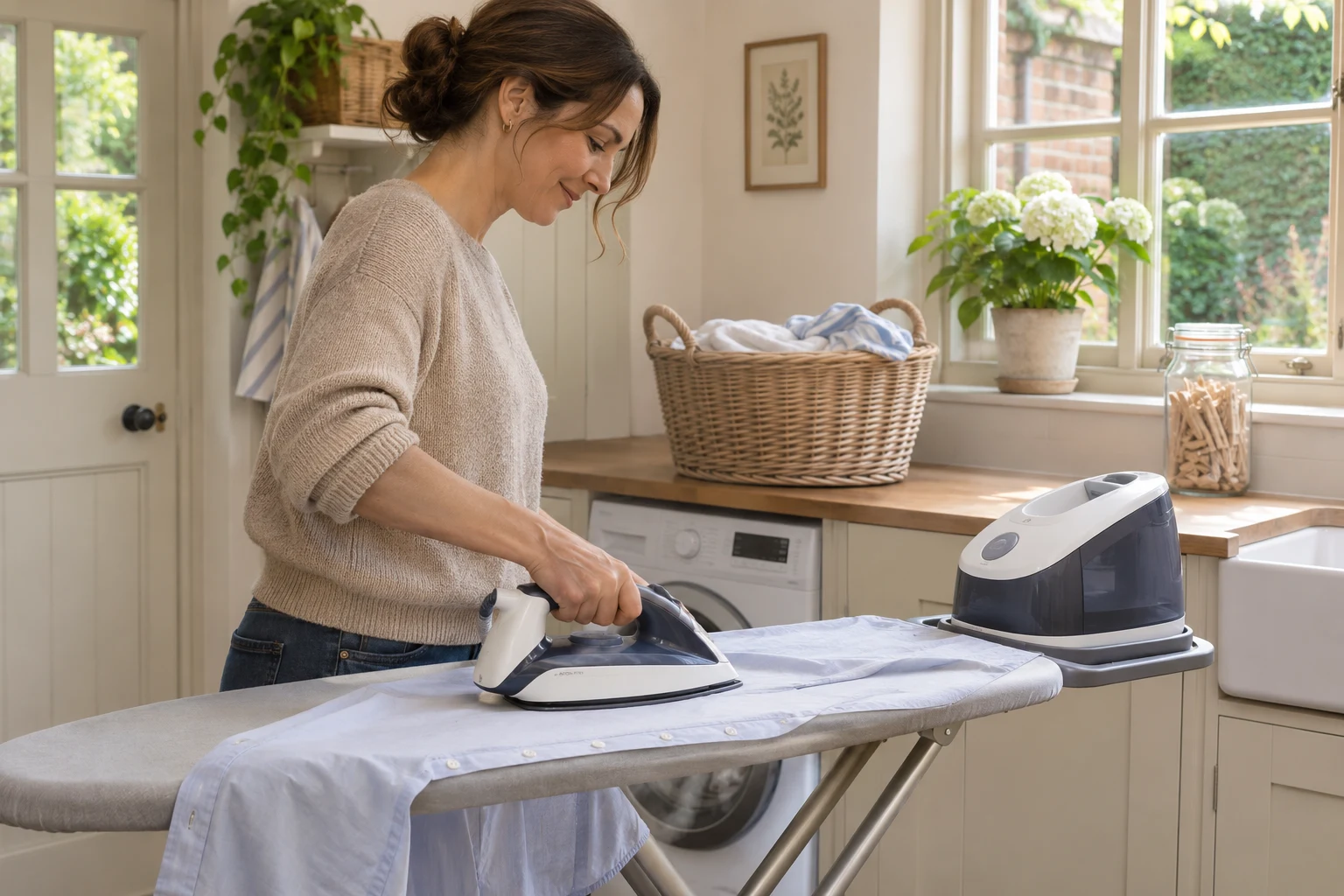
If you usually tackle the ironing in one go, it’s handy to know what a full basket adds to your electricity bill. The wattage on a steam generator iron gives you a starting point, but it doesn’t tell you how much electricity you’ll use from the first shirt to the last.
To work out how much a steam generator iron costs to run, you’ll need two numbers: the electricity it uses during a session (measured in kilowatt-hours, or kWh) and the price you pay per kWh. We’ll walk through an example and show you how to compare the cost with your usual iron. If you’re still deciding which model to buy, see our steam generator iron buying guide.
How to calculate an ironing session’s cost
Electricity is charged by the kilowatt-hour, not by the wattage printed on the appliance. Multiply the kWh used during your session by the electricity unit rate on your bill. Ofgem explains how unit rates and standing charges appear on bills. Your rate may differ by tariff, payment method, region or time of day, so use your own figure rather than a national average.
For a simple example, if your session uses 0.8 kWh and your unit rate is 25p per kWh, the electricity for that session costs 20p. The 25p rate is an illustration, not a current tariff quote. The daily standing charge is not an extra cost caused by this particular session.
Illustrative session costs at 25p per kWh
| Energy used in a session | Calculation at 25p/kWh | Illustrative cost |
|---|---|---|
| 0.5 kWh | 0.5 × 25p | 12.5p |
| 1.0 kWh | 1.0 × 25p | 25p |
| 1.5 kWh | 1.5 × 25p | 37.5p |
These are arithmetic examples, not measured results for any iron. On a phone, swipe the table sideways to see all three columns.
If your own electricity rate is 30p/kWh, replace 25p with 30p. If you use a multi-rate tariff, choose the rate that applies when you iron. Costs can change as tariffs change.
Why the wattage label is not an hourly bill
Watts describe power at a moment; kWh describes energy over time. Dividing 2,400W by 1,000 gives 2.4 kW. If a 2.4 kW appliance drew that power continuously for a full hour, it would use 2.4 kWh, costing 60p at the illustrative 25p rate. That is a constant-draw calculation, not a predicted ironing cost.
An iron’s heating element switches on and off as it maintains temperature. Steam settings, pauses between garments and how long the appliance stays on all affect total energy. Two irons with similar wattage labels can therefore have different session costs, and a higher-rated iron is not automatically the more expensive choice for the same finished pile.
How to get a figure for your own iron
A suitable plug-in electricity monitor can show kWh for a complete ironing session. Check that the monitor is rated for the appliance’s load and follow its instructions; do not use an unsuitable adaptor or overload a socket. Note the reading at the start and finish, including warm-up and normal pauses. Then multiply the measured kWh by the unit rate on your bill.
For a fair comparison, measure the same sort of laundry pile with the settings you usually use. A household smart meter or in-home display shows your whole home, so other appliances running at the same time can obscure the iron’s contribution. A single short session is a guide, not a guarantee of what every week will cost.
Is a generator cheaper than a standard iron?
There is no reliable category-wide answer from advertised wattage alone. A generator may help you move through a large pile with fewer refills, but it has a separate base and its own heating pattern. A standard iron may be enough for quick jobs without a long set-up. Compare the kWh for the same completed pile, not only the power label or time plugged in.
Electricity is only one part of the decision. Up-front price, storage and maintenance may matter more to you. Our steam generator vs standard iron guide compares those practical trade-offs; the main steam generator guide compares six models if you have decided on a generator.
What can change the total?
The biggest everyday variable is often how long the appliance is on. Set up a sensible pile before heating it, use an appropriate setting for the fabric and switch it off when you have finished. Follow the garment label and the iron manual: reducing heat or steam indiscriminately can simply make stubborn creases take longer.
Keep the appliance in good condition too. Follow its model-specific scale-care instructions, particularly in a hard-water home; blocked steam pathways can make an iron frustrating to use. Our hard-water steam generator comparison explains the different cleaning systems. We have not measured an energy saving from descaling, so it is a care recommendation rather than a promised bill reduction.
How we worked out the examples
We used the standard kWh × unit-rate calculation and an explicitly illustrative 25p/kWh rate. We did not measure the electricity use of any featured iron, and the table is not a benchmark for a particular model or household. Use your own bill and a suitable meter for a personal estimate.
Frequently asked questions
How much does a steam generator iron cost to run for an hour?
There is no single hourly cost. Measure the kWh used during your own session and multiply it by the electricity unit rate on your bill. At an illustrative 25p/kWh, 1 kWh costs 25p; your iron may use more or less than 1 kWh in an hour.
Does a 2,400W steam generator use 2.4 kWh every hour?
No. 2,400W is a rated power figure, not proof of continuous draw. If an appliance drew 2.4 kW continuously for a full hour, that would be 2.4 kWh, but heating cycles and settings mean a real session can differ.
Is a steam generator cheaper to run than a standard iron?
Not necessarily. Compare measured kWh for the same amount of ironing, not just the nameplate wattage or the minutes the appliance is plugged in. A longer or shorter session can change the total.
Should I add the standing charge to the cost of ironing?
The daily standing charge is part of your electricity bill whether or not you iron that day. For the extra cost of an ironing session, use the electricity consumed multiplied by your unit rate.