
If you only iron the odd shirt, setting up a large steam generator might feel like more effort than the job itself. If a week’s washing usually leaves you with a stack of shirts and bedding, the bigger water tank and steady steam may be worth the extra space.
This guide compares a steam generator with a standard steam iron by the things you’ll notice at home: how often you refill, where the base sits, what you need to store and how much upkeep you will do. If you already know you want a generator, see our best picks.
What is the difference?
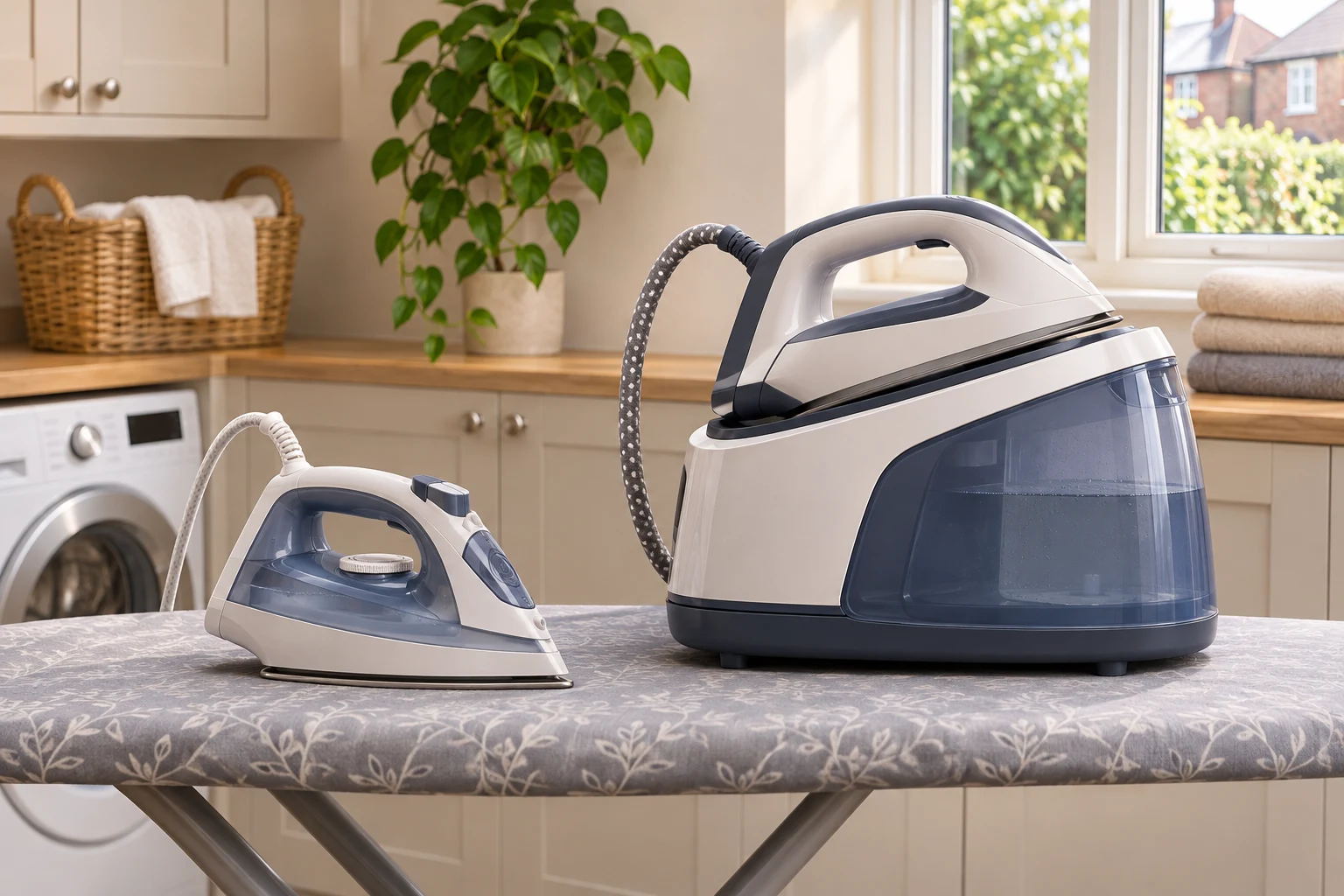
A standard steam iron carries its water in the handheld iron. It is one appliance to fill, plug in and put away. A steam generator has a separate base with the water tank and a hose leading to the iron. That arrangement usually gives you more water for a longer session, but the whole unit takes up more room.
Neither type removes the need to check garment care labels. Steam output, temperature controls and scale-care instructions vary by exact model, so avoid treating every generator—or every standard iron—as identical. Tefal’s explanation of its steam ranges also identifies the separate tank and fewer refills as the generator’s main practical distinction.
Steam generator vs standard iron at a glance
| What matters | Standard steam iron | Steam generator iron |
|---|---|---|
| Water and refilling | Smaller built-in tank; more refills during a long pile. | Separate, generally larger tank; often fewer pauses to top up. |
| Set-up | One iron to fill and put on the board. | Base and hose need a stable position before you start. |
| Storage | Usually easier to fit in a cupboard. | Measure the base, hose and cable space as well as the iron. |
| Upkeep | Follow the model’s water and cleaning instructions. | Check the model’s collector, drain or cleaning-cycle routine. |
| Best fit | Short or occasional sessions. | Regular, larger ironing piles where fewer refills matter. |
On a phone, swipe the table sideways to see all three columns.
Start with how much you actually iron
For a few garments before work or a quick school-uniform touch-up, a standard iron keeps the job simple. You will not have to carry a separate base to the board, and the smaller tank is less of a drawback when you are finished in minutes.
For a large weekly pile, repeated trips to refill a small tank can interrupt the flow. A generator’s larger tank can be more convenient for shirts, bedding and other suitable fabrics. But a big tank is not automatically better: if the base is awkward to lift or store, you may find yourself avoiding it. Judge the whole session, including set-up and putting it away.
Check the board and storage before buying a generator
The base must sit flat and securely, whether on the board’s rest or another surface permitted by the manufacturer. Compare its exact footprint and weight with the board’s stated limits. Keep the hose and cable clear of the board edge and children. Our ironing-board guide can help you judge the rest and stability.
Measure the cupboard shelf or utility-room space too. Allow room for the hose and power cable rather than comparing only the iron’s handheld dimensions. A carry lock or cord tidy helps with moving and storage; it does not make a base fit a shelf that is too shallow.
Look beyond the purchase price
A generator can cost more to buy, but prices vary too much by model and offer to use one figure for the whole category. Compare the exact model and the value of fewer refills to you. Do not assume its high wattage rating means that it draws that power throughout an ironing session: the heater cycles, and settings and use change the result. Our steam generator running-cost guide explains how to estimate electricity cost from energy used.
Maintenance can matter more than a small electricity difference. In a hard-water home, check how the exact iron is cleaned and what water its manual permits. A generator may use a removable scale collector, a drain or a cleaning cycle; a standard iron has its own instructions. For generator options with different systems, see our hard-water comparison.
Which is right for your home?
Choose a standard steam iron if ironing is occasional, cupboard space is tight or you want one small appliance to take out for a quick job. Choose a steam generator if you regularly work through a substantial pile, fewer refills would genuinely help and your board and cupboard can accommodate the base.
If the generator sounds like the right fit, compare the different trade-offs in our best steam generator irons guide. You do not need the biggest tank or strongest headline boost to make a sensible choice.
Frequently asked questions
Is a steam generator iron better than a standard iron?
Not for everyone. A separate-base steam generator is useful for a long, regular ironing pile and fewer refills. A standard steam iron is often simpler to store and set up for occasional garments.
Do I need a special board for a steam generator iron?
Check the exact base size and weight against your board’s rest and load limit. The base must sit securely and the hose must not catch. Do not assume a rest designed for a standard iron will fit a generator.
Does a steam generator iron use more electricity?
You cannot tell from the label wattage alone. Actual electricity use depends on the model, settings, heating cycles and how long you iron. Our running-cost guide shows how to calculate a session’s cost from measured kWh.
Can a steam generator replace a standard iron?
It can handle normal ironing, but whether it is worth the larger base depends on your routine and storage. If you iron only a few items at a time, a standard iron may be more convenient.