
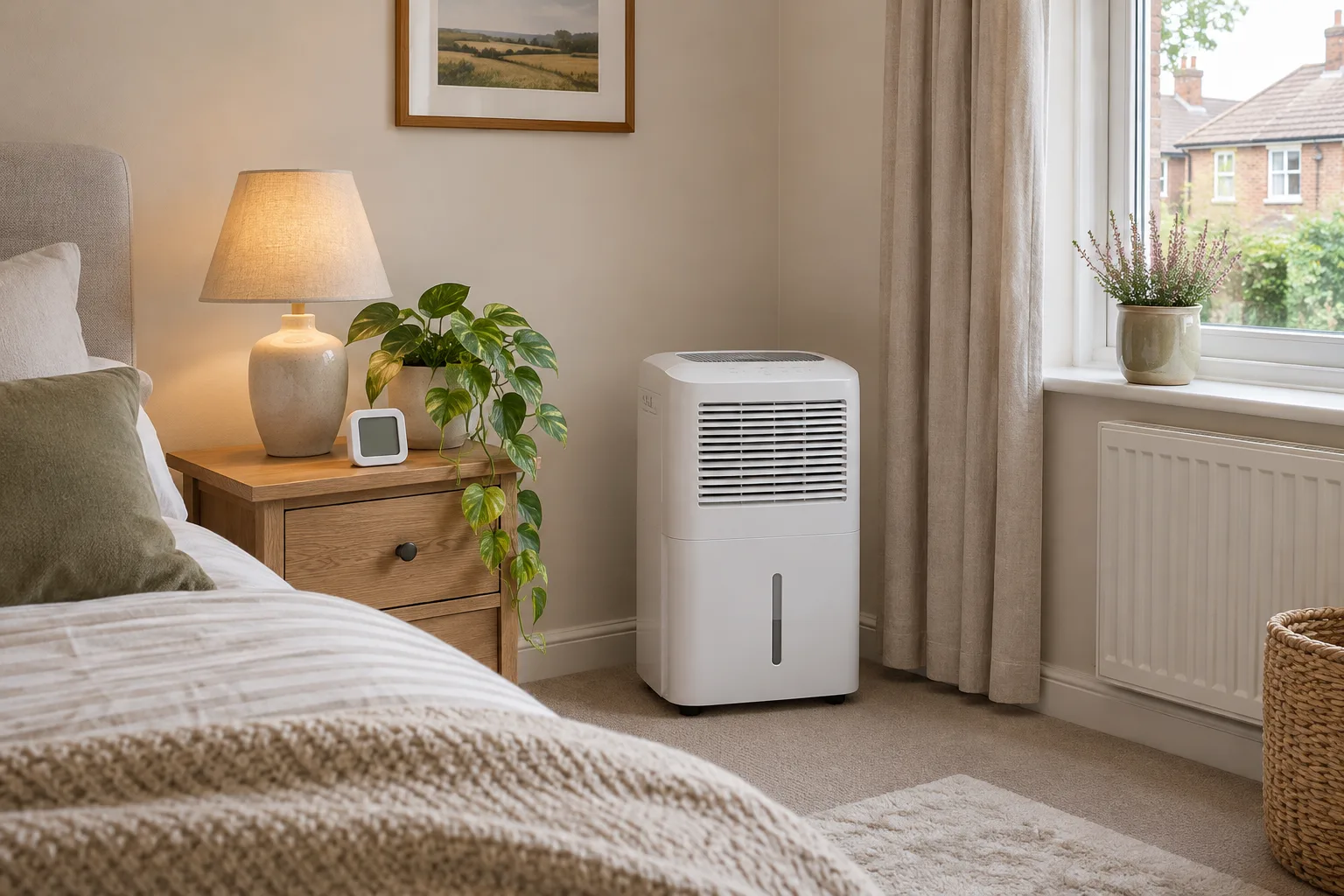
If you’re buying a dehumidifier to tackle condensation or help dry the washing, think about where it’ll go and when you’ll use it. A quiet setting might matter if it’s going in the bedroom, while a tank that’s easy to carry and empty can make a difference if you use it most days.
Our dehumidifier buying guide explains which features are worth paying for, from choosing a model that suits the temperature of your room to deciding whether you’ll use a timer or humidity control. If you’re unsure how many litres per day you need, start with our dehumidifier size guide. Ready to compare models? See our guide to the best dehumidifiers.
Start with the room
Where will it run most often? A heated bedroom, a chilly utility room and an open landing give the machine different jobs. A compressor model is usually the natural starting point for a heated living space; a desiccant model is worth comparing for a room that regularly stays cold. Check the exact operating range rather than assuming every machine behaves like its category. EcoAir’s technology comparison explains the temperature trade-off.
If condensation is confined to one window, look for the cause as well as the appliance. Better ventilation, drying clothes differently or repairing a leak may matter more than a larger dehumidifier. A machine removes moisture from air; it does not repair water getting into the building.
Controls worth having
Humidity setting and automatic stop
A humidistat lets you choose a target relative humidity, often shown as % RH. Once the room reaches it, the machine can reduce or pause extraction instead of running flat out unnecessarily. Around 50–60% RH is a useful starting range for many homes, but check the manufacturer’s guidance and what happens in your actual room. Meaco’s dehumidifier help centre gives a 40–60% comfort range.
Timer or laundry mode?
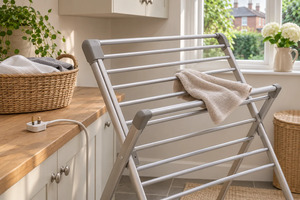
A timer is handy if you want the machine to stop after a set period. A laundry mode usually favours faster drying and may use a stronger fan or run for longer. It is useful for regular indoor washing, but it is not essential for everyday condensation control. Our laundry-drying comparison deals with that separate use.
Tank and drainage
The tank volume is the water it holds before it needs emptying, not how much water the machine can remove in a day. Think about whether you can carry a full tank to the sink without spilling it, especially if the unit will live upstairs. A full-tank shut-off is worth checking.
Continuous drainage helps only if the exact model accepts a hose and you have a suitable route to a drain. Check whether a hose is supplied; some manufacturers sell it separately. Follow the manual for the hose position and avoid leaving a loose outlet where water can damage the floor.
Noise and electricity use in real life
A low noise figure is usually measured at a particular fan setting. Compare the setting you would actually use, then consider the room: a gentle hum in the utility room can feel intrusive beside a bed. Look at published power in watts as well as modes. A high-power desiccant unit may be the right choice for a cold space, but do not assume it has the same running cost as a compressor model in a warm room.
To estimate electricity use, multiply the running power in kilowatts by hours used and your tariff per kWh. For example, a 300W setting running for four hours uses 1.2kWh before accounting for any automatic cycling. Actual use depends on humidity, settings and how often the machine pauses.
Filters, app controls and portability
A washable dust filter is routine maintenance, not a promise that the machine replaces ventilation or an air purifier. HEPA filters, where offered, may be optional or need replacing. Check the exact package and replacement cost. App control is convenient if the machine lives away from you, but it should come after room suitability, noise and emptying in the buying decision.
Handles and castors help if you move it between rooms. Measure the floor space and the air clearance required by the supplied manual; a larger machine squeezed behind furniture will not work as intended.
Before you buy
- Note the room size, whether it is heated and where moisture is coming from.
- Check the operating temperature and extraction size for that job.
- Compare the actual tank, full-tank stop and drain-hose contents.
- Look at noise and power in the modes you will use.
- Check the manual’s placement clearances, filter care and exact model variant.
Once you know those answers, our broad dehumidifier comparison can help you choose a model. For an unheated space, look at the separate cold-room shortlist.
How we put this guide together
We compared manufacturer guidance on compressor and desiccant operation, extraction figures, tanks, controls, drainage and power, alongside the everyday questions that affect a home purchase. This is advice based on published information, not hands-on testing or an assessment of your building.
Frequently asked questions
Do I need a dehumidifier with a humidity setting?
It is useful for everyday moisture control because the machine can respond to a target rather than run continuously. Check how the exact model behaves when the target is reached.
Is a laundry mode essential?
No. It is most useful if you regularly dry washing indoors. For general condensation control, room suitability and a usable humidity setting matter more.
Should I buy one with a drain hose?
Only if you have a suitable drain route and can install the hose as the manual requires. Check whether the hose is included with the exact model.
Can a dehumidifier fix damp walls?
It can reduce airborne moisture, but it will not repair a leak, rising damp or water entering through the building fabric. Find and address the cause.