
The spare bedroom is chilly when you sit down to work, but a large radiator could take up more floor space than you want to give it. The right size is about the heat the room loses as well as the space you have for the heater.
This guide explains how to choose the wattage and physical size of an oil-filled radiator. We’ll use a simple room example, show what to check on a product page and explain when a room-by-room heat-loss estimate is more useful than a square-metre claim.
Measure the room you actually want to heat
Measure the length and width of the room in metres and multiply them to get the floor area. If a heater maker gives its coverage in cubic metres, multiply that area by the ceiling height as well. A 3m by 2.5m room with a 2.4m ceiling is 7.5m², or 18m³.
Those figures help you compare product claims, but they aren’t a promise that one wattage will work. A draughty room with a large window loses heat differently from an insulated room of the same size. Dimplex’s heating guidance explains that volume, insulation, glazing, external walls and your preferred temperature all affect the heating requirement.
Use wattage as a starting point, not a room guarantee
Wattage is the radiator’s maximum electrical input and, for a resistance heater, broadly its maximum heat output. A 500–800W compact unit can be a sensible top-up for a small, reasonably warm space; 1,500–2,000W models offer more heat for a colder or larger room. These are comparisons of output, not a fixed sizing rule. A poorly insulated room may need more heat than a portable heater can comfortably provide.
| What you need | What to compare | Keep in mind |
|---|---|---|
| A gentle top-up | 500–800W compact models | Less output; allow time and check the maker’s stated room capacity. |
| A room used for several hours | 1,500–2,000W models | Check the heat loss and floor space before assuming the room will stay warm. |
| A larger or harder-to-heat space | 2,000–2,500W models | Higher input gives more potential heat, not better efficiency per unit of electricity. |
A thermostat cycles the heater on and off when its sensor reaches a setting. It doesn’t turn a 500W heater into a 2,000W one. Separate power settings limit the maximum draw while selected; check the manual for the exact settings. Our oil-filled radiator buying guide explains controls in more detail.
An example: a 7.5m² home office
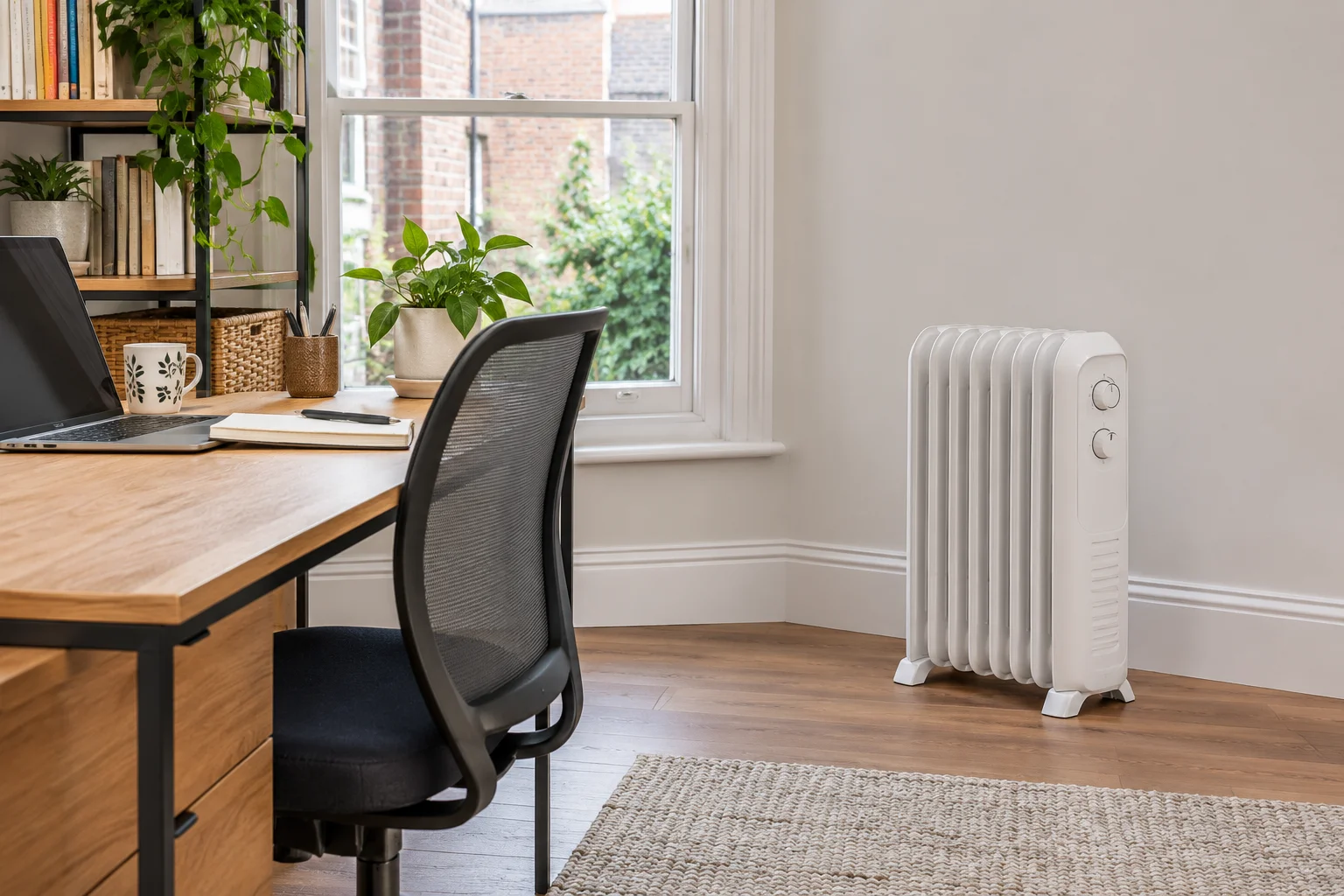
Suppose your home office measures 3m by 2.5m with a 2.4m ceiling. You’re using it during the day, with the main heating on, and want a little extra warmth near where you work. You might compare compact heaters first, then check the maker’s coverage claim and how quickly the room cools when the main heating is off.
If the same room has single glazing, an exposed outside wall or noticeable draughts, the heating job changes even though the tape measure hasn’t moved. Try a room-heating calculator that accounts for those conditions, or ask for a room-by-room heat-loss assessment if you need a dependable primary heating solution. Don’t use a portable radiator’s advertised area as a substitute for that assessment.
Check the assembled size as well as the fins
Read the full length, depth and height with wheels or feet fitted. A narrow fin body may have a wider base, and a cable still needs a clear route to a wall socket. If you’ll move the radiator between rooms, check its weight and handle, and move it only after it has cooled.
Fin count can help describe the radiator’s shape, but compare the stated wattage and assembled dimensions before using it as a proxy for output. For models to compare, see our oil-filled radiator picks and compact small-room options.
Give the heater its own clear space
Electrical Safety First advises placing a portable heater on a level surface, at least one metre from combustible materials such as curtains and furniture, and plugging it directly into a wall socket rather than an extension lead. Never cover it or use it to dry clothes. Don’t leave it running unattended or while you sleep, even if it has a thermostat or timer.
Frequently asked questions
What size oil-filled radiator do I need for a small room?
Measure the room and check a heater maker’s stated capacity, then allow for insulation, glazing and draughts. A compact radiator may be enough for a gentle top-up, but room area alone cannot tell you the wattage needed to hold a comfortable temperature.
Does a higher fin count mean more heat?
Not necessarily. Compare the heater’s maximum wattage as well as its dimensions. Fins help transfer heat into the room, but fin count on its own does not establish the heat output.
Can a thermostat make a small radiator heat a larger room?
No. A thermostat switches the element on and off around its setting; it cannot raise the heater’s maximum output. If the radiator runs continuously and the room is still cold, the room may be losing heat faster than the heater can supply it.
Can I leave an oil-filled radiator on while I sleep?
Electrical Safety First advises against leaving portable heaters running while you sleep or unattended. Follow the manual for your exact model, keep combustible items at least one metre away and plug it directly into a wall socket.