
If you often dry your washing indoors, a heated clothes airer can be a handy addition. But is it worth getting one with a cover, or are you better off leaving the rails open? A fitted cover can keep more warmth around the clothes, but it also changes how you load the rack, how much space it takes and how you deal with damp air.
This comparison helps you decide whether a covered or uncovered heated airer suits your usual laundry and room. If you are choosing the frame itself, our heated clothes airer buying guide covers layout, timers and storage; our main product guide compares current options.
What changes when you add a cover?
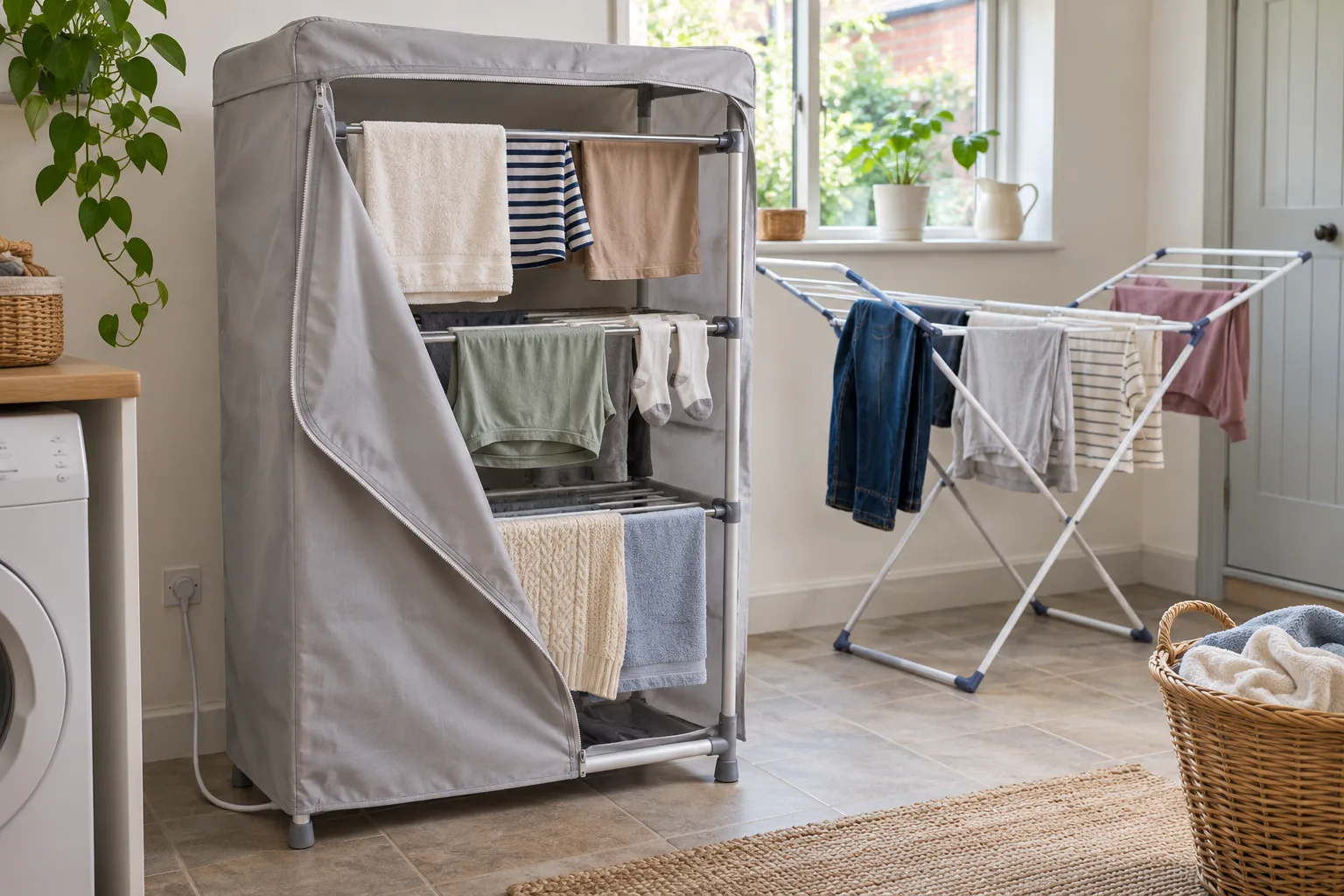
On a rail airer, a fitted cover surrounds the loaded frame and helps keep warmth around garments that are not touching a heated bar. It does not make the airer a sealed tumble dryer or remove the water from the washing. The moisture still has to leave the cover and the room.
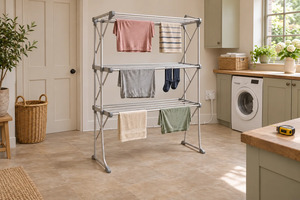
An uncovered rack gives you easier access to each rail and more freedom for long items that hang over a side. Its warmth is less contained, so a thick towel hanging between warm bars may dry unevenly. Neither arrangement guarantees a particular drying time: fabric, load spacing, room conditions and the exact model matter.
Covered and uncovered at a glance
| Consideration | Covered | Uncovered |
|---|---|---|
| Best use | Mixed clothing on a fitted rack | Quick access; long or awkward pieces |
| Warmth | Held closer to the load | Disperses into the room |
| Access | Open a flap or zip | Reach every rail directly |
| Fit | Check cover size and vents | Check frame and hanging drop |
| Storage | Store and dry the cover too | Just the airer to put away |
On a phone, swipe the table sideways to compare every column.
When a covered airer makes sense
A cover is worth considering if you regularly dry a mixed load on a tiered rack and can give the whole covered frame a clear, ventilated place to stand. A front flap is useful when you need to check shirts or turn a towel without removing the cover. Mesh or designed vents should stay clear; do not treat the cover as a way to hide the airer in a tight, unventilated cupboard.
Check the exact package. Rediffusion’s RED248 includes its fitted cover, while Lakeland describes the Dry:Soon Mini cover as a separate accessory unless you buy a specific bundle. A cover designed for a different frame may obstruct controls or vents. Our covered heated-airer comparison checks complete sets rather than cover-only accessories.
When leaving the rack open is simpler
An uncovered heated rack can be easier for one or two items you want to remove as they dry. A winged model may give a longer drop for trousers or sheets, though you still need to check how the fabric sits on the warm bars. If the airer is in a shared room, direct access may matter more to you than keeping warmth inside a cover.
You can start with an uncovered model that the manufacturer explicitly offers a matching cover for, then add that accessory if your routine calls for it. Check the combined cost and the exact frame code before ordering. Do not improvise with a blanket or duvet: use only a cover approved for that airer and follow its instructions.
A drying pod is a different choice
A covered hanging pod uses a fan to circulate warm air around clothes on hangers. It can suit shirts, dresses and uniforms, but it is less flexible for towels or bedding than a rail rack. Its wattage can also be much higher, so compare the energy for a whole drying session rather than assuming every covered option costs the same. A pod is not just a rail airer with a cover over it.
Leave the moisture somewhere to go
The government’s home ventilation guide identifies drying laundry as a source of indoor moisture. A fitted cover may keep warmth close to the load, but it does not replace room ventilation. Watch for condensation, use the room’s ventilation as intended and keep the maker’s cover vents open.
Place the airer on a stable, dry floor, with the clearances and supervision required by its own manual. Keep the cable, plug and controls away from drips. The choice between covered and uncovered should follow the room and your laundry, not a claim that one is always safer or cheaper.
How to choose for your usual wash
Start with the garments you actually dry. If shirts, smalls and light layers fill a tiered rack, a correctly fitted covered model may be helpful. If you often hang long trousers or a sheet and want access from every side, an uncovered winged rack may be easier. For hanger-friendly clothes, compare a pod separately.
Measure the open frame with its cover in place, not just the folded rack. Then check whether the cover is included, how it opens and where it will dry and be stored after use. For the rail length and footprint decision, use our heated-airer size guide.
Frequently asked questions
Will a cover make every load dry faster?
No. A fitted cover can retain warmth around a suitable rack, but drying also depends on fabric, spacing, ventilation and the model. Do not rely on a fixed time saving.
Can I put a duvet over my heated airer?
Do not use an improvised cover. Use only a purpose-made cover approved for the exact airer and follow its instructions for vents, clearances and supervision.
Does a covered heated airer stop condensation?
No. Water evaporating from laundry enters the room air. Keep the cover vents clear and ventilate the room appropriately.
Is a drying pod the same as a covered rail airer?
No. A pod uses fan-assisted warm air around hanging garments. A covered rail airer warms its bars beneath a fitted cover, so the layouts and power ratings are different.
Do covered heated airers cost more to run?
A cover itself uses no electricity, but it may change the time needed to dry a load. Compare the exact airer’s power, actual run time and your tariff. Our running-cost guide shows the calculation.