
When the washing has to dry indoors, a heated airer can give it a little help without taking over the radiators. The right design depends less on the biggest advertised load and more on what you wash, where the open frame will stand and how you will put it away.
This buying guide explains the features that change everyday use. If you are ready to compare actual models, start with our best heated clothes airers guide; this page is about the decisions behind a good purchase.
Start with the layout, not the wattage
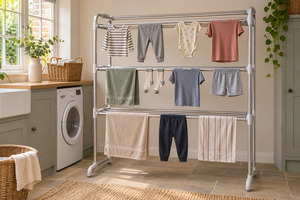
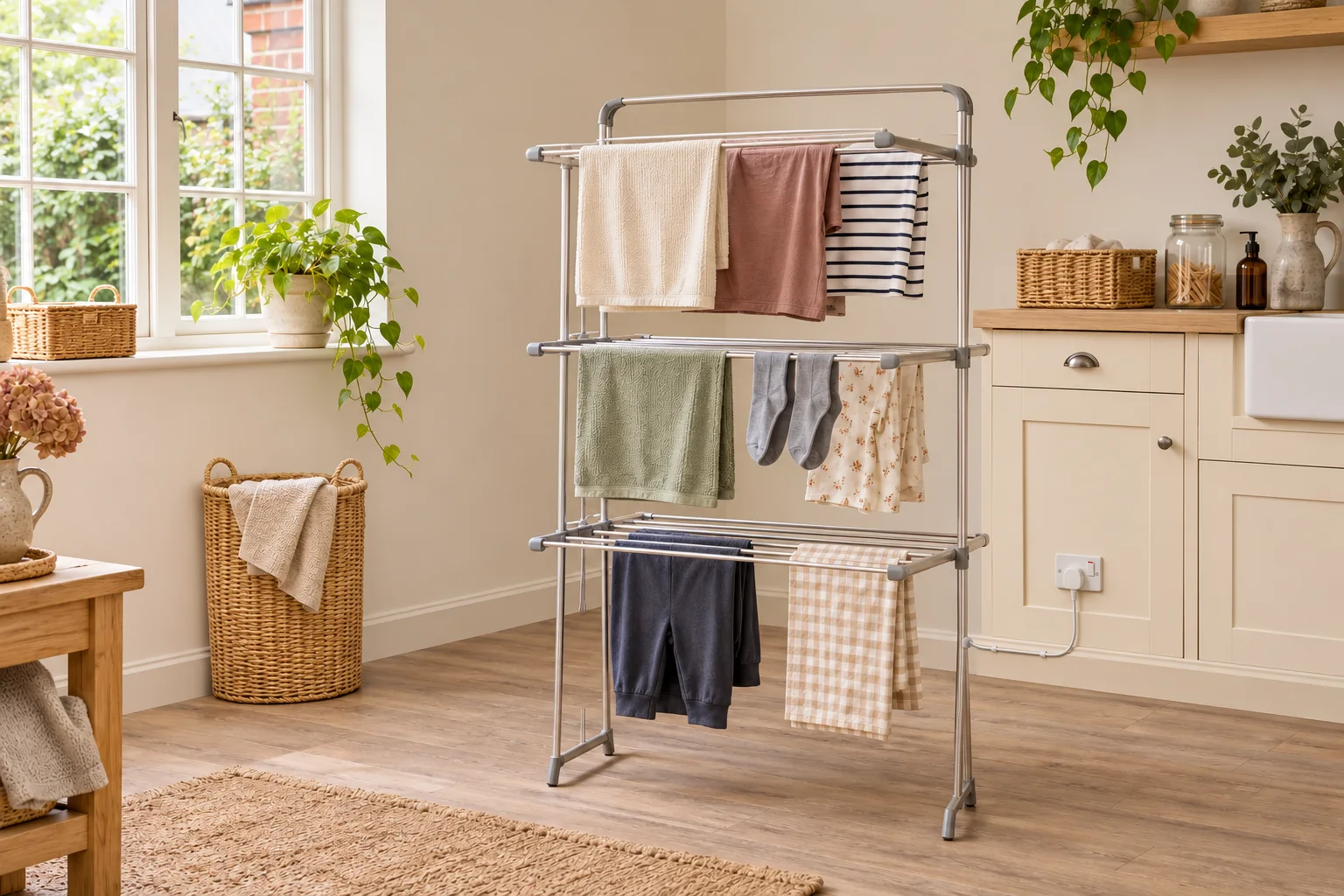
A winged rack spreads clothes across a low, wide frame. It can be easy to reach and folds flat, but the wings need room when open. A tiered tower uses less floor area for its rail length; its height and upper shelves can be awkward for long garments. A slim rail rack suits a few essentials, not a whole family wash. A warm-air pod encloses hanging clothes and uses a fan, making it a different drying method from warm rails.
Think about the load that most often causes trouble: school uniform overnight, work shirts, towels or bedding. A design that handles that load without bunching clothes together is more useful than one with a large headline kilogram limit.
Decide whether a cover is worth it
A correctly fitted cover can hold warm air around a rail rack. It may help thicker items, but it does not remove moisture from the room. Check whether the exact offer includes a cover, whether the maker approves it and how the cover vents. A separate cover for a similar-looking airer may not fit the frame or controls.
For example, Lakeland sells the Dry:Soon Mini cover separately, whereas Rediffusion includes one with its RED248. A hot-air pod includes an enclosure as part of the system. Do not drape an improvised blanket over an electrical airer; follow the supplied instructions and keep the specified vents clear.
Check controls and power in context
A timer can be useful if you want the airer to switch off after a set period. Check whether the exact model has a timer, its available intervals and whether it retains a previous setting. A simple on/off switch may be enough for a small load if you will be nearby and can switch it off yourself. Do not assume any model is safe to run unattended or overnight; use the maker’s instructions.
The wattage tells you the maximum power draw, not how quickly a load will dry. A 300W rail rack running for six hours would use 1.8kWh at its stated power; an 850W fan pod running for two hours would use 1.7kWh. Those are illustrative arithmetic examples, not measured consumption or promises of equal drying. Multiply kWh by your own electricity price for a cost estimate.
Measure the open and folded space
Measure the full open width and depth, then check doors, cupboards, walking routes and the route to a suitable socket. The folded depth matters only when you have a real storage spot for the full height and width too. Leave the clearances required by the manual; do not wedge an operating airer against furniture or curtains to make a tight space work.
Drying metres count the total rail length, while kilograms describe a maximum supported wet load. They are not interchangeable: bulky towels can fill the rails well below the weight limit. We work through that decision in the separate heated-airer size and capacity guide.
Plan for moisture as well as heat
Heating the rails does not make the water in washing disappear; it enters the room air. Dry in a place with suitable ventilation and watch for condensation, particularly in a small room. The government’s home ventilation guide explains how moisture from washing and other everyday activities can accumulate indoors.
A dehumidifier can help in some homes, but it adds power use and needs appropriate placement. Our laundry-drying dehumidifier guide covers that separate decision. Keep electrical plugs and controls away from water and use the airer only as its manual permits.
The short buying checklist
- Choose the rack or pod format for the clothes you actually dry.
- Compare open footprint and folded storage dimensions, not just the product photo.
- Check rail length, load limit and room for air between garments.
- Confirm whether the exact model includes a cover, timer and any required accessories.
- Use wattage and expected hours with your own tariff; do not rely on a fixed “pence per hour” claim.
- Read the maker’s placement and cleaning instructions, and plan how the room will release moisture.
Frequently asked questions
Is a covered heated airer better than an uncovered one?
A correctly fitted cover may retain warmth around a rail rack, but results depend on the load and room. It must be approved for the exact model and used with the maker’s ventilation instructions.
Does a higher wattage mean faster drying?
Not necessarily. Rack layout, clothing thickness, spacing, cover and room conditions also matter. Wattage is useful for estimating electricity use; it is not a drying-time rating.
Is a heated airer cheaper than a tumble dryer?
It depends on the exact appliances, programme, load and time used. Compare kWh for a complete drying session at your own tariff rather than the airer’s hourly power alone.
Can I leave a heated clothes airer on overnight?
Do not assume so. Read the exact model’s instructions on supervision, placement and switching off; a timer is not permission to ignore those instructions.
Should I buy a pod or a heated rail rack?
A pod suits garments on hangers and uses fan-assisted warm air. A rail rack is usually more flexible for mixed small items and flat-spread pieces. Compare the open footprint, power and what you normally dry.