
If you’ve ever sanded a door and found a fine layer of dust on the skirting boards afterwards, you’ll know how far it can travel. A dust extractor helps collect it where you’re sanding. Before you buy, check that the extractor is designed for the dust your job creates and that you can connect it securely to your tool.
Our dust extractor buying guide explains what the dust classes mean, how to check whether the hose will fit and what to look for if you’ll be moving the extractor from room to room. If you already know you need an M-class model, see our five M-class dust extractor picks.
Start with the dust you need to control
Sanding a painted door, cutting timber and working with masonry do not all create the same dust. HSE’s CIS69 on-tool extraction guidance says a suitable M- or H-class unit is needed for many construction tasks. L class is limited to lower-toxicity dust in particular circumstances. A HEPA filter in an otherwise ordinary vacuum does not, by itself, make the machine a suitable construction-dust extractor.
For renovation work, do not choose by the “wet and dry” label alone. Check the machine’s declared dust class for the exact variant and the guidance for your material. If you suspect asbestos, stop work and use specialist advice rather than this guide or a standard shortlist.
Check the tool, hood, hose and airflow together
The extractor can only catch dust that reaches it. A tool with an effective hood or shroud, a secure hose connection and enough airflow at the working end form the system. HSE advises checking the whole setup, not just the vacuum. A power-tool socket is useful because it starts the extractor with the tool, but it is not evidence of suitable dust control.
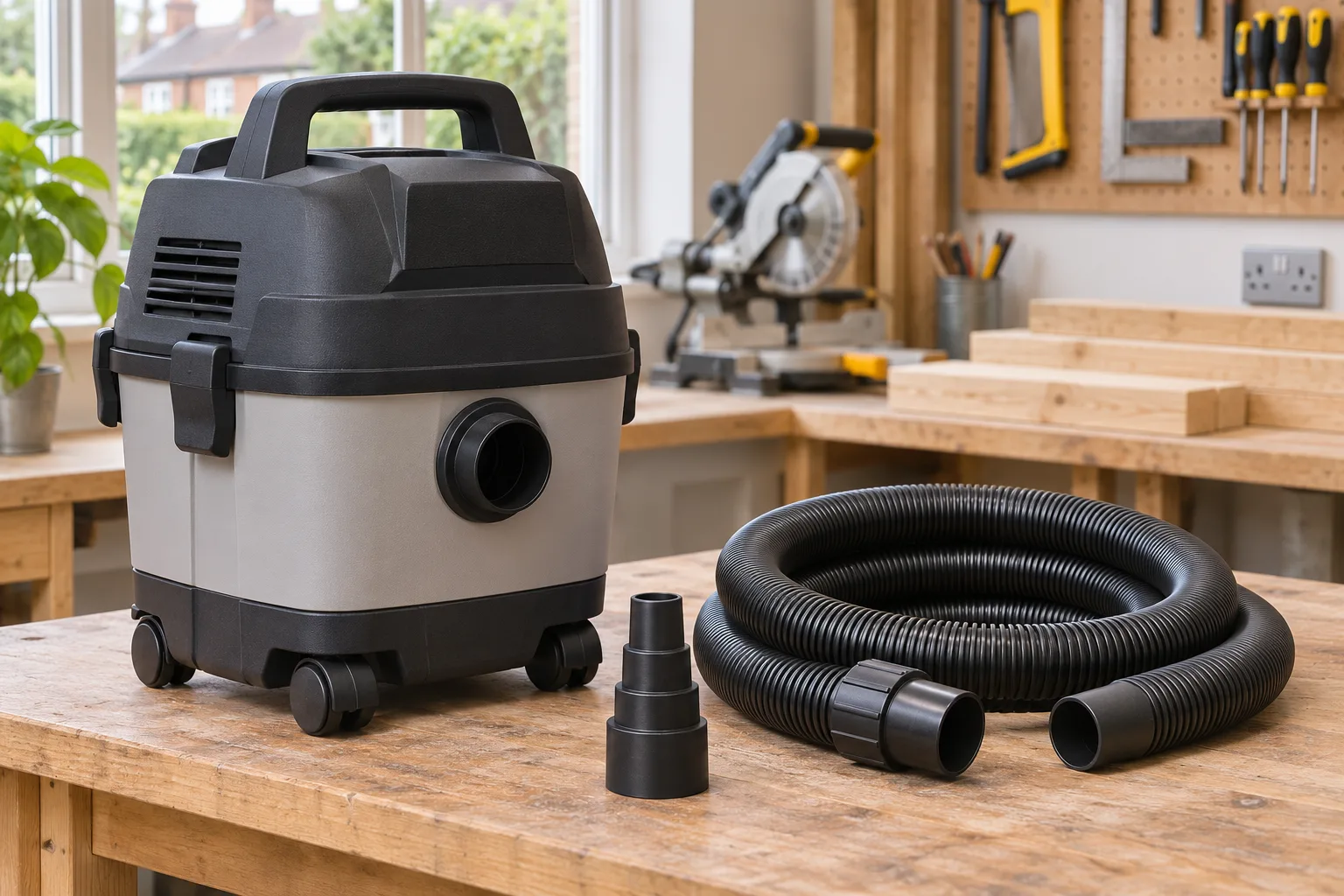
Before buying, measure or identify the tool outlet, check which adapters are included and look at the hose length. A long hose gives freedom to move, but the machine must still maintain the airflow required for the task. If you use a random-orbital sander, our connection guide takes you through a common fitting problem.
Features you will notice in everyday use
Collection capacity and carrying
Look at usable bag capacity as well as tank size. A large tank means fewer emptying stops but more weight and storage space. A compact machine is easier to take upstairs or between rooms. Think about where it will sit while you work, not just where it lives afterwards.
Filter cleaning and replacement bags
Fine dust can clog a filter and reduce suction. Some models ask you to shake or clean the filter manually; others have push-button or automatic systems. Check what the exact model supplies and follow its instructions. Also check that suitable replacement bags, liners and filters are available: they are part of the ongoing cost and help you dispose of dust without releasing it again.
Wet pickup and tool starting
If you need to collect liquids too, confirm the wet setup and its filter before ordering. Switching from dry dust to wet pickup often requires removing the dry bag and fitting a different filter. An auto-start socket saves a separate switch-on step when using mains tools; check its connected-load limit against your tool. Battery-tool starting may need compatible Bluetooth equipment and should not be assumed from a Bluetooth badge alone.
A short buying checklist
- Dust: What material and task are you dealing with, and what does HSE recommend?
- Machine: Is the exact variant declared M or H class where that is required?
- Connection: Will the hood, outlet, adapter and hose fit securely?
- Use: Is the bag capacity, hose reach and cable length workable in your space?
- Care: Can you get the right bags and filters, and how does cleaning work?
- Extras: Do you actually need wet pickup or automatic tool starting?
Once you know those answers, compare the six machines in our best dust extractors guide. If you mainly need to clear up larger debris and occasional water rather than capture dust at the tool, see the wet and dry vacuum buying guide instead.
How we put this guide together
We compared the questions that affect real use—dust class, connection, airflow, collection, filter care and storage—against HSE’s on-tool extraction guidance and current manufacturer instructions. This is an information guide based on published guidance and product information, not hands-on testing by Love Renovate. Always follow the instructions for your exact tool and extractor.
Questions people ask
Is a wet-and-dry vacuum the same as an M-class dust extractor?
Not necessarily. Wet-and-dry describes what a machine can collect; M class is a declared dust classification. Check both separately for the exact model and task.
Will any hose adapter work with my sander?
No. The connection needs to fit securely at the tool and extractor. Check the outlet, adapter dimensions and tool hood, then follow the manufacturer’s instructions.
Does a HEPA filter make a domestic vacuum suitable for construction dust?
No. HSE says a HEPA filter in a general vacuum is not enough by itself. The whole extraction unit and tool setup need to suit the task.
What costs should I allow for after buying?
Check the price and availability of the correct dust bags or liners and replacement filters. They are consumables, and the exact machine instructions determine when they need attention.