
A heated airer can be useful when a damp load has nowhere else to go, but “pennies an hour” tells only part of the story. A low-power rack left on for most of the day can use more electricity than its hourly figure suggests.
This guide shows you how to estimate a heated clothes airer’s running cost from its power, how long you actually use it and your electricity rate. The figures below are worked examples, not a quoted tariff or measured performance for a particular product. For choosing a suitable rack, see our heated clothes airer comparison.
The simple running-cost calculation
Find the airer’s rated power in watts (W), divide by 1,000 to get kilowatts (kW), then multiply by hours used. That gives kilowatt-hours (kWh), the unit on your electricity bill. Multiply kWh by your electricity unit price to estimate the cost.
Cost = (watts ÷ 1,000) × hours × electricity price per kWh. If your rate is in pence, the answer is in pence. Use the unit rate on your own bill, not the standing charge: the standing charge is paid whether this appliance is on or not. A thermostat, timer or variable heater may draw less than its full rating over a session, so this simple method is an estimate; a suitable plug-in energy meter can show actual use where the manufacturer permits one.
Worked examples at an illustrative 25p per kWh
For illustration only, the table uses 25p per kWh. It is not a current UK tariff or an estimate of how long any model needs to dry a load. Every row assumes the appliance draws its stated power throughout the period.
| Example power | Time on | Electricity used | Cost at 25p/kWh |
|---|---|---|---|
| 200W rail rack | 4 hours | 0.8kWh | 20p |
| 300W rail rack | 4 hours | 1.2kWh | 30p |
| 300W rail rack | 8 hours | 2.4kWh | 60p |
| 1,000W fan pod | 2 hours | 2.0kWh | 50p |
On a phone, swipe the table sideways to compare every column.
For example, 300W is 0.3kW. Four hours at the full rated power uses 0.3 × 4 = 1.2kWh; at the illustrative 25p rate that is 30p. Replace both the hours and unit rate with your own figures.
Compare a full drying session
Wattage is a rate of power use, not a drying-speed score. A 300W rack uses less electricity per hour than a 1,000W pod at full power, but the pod might be on for fewer hours. The useful comparison is kWh from the start of a load until the clothes are dry enough to put away. Even then, compare similar loads and fabrics; a rack full of towels is not the same task as a pod of shirts.
A cover can help retain warmth around a compatible rail airer, but it does not create a guaranteed saving. A cover that encourages you to crowd garments together may not help. Our covered versus uncovered guide explains the practical trade-offs.
Why the real figure can differ
Thermostats cycle the heating elements, and some appliances have different heat settings. The room temperature, how wet the clothes are after spinning, fabric thickness and spacing all affect how long you keep the airer on. A timer limits the maximum period you set; it does not prove the load has dried in that time.
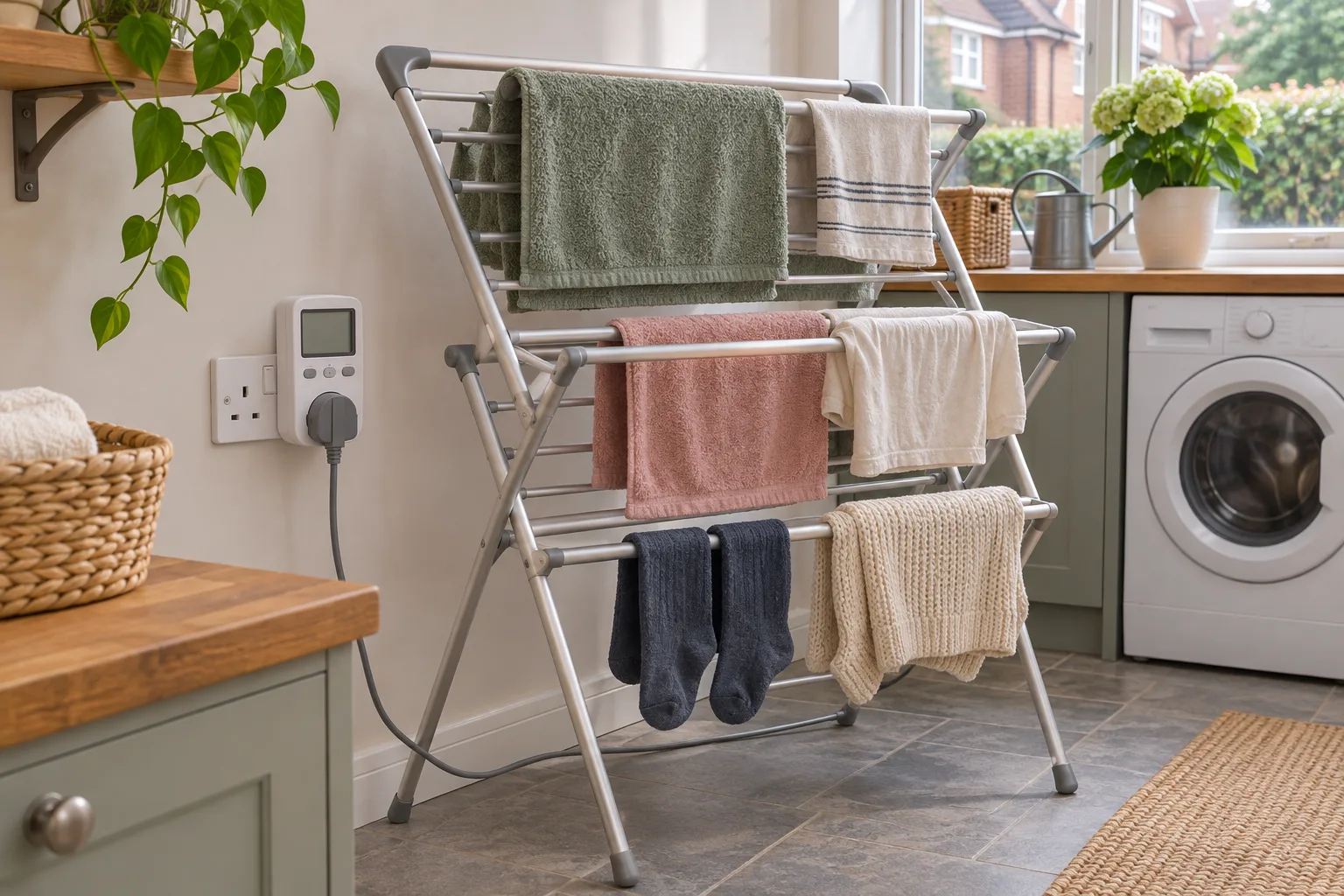
If you use an energy meter, check its rating and the airer’s manual before connecting it, particularly with a higher-power fan pod. Read the meter’s kWh for the whole session and multiply by your own pence-per-kWh rate. Do not leave an appliance running unattended merely to obtain a reading.
How does it compare with a tumble dryer?
It is tempting to compare the airer’s pence-per-hour figure with the price of one tumble-dryer cycle, but those are different measures. A tumble dryer’s consumption depends on its type, programme and load; a heated airer’s depends on the full drying time. Compare kWh for the same sort of load, allowing for any dehumidifier used alongside the airer. A dehumidifier adds its own electricity use.
A heated airer also releases moisture into the home. The government’s ventilation guidance explains why indoor laundry needs airflow; the electricity calculation does not replace that consideration.
Keep the time useful without overloading it
Use the washing machine’s appropriate spin cycle for the fabrics, then space garments so warm air can reach them. Check care labels, the airer’s weight limit and its instructions for covers and clearances. Remove dry items and switch the airer off when the load is finished. Do not make the room unsafe or block vents to chase a lower bill.
If you are buying a model, compare its stated wattage with the rail length and open footprint you need. Our buying guide covers those features without treating the lowest wattage as automatically the best choice.
Frequently asked questions
How much does a 300W heated airer cost per hour?
At an illustrative 25p per kWh, 300W drawing full power for one hour uses 0.3kWh and costs 7.5p. Your tariff and the airer’s actual power cycling may change that.
Does a cover reduce running costs?
It may shorten a drying session on a compatible airer, but there is no universal saving. Use the exact model’s approved cover and compare total kWh for similar loads.
Is a 1,000W drying pod always more expensive?
It uses more electricity per hour at full power than a 200–300W rack. It may run for fewer hours, so compare complete sessions for similar laundry rather than hourly figures alone.
Should I include the electricity standing charge?
Use your unit rate to estimate the extra cost of running the airer. The standing charge is payable whether or not the airer is switched on.
Can a timer tell me when the clothes are dry?
No. A timer switches the appliance off after the period you set; actual drying depends on the load, spacing and room conditions. Follow the appliance instructions.